
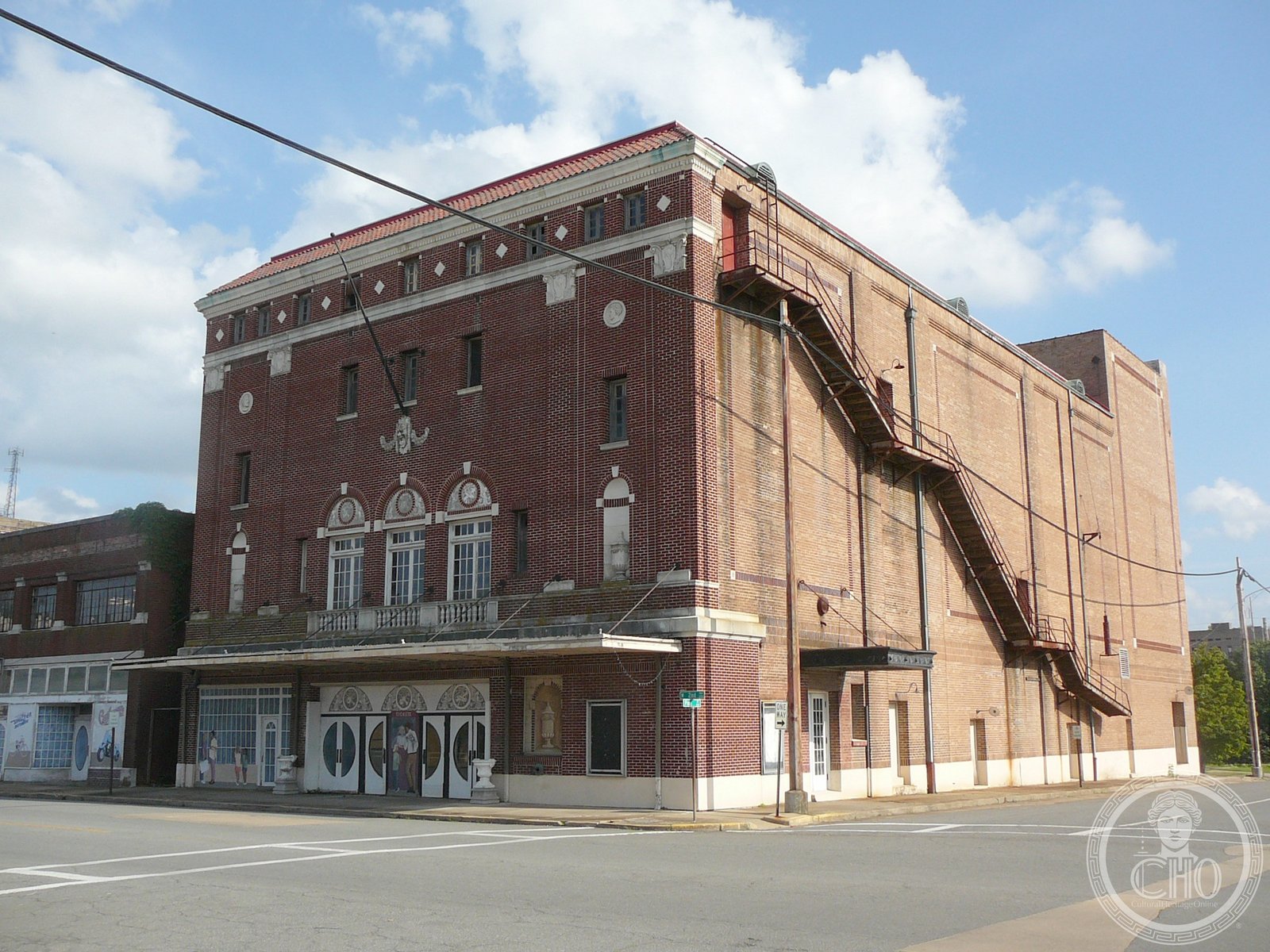
One of the southernmost outposts of the Saenger Amusement Company’s regional circuit, this Pine Bluff theater brought the standardized glamour of the 1920s theater chain to the Arkansas Delta — a meeting of corporate entertainment design and a cotton-economy city at the height of its commercial prosperity.
At a glance
The Saenger Theatre in Pine Bluff, Arkansas, is a surviving example of the regional theater chain building model that transformed American downtown entertainment in the 1920s. The Saenger Amusement Company, founded in New Orleans by brothers Abe and Julian Saenger, operated one of the South’s major theater circuits, bringing professional design and management to cities across Louisiana, Mississippi, Arkansas, and beyond. Pine Bluff, a significant commercial hub of the Arkansas River valley’s cotton and timber economy, was a natural fit for the circuit’s expansion. Listed on the National Register of Historic Places, the theater preserves the architectural language of the interwar South’s urban entertainment culture.
Key facts
- Address: Main Street, Pine Bluff, Arkansas 71601
- Built: c.1920s
- Operator: Saenger Amusement Company circuit
- Style: Art Deco / 1920s commercial theater design
- GPS: 34.2284° N, 92.0032° W
- Status: National Register of Historic Places
- Region: Arkansas Delta, Arkansas River valley
History
Pine Bluff in the 1920s was a prosperous river city. The Arkansas River, navigable to the Gulf via the White River system, made Pine Bluff a commercial center for the cotton, timber, and agricultural processing industries of the surrounding Delta and Gulf Coastal Plain. The city had a substantial African American community with its own professional and cultural institutions, and the University of Arkansas at Pine Bluff — then known as Branch Normal College — had been educating students since 1875, making Pine Bluff one of the few Arkansas cities with a significant higher-education presence in the early twentieth century.
The Saenger brothers began their theater business in New Orleans at the turn of the twentieth century and systematically expanded across the Deep South, building or acquiring theaters in second-tier cities where the major national chains had not yet established a presence. Their design approach combined professional theatrical standards — good sightlines, effective acoustics, appropriate mechanical systems — with locally responsive exterior design that gave each theater a degree of civic identity while adhering to the Saenger corporate aesthetic. The Art Deco vocabulary of the 1920s and early 1930s provided an adaptable template for these regional theaters: bold geometric ornament, theatrical lettering, and the marquee as primary architectural element all translated well to main street commercial blocks of varying scale.
The Pine Bluff theater served its community through the golden age of Hollywood, the integration era, and the postwar transformation of the entertainment economy. Its survival as a physical structure, and its listing on the National Register of Historic Places, documents the reach of the mid-century entertainment industry into the Arkansas Delta.
What you see
The Saenger Pine Bluff presents the characteristic visual grammar of the 1920s Southern regional theater: a primary commercial facade organized around the projecting marquee, with decorative brick or terracotta ornament above and to the sides that fills the building’s width in the main street block. The Art Deco elements — geometric relief panels, stylized lettering, the vertical sign tower that marks the theater’s presence from down the block — are applied with the economy appropriate to a regional rather than a metropolitan venue, but the design vocabulary is unmistakably of its era and of the Saenger chain’s corporate aesthetic.
The building’s scale fits the main street grain of Pine Bluff’s commercial downtown, asserting itself through the marquee and signage rather than through monumental height or elaborate colonnades. Inside, the auditorium preserves the basic configuration of the 1920s movie house: a single screen, tiered seating, and the decorative ambition expressed in plasterwork that allowed regional chains to offer their audiences something approximating the grandeur of the major-city palace, at a proportional investment appropriate to the market.
Practical information
- Access: Check current operating status with Pine Bluff Arts and Grounds or local visitor center
- Season: Pine Bluff is accessible year-round; the Delta region’s cultural programming peaks in spring and fall
- Duration: Allow 30–60 minutes for the theater; combine with the downtown historic district for a half-day itinerary
- Parking: Street parking and municipal lots in downtown Pine Bluff
Getting there
Pine Bluff is approximately 45 miles south of Little Rock via US Highway 65 and Interstate 530. Clinton National Airport in Little Rock (LIT) is the nearest major airport, approximately 50 miles north, with connections to Dallas, Chicago, Atlanta, and other hubs. By road, Pine Bluff is accessible from I-530 (US-65) from the north and from US-79 from the east (connecting to Memphis, Tennessee, approximately 135 miles away). Amtrak’s Texas Eagle (Chicago to San Antonio) stops at Little Rock, providing rail access to the region.
Nearby
- University of Arkansas at Pine Bluff (UAPB) — historically Black university established 1875; the Persistence of Vision Gallery on campus documents African American art and culture of the Arkansas Delta
- Arkansas Railroad Museum — downtown Pine Bluff; the Cotton Belt Shops complex preserves locomotive maintenance history from the St. Louis Southwestern Railway era
- Lake Pine Bluff — reservoir on the southwest edge of the city; water recreation and wildlife habitat in the Arkansas River floodplain
- Little Rock Central High School — approximately 50 miles north via I-530; National Historic Site commemorating the 1957 desegregation crisis
Sources
- National Register of Historic Places — Arkansas SHPO documentation, Jefferson County
- Encyclopedia of Arkansas History and Culture — Pine Bluff entry; Saenger Theater entry
- University of Arkansas at Pine Bluff — institutional history documentation
- Wikimedia Commons — Saenger Theatre Pine Bluff 2014 (CC BY-SA 3.0, Kieferonline)
- Arkansas Historic Preservation Program — regional theater surveys
Find it on the map
See this place and what’s around it →Record researched and written by Luigi De Marchi for Cultural Heritage Online, 2026.
📷 Become a Cultural Heritage Online photographer
Share your photos of places: they stay published under your name as the author. The more they're seen, the more you get noticed — and soon a contest will reward the most appreciated photos.
Log in or sign up free to add a photoIs this page about you?
This page is read by travellers and heritage enthusiasts who find it on Google. Tell us how you are connected to this place and we will take it from there.