
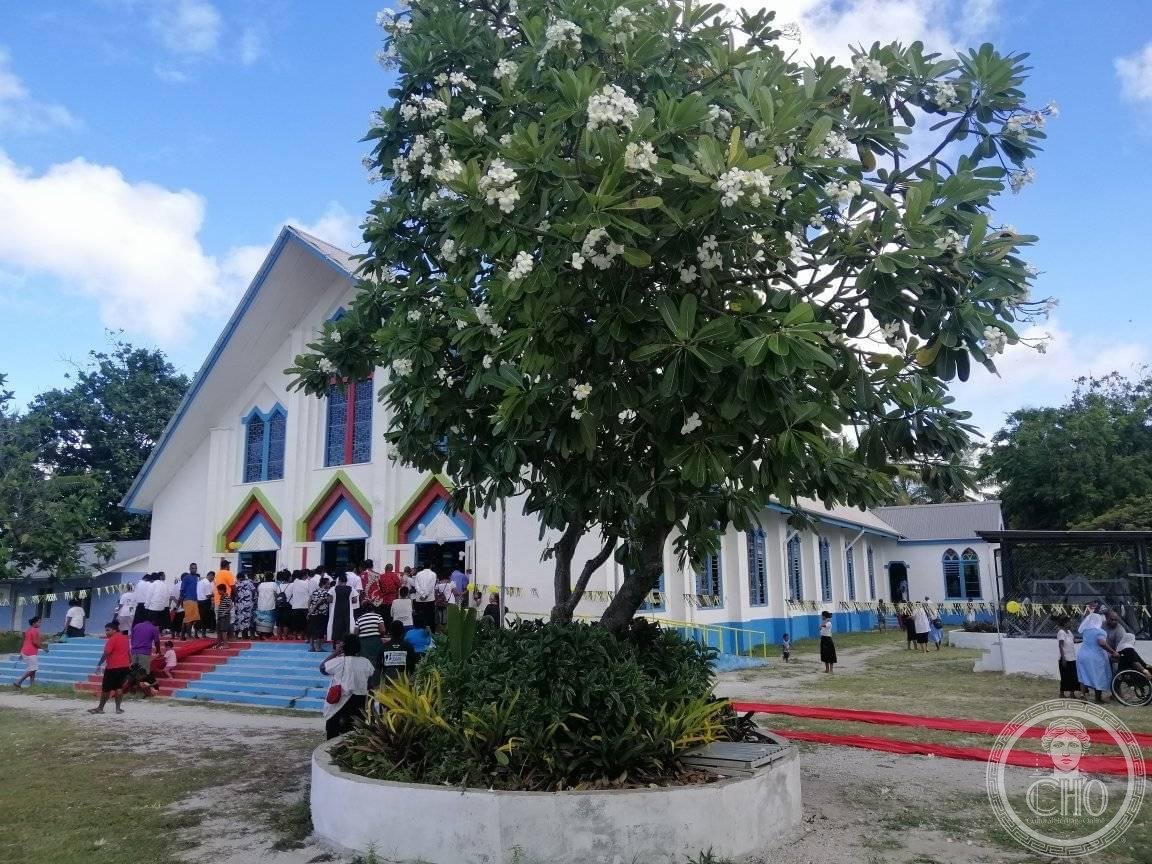
In Teaoraereke, on the atoll of South Tarawa, in Kiribati, stands the Sacred Heart Cathedral, seat of the diocese of Tarawa and Nauru. No source consulted documents the date of construction, the architect or the architectural style of the present building, a real gap in the record. Some descriptions circulating online, which date it to 1978 as an octagonal concrete-block structure, in fact refer to a different building, the chapel of the convent of the Sisters of Our Lady of the Sacred Heart, about six kilometres away, and should not be confused with the cathedral itself. The apostolic vicariate of the Gilbert Islands was erected on 28 June 1897, raised to the diocese of Tarawa on 21 June 1966, renamed diocese of Tarawa, Nauru and Funafuti in 1978 and finally divided in 1982 into the present diocese of Tarawa and Nauru, after Funafuti was separated off. Among its bishops, Paul Eusebius Mea Kaiuea led it for forty-two years, from 15 November 1978 to 29 June 2020, the longest episcopate of the diocese. On his death the funeral was held in this very cathedral, with a large turnout of the faithful. He was briefly succeeded by Koru Tito, from 2020 to 2022, and after a period of vacancy not fully documented in the sources, by the present bishop Simon Samendra Mani, a missionary of the Sacred Heart from Fiji and formerly rector of the Pacific regional seminary in Suva, appointed by Pope Francis in May 2024. Kiribati is one of the few Pacific nations with a Catholic majority, with estimates placing the faithful between 53 and 59 per cent of the population depending on the year considered, an exception in a mostly Protestant region. No source links this cathedral, or an earlier Catholic church on the same site, to the battle of Tarawa of November 1943, one of the bloodiest clashes of the Pacific war, fought mostly on the islet of Betio: no Catholic church is documented on Betio at the time of the battle, and the seat of the vicariate was then on the atoll of Tabiteuea, not on Tarawa. No pope has ever visited Kiribati. The only documented direct contact between the Vatican and the country goes back to 5 February 2015, when Pope Francis received the Kiribati president Anote Tong in audience to discuss climate change, on the eve of the Paris conference COP21 and a few months before the encyclical Laudato si’. No source documents a flood, a direct threat or a specific event involving this cathedral in relation to rising sea levels, although Kiribati, and the atoll of South Tarawa in particular, is among the most vulnerable territories in the world according to the World Bank and NASA.
About Sacred Heart Cathedral
In Teaoraereke, on South Tarawa atoll in Kiribati, stands Sacred Heart Cathedral, seat of the Diocese of Tarawa and Nauru. No source consulted documents the construction date, architect, or architectural style of the current building — a real information gap, not an oversight; some descriptions circulating online that date it to 1978 as an octagonal concrete-block structure actually describe a different building, the convent chapel of the Sisters of Our Lady of the Sacred Heart roughly six kilometers away, and should not be confused with the cathedral itself.
Key facts
- 28 June 1897: the Apostolic Vicariate of the Gilbert Islands erected.
- 21 June 1966: elevated to the Diocese of Tarawa.
- 1978-2020: Bishop Paul Eusebius Mea Kaiuea’s 42-year tenure, the diocese’s longest.
- Catholics form 53-59% of Kiribati’s population, a rare Pacific majority.
- 5 February 2015: Pope Francis receives President Anote Tong at the Vatican to discuss climate change.
- No pope has ever visited Kiribati, and no documented event ties this cathedral to the 1943 Battle of Tarawa.
History
Undocumented in its own architectural details, this cathedral’s clearest history is institutional: from an 1897 apostolic vicariate through a 1966 elevation to diocese, to the 42-year tenure of Bishop Paul Mea, whose 2020 death brought large crowds to this cathedral for his funeral. Kiribati’s unusual status as a majority-Catholic nation in an otherwise largely Protestant Pacific gives the diocese a weight beyond the country’s small population — one now shadowed by Kiribati’s position as one of the world’s most sea-level-vulnerable nations, a fact that reached the Vatican itself in a 2015 audience between Pope Francis and Kiribati’s president, months ahead of the pope’s own encyclical on the environment.
Practical information
- Opening hours: generally open daily outside services; check current hours before visiting.
- Address: Teaoraereke, South Tarawa, Kiribati.
Getting there
The cathedral stands in Teaoraereke village on South Tarawa atoll. GPS: 1°19′58″N, 173°00′25″E.
Nearby
- Betio — the western islet of Tarawa atoll, site of the November 1943 Battle of Tarawa.
Sources
- Wikipedia — “Sacred Heart Cathedral, Kiribati” and “Roman Catholic Diocese of Tarawa and Nauru”
- Catholic-Hierarchy.org and GCatholic.org — Diocese of Tarawa and Nauru records.
- Missionaries of the Sacred Heart (misacor-mscppi.org) — history of the diocese.
- Rome Reports and Radio New Zealand — coverage of the 2015 Francis-Tong Vatican audience.
- NASA Sea Level and World Bank — climate vulnerability data for Tarawa/Betio, Kiribati.
Find it on the map
See this place and what’s around it →📷 Become a Cultural Heritage Online photographer
Share your photos of places: they stay published under your name as the author. The more they're seen, the more you get noticed — and soon a contest will reward the most appreciated photos.
Log in or sign up free to add a photo