
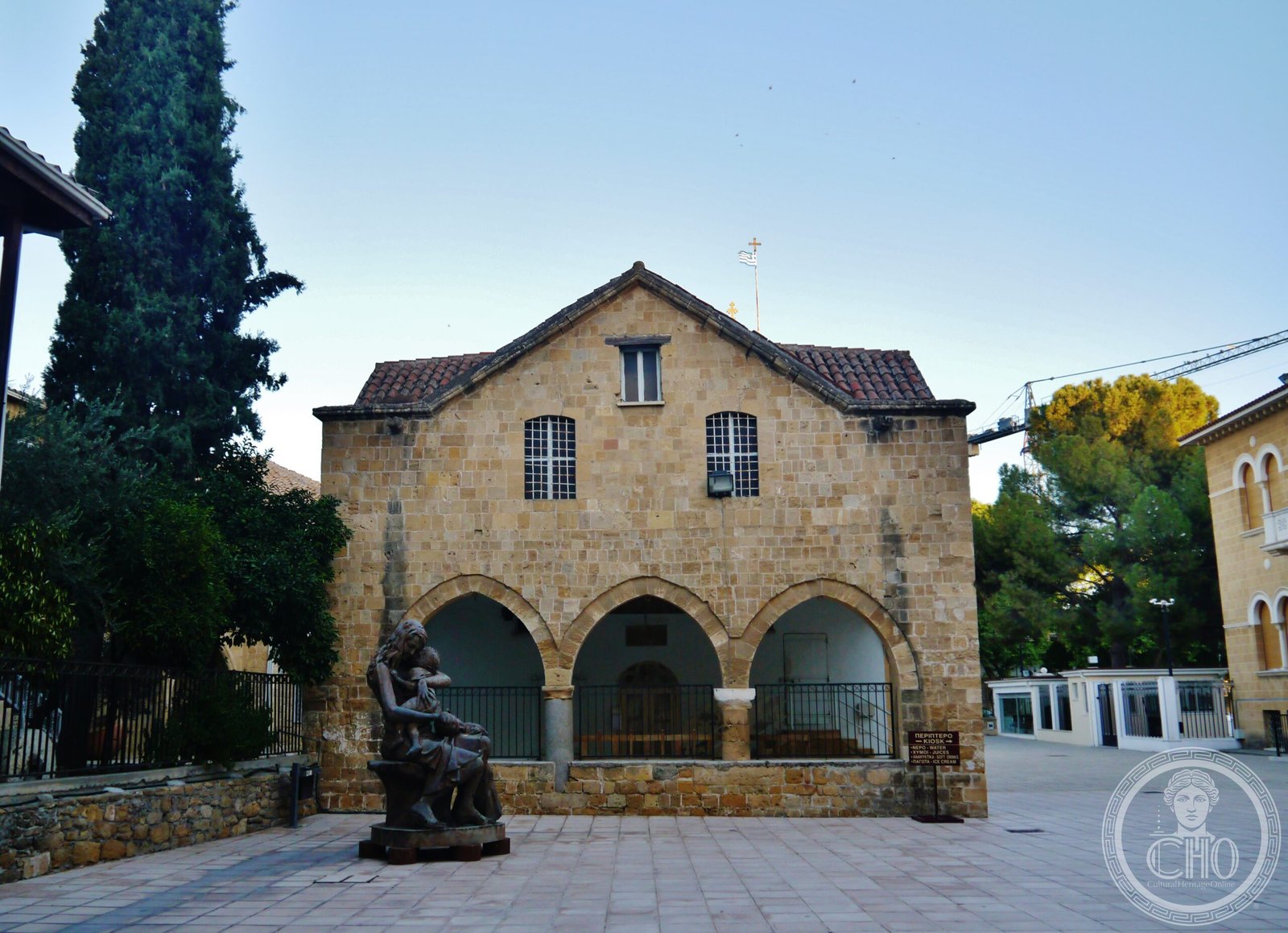
In Nicosia, Cyprus, a chapel is attested on this site as early as the 11th century, followed by a Benedictine abbey of St John the Theologian, founded under the Lusignan dynasty, whose monks left the island in 1426 in the face of the Mamluk invasions. The present building dates from 1662, when Archbishop Nikephoros rebuilt it from its foundations, reusing the earlier masonry, as a marble inscription above the west entrance dated 30 April of that year records. In the eighteenth century Archbishop Sylvestros turned it into a cathedral, seat of the Orthodox archbishopric from 1720. The building has a single nave and a barrel vault, in a hybrid Franco-Byzantine style that reworks a Gothic frame of the Lusignan period into Orthodox liturgical form. Its outside was kept deliberately modest under the Ottoman restrictions on non-Muslim religious building, against a far richer interior, with gilded woodwork and crystal chandeliers. It is described as the only church in Nicosia where the original cycle of frescoes survives intact, painted between 1736 and 1756 under Archbishop Philotheos. The cycle devoted to Saint Barnabas, dated to 1736, is attributed by the academic literature to the hieromonk Ioannikios and his workshop, while the iconostasis holds four large icons by the Cretan master Ioannis Kornaros, of 1795-1797. The four scenes of the Barnabas fresco tell, according to the tradition of the Church, of the appearance of the saint in a dream to Archbishop Anthemios in 478, the finding of his tomb at Salamis, the presentation to the emperor Zeno of the Gospel of Matthew found on his breast, in the hand of Barnabas himself according to tradition, and the resulting confirmation of the autocephaly of the Church of Cyprus, already recognised by the council of Ephesus in 431. It is an episode of hagiographic tradition with a documented historical core, not an archaeologically verified fact, but it is depicted on these very walls. This cathedral is traditionally the place of the enthronements of Cypriot archbishops, a role that makes plausible, though not directly documented by a specific source, the enthronement here of Makarios III himself in 1950, the future first president of an independent Cyprus from 1960. No source links the building specifically to the EOKA campaign or to the independence ceremony of 1960, nor to the Cyprus crisis of 1974, and such connections should not be assumed. Well documented instead is the funeral of Makarios, in August 1977: the body lay in state for about a week in this cathedral, with one hundred and eighty-two delegations from fifty-two countries and about two hundred and fifty thousand people queuing to pay their respects, a quarter of the Greek Cypriot population of the time, before burial at Throni hill, near the monastery of Kykkos. In June 2021 a new cathedral dedicated to Saint Barnabas was inaugurated beside this historic one, within the same archiepiscopal complex, described by the then archbishop Chrysostomos II as a personal project of long standing. When Pope Francis met the Holy Synod of the Church of Cyprus on 3 December 2021, the official Vatican text speaks generically of the «Orthodox cathedral in Nicosia», without saying whether it was this building of 1662 or the newly inaugurated cathedral of Saint Barnabas: a detail not to be taken for granted. The present archbishop of Cyprus is George III, elected on 18 December 2022 after the death of Chrysostomos II.
About St. John’s Cathedral
In Nicosia, Cyprus, a chapel is attested on this site from the 11th century, followed by a Benedictine Abbey of St. John the Theologian founded under the Lusignan dynasty, whose monks left the island in 1426 amid Mamluk invasions. The present building dates to 1662, when Archbishop Nikephoros rebuilt it from its foundations reusing earlier masonry, as recorded in a marble inscription above the west entrance dated 30 April of that year; in the 18th century, Archbishop Sylvestros converted it into a cathedral, seat of the Orthodox Archbishopric from 1720.
Key facts
- 30 April 1662: Archbishop Nikephoros rebuilds the church from its foundations.
- 1720: becomes the seat of the Orthodox Archbishopric of Cyprus.
- 1736: the Barnabas fresco cycle painted, attributed to hieromonk Ioannikios.
- 1795-1797: the iconostasis’s four icons painted by Cretan master Ioannis Kornaros.
- August 1977: Archbishop-President Makarios III’s funeral, roughly 250,000 mourners.
- 18 December 2022: Archbishop George III elected, current head of the Church of Cyprus.
History
Rebuilt in 1662 on the site of a Benedictine abbey and converted into a cathedral in the 18th century, this small stone church houses the only complete surviving original fresco cycle in Nicosia — including a 1736 cycle depicting the discovery of Saint Barnabas’s relics, the tradition that underpins the Church of Cyprus’s rare status as one of Christendom’s oldest self-governing churches. In August 1977 it became the site of one of Cyprus’s largest public gatherings, as some 250,000 mourners — a quarter of the Greek Cypriot population — filed past the body of Archbishop-President Makarios III.
What you see
A small, single-aisled, barrel-vaulted church in a Franco-Byzantine hybrid style reworks a Gothic Lusignan-era skeleton into Orthodox liturgical form, its deliberately modest stone exterior — a triple-arched loggia beneath a gabled roof and cross finial — concealing a richly gilded interior with crystal chandeliers and the 1736 Barnabas fresco cycle on its south wall.
Practical information
- Opening hours: reported as Tuesday-Friday 09:00-15:00, Saturday 09:00-12:00, closed Sunday and Monday; verify current hours before visiting.
- Address: Archbishop Cyprianos Square, walled Old City, Nicosia, Cyprus.
Getting there
The cathedral stands on Archbishop Cyprianos Square, next to the Archbishop’s Palace, within Nicosia’s walled Old City. GPS: 35°10′19″N, 33°22′01″E.
Nearby
- Archbishop’s Palace and the new Saint Barnabas Cathedral (2021) — both adjoining the same archiepiscopal complex.
Sources
- Wikipedia — “St. John’s Cathedral, Nicosia,” “Church of Cyprus,” and “Makarios III”
- NASSCAL (academic database) — “Cycle of Barnabas, Cathedral of St John (Nicosia)”
- Visit Cyprus and Nicosia Municipality — official tourism and city listings.
- Cyprus Mail — on the 2021 opening of the new Saint Barnabas Cathedral.
- Vatican.va — official transcript, Pope Francis’s meeting with the Holy Synod of Cyprus, 3 December 2021.
Find it on the map
See this place and what’s around it →📷 Become a Cultural Heritage Online photographer
Share your photos of places: they stay published under your name as the author. The more they're seen, the more you get noticed — and soon a contest will reward the most appreciated photos.
Log in or sign up free to add a photo