
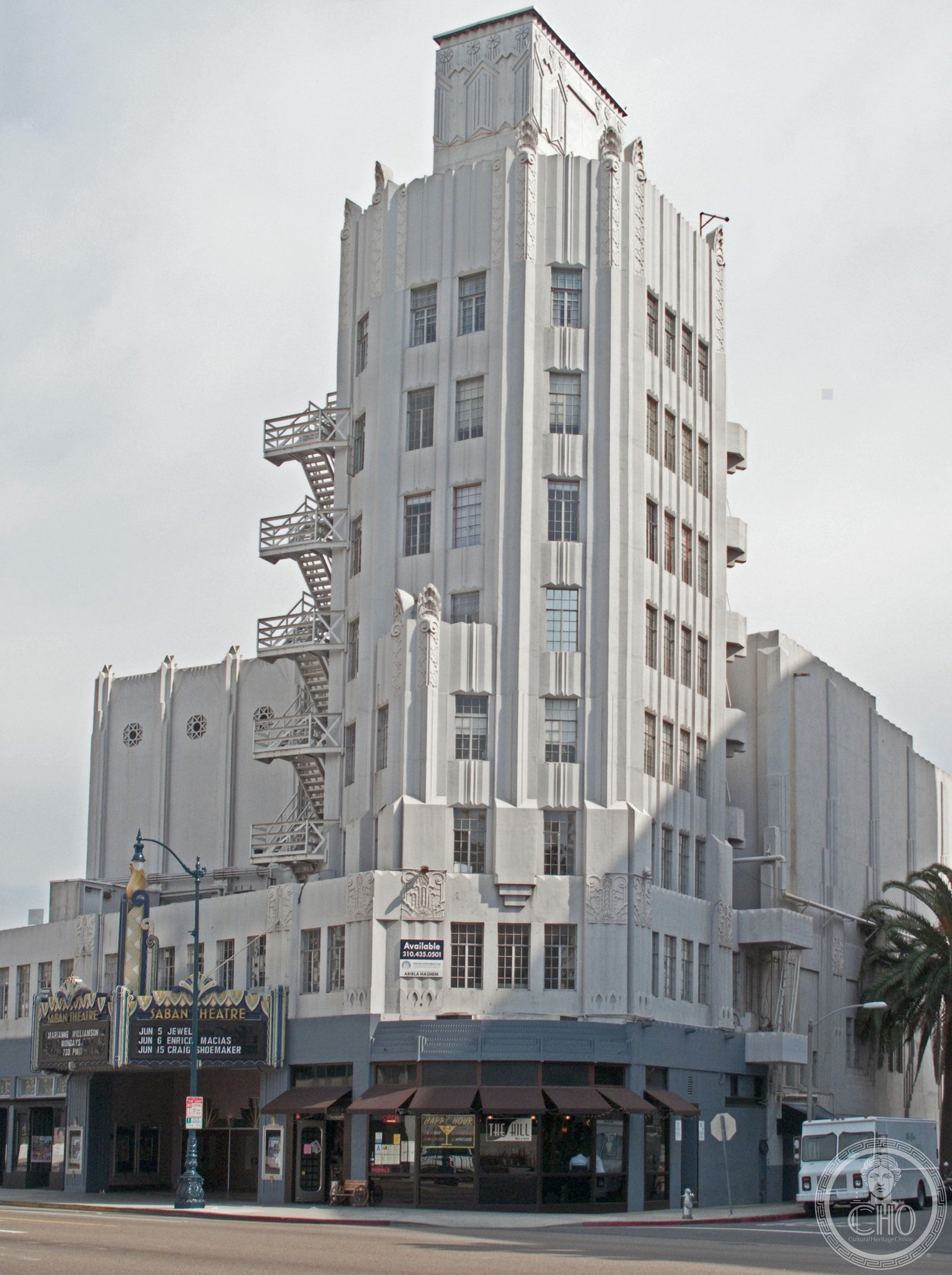
Opened in October 1930 as the Fox Wilshire Theatre, S. Charles Lee’s 2,000-seat house on Wilshire Boulevard brought the full Art Deco vocabulary of the picture palace to Beverly Hills — a terra-cotta facade of concentrated ornament, a vertical sign tower, and an interior of stylized geometric decoration that established the aesthetic of the Wilshire commercial corridor in the early sound era.
At a glance
The Fox Wilshire Theatre was designed by S. Charles Lee, the most prolific cinema architect of the Los Angeles Art Deco period, and opened in October 1930 at 8440 Wilshire Boulevard in Beverly Hills. Built for the Fox West Coast Theatres chain, it seated approximately 2,000 patrons and was among the first major picture palaces on the Wilshire Boulevard corridor. Lee’s design organized the Wilshire facade as a concentrated surface of Art Deco ornament — stylized eagles, geometric friezes, and foliated panels in polychrome terra-cotta — topped by a vertical sign tower that read from blocks away along the straight commercial boulevard. The building was listed on the National Register of Historic Places in 1987. After decades of varied use, the theatre was acquired by philanthropist Haim Saban, renovated in 2012, and renamed the Saban Theatre. It now operates as a performing arts venue.
Key facts
- Completed: 1930
- Architect: S. Charles Lee
- Address: 8440 Wilshire Boulevard, Beverly Hills, CA 90211
- Original capacity: ~2,000 seats
- Style: Art Deco / Picture Palace
- Status: National Register of Historic Places (1987); Beverly Hills Landmark
- GPS: 34.0607°N, 118.3606°W
History
S. Charles Lee arrived in Los Angeles in 1922 and over the next two decades designed more than 400 theatres, many of them in the Art Deco idiom that defined Southern California’s entertainment architecture of the late 1920s and early 1930s. The Fox Wilshire commission came at the height of the picture palace era: Fox West Coast Theatres was expanding rapidly along the emerging Wilshire corridor, and the theatre was intended to serve the affluent residential neighborhoods of Beverly Hills, Hancock Park, and the Miracle Mile that were developing along the boulevard. Lee’s design answered the commercial brief — maximum visibility, maximum ornament — with a facade that compressed the full vocabulary of Deco decoration into the Wilshire frontage.
The theatre opened on October 5, 1930, during the first months of the Depression. Fox Theatres had recently merged with Loew’s in the studio consolidations of the sound era, and the Wilshire location became one of the chain’s premium West Coast venues. Through the 1930s and 1940s, it presented first-run films alongside stage performances for Beverly Hills’ and West Hollywood’s audiences. The suburban shift of the 1950s and 1960s affected the Wilshire corridor theatres; by the 1970s, the Fox Wilshire had been converted to a live performance venue and had passed through several ownership changes. The National Register listing in 1987 recognized the building’s architectural significance and provided a framework for preservation during the period of ownership uncertainty that followed. Haim Saban’s acquisition and 2012 renovation returned the theatre to active cultural use and restored major elements of Lee’s 1930 interior.
What you see
The Wilshire Boulevard facade is Lee’s picture-palace Art Deco compressed into a single unified surface: polychrome terra-cotta panels packed with stylized eagles, geometric friezes, foliated ornament, and the vertical piers that give the composition its upward reading. The ornament is not distributed evenly but concentrated in the areas of maximum visibility — the entrance canopy, the cornice level, and the flanking pilasters — leaving the central wall surface as a relatively plain field that throws the detailed sections into relief. At the roofline, the vertical sign tower — originally carrying “FOX WILSHIRE” in illuminated letters — provides the landmark element visible from the long Wilshire straightaway in both directions.
The theatre’s Wilshire frontage has survived with its principal decorative elements intact. The 2012 renovation restored the sign tower, repointed the terra-cotta, and returned the entrance canopy to a configuration close to Lee’s original. The interior, which was altered substantially during the years of live-performance use, retains decorative elements from 1930 alongside the renovations. The auditorium volume — deep, with a steeply raked orchestra and a balcony of considerable overhang — was designed for the large picture-palace format that Lee perfected across his Los Angeles commissions.
Practical information
- Access: Open for ticketed events; the exterior is freely visible from Wilshire Boulevard at all hours
- Events: Film premieres, concerts, lectures, and performing arts events; check the Saban Theatre website for current programming
- Photography: The Wilshire facade photographs best in late-afternoon light from the south side of the boulevard
- Time needed: 15–20 minutes for exterior; allow full event duration for interior
Getting there
The Saban Theatre is at 8440 Wilshire Boulevard in Beverly Hills, between La Cienega Boulevard and Doheny Drive. The Metro D Line (Purple Line) La Cienega/Jefferson station is approximately 1.5 miles south; several Metro bus lines serve the Wilshire corridor directly. The Sunset Tower Hotel (1931) is approximately 1 mile north on Sunset Boulevard. Street and garage parking are available on Wilshire and the surrounding blocks.
Nearby
- Los Angeles County Museum of Art (Wilshire Blvd) — 0.7 miles east
- Sunset Tower Hotel (1931) — Art Deco, 1.1 miles north on Sunset Boulevard
- Oviatt Building (1927) — Art Deco, 8.5 miles east in downtown Los Angeles
Sources
- National Register of Historic Places, Fox Wilshire Theatre nomination, 1987
- Nissen, Joseph. S. Charles Lee: The Golden Age of Movie Theatres. UC Press, 1992.
- City of Beverly Hills, Historic Resources Survey, Saban Theatre documentation
- Los Angeles Conservancy, Art Deco inventory, Fox Wilshire Theatre entry
Find it on the map
See this place and what’s around it →Record researched and written by Luigi De Marchi for Cultural Heritage Online, 2026.
📷 Become a Cultural Heritage Online photographer
Share your photos of places: they stay published under your name as the author. The more they're seen, the more you get noticed — and soon a contest will reward the most appreciated photos.
Log in or sign up free to add a photoIs this page about you?
This page is read by travellers and heritage enthusiasts who find it on Google. Tell us how you are connected to this place and we will take it from there.