
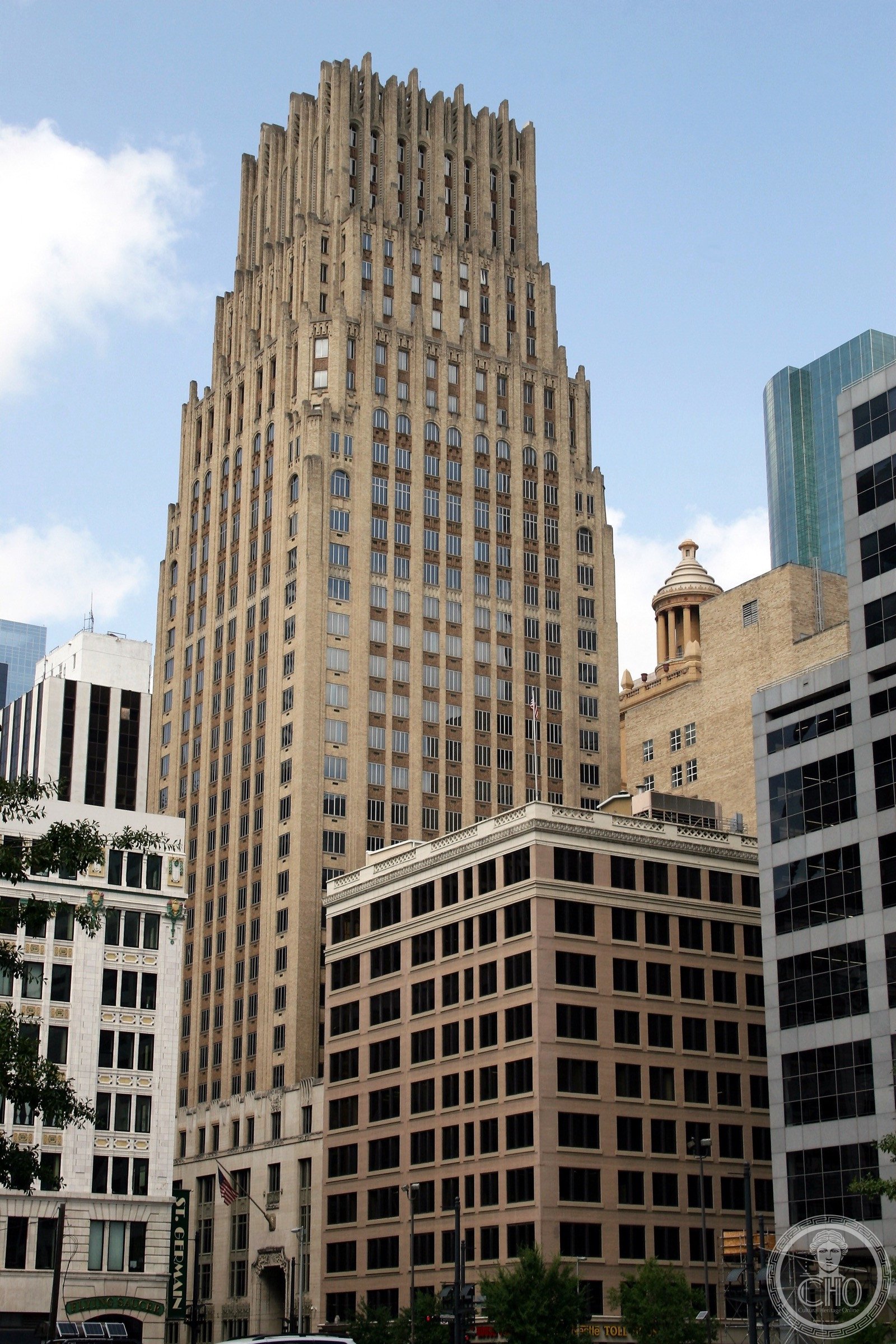
Rising 37 stories above Main Street in downtown Houston, the Gulf Building was the tallest structure in Texas at the time of its completion in 1929 — a stepped Art Deco tower by Alfred C. Finn whose tiered limestone crown and vertical ornamental language brought the Manhattan skyscraper idiom to the Gulf Coast city at the peak of the Texas oil boom.
At a glance
The Gulf Building was designed by Alfred C. Finn and completed in 1929 at 712 Main Street in the heart of Houston’s downtown commercial district. Commissioned by the Gulf Oil Corporation — one of the dominant oil companies of the early twentieth century — the building was intended to serve as both a functional headquarters and a civic statement of Gulf Oil’s position in the Texas economy. At 37 stories, it was the tallest building in Texas at completion, surpassing all existing structures in Dallas, Fort Worth, and San Antonio and placing Houston in the emerging category of cities with a recognizable skyscraper skyline. The building’s Art Deco vocabulary — setback massing, vertical ornamental piers, concentrated ornament at the base and crown, and the characteristic stepped pyramid profile at the top — connects it directly to the New York commercial Deco tradition that was defining the American skyscraper in the late 1920s.
Key facts
- Completed: 1929
- Architect: Alfred C. Finn
- Address: 712 Main Street, Houston, TX 77002
- Height: 37 stories
- Style: Art Deco
- Original tenant: Gulf Oil Corporation
- Status: City of Houston Protected Landmark; listed on National Register of Historic Places
- GPS: 29.7549°N, 95.3676°W
History
Houston’s transformation from a regional cotton-trading port into a major American city was driven by oil. The Spindletop discovery in 1901 initiated the Texas oil boom, and by the 1920s Houston had positioned itself as the commercial and financial hub of the Gulf Coast petroleum industry. The Gulf Oil Corporation — founded by the Mellon banking family in Pittsburgh following the Spindletop discovery — established a significant Texas presence, and its decision to commission a headquarters tower in downtown Houston in the late 1920s was an expression of corporate confidence in the city’s future as much as a functional office requirement.
Alfred C. Finn, a Houston-based architect who had established his practice on commercial and civic commissions in Texas, brought the New York Art Deco formula to the Gulf Building commission: setback massing to reduce the visual bulk as the tower rose, vertical ornamental piers to emphasize the height, concentrated ornament at the entry portal and at the crown, and the stepped pyramid at the top that was becoming the signature element of the American Deco skyscraper in the late 1920s. The building was completed in 1929, months before the Wall Street crash, and weathered the Depression as a functioning headquarters for a company whose oil revenues sustained it through the economic crisis.
The Gulf Oil Corporation eventually vacated the building as its operations expanded beyond what a 1929 tower could accommodate. The building has been converted to multiple uses over the decades and has received City of Houston Protected Landmark status, ensuring the preservation of its exterior and significant interior spaces. The stepped crown remains one of the most distinctive profiles on the Houston downtown skyline.
What you see
The Main Street facade presents the building’s full vertical composition: a rusticated base of several stories, a smooth limestone shaft rising to the setback crown, and the ornamental piers that run vertically from base to crown, giving the facade its characteristic upward emphasis. The ornament is concentrated at the entry portal — where the Art Deco vocabulary of geometric abstraction, stylized plant forms, and angular relief work appears at close range — and at the crown, where the stepped pyramid profile is visible from blocks away. The vertical piers narrow as they rise, converging toward the pinnacles at the top, a compositional device that gives the tower its visual lift and distinguishes it from the bulkier commercial buildings that preceded the Art Deco period.
From the street, the Main Street elevation reads as a compressed exercise in the New York commercial Deco formula: the entry portal with its concentrated ornament, the setback massing visible from across the street, and the stepped crown that anchors the building’s identity from a distance. The interior lobby retains Art Deco metalwork and proportions that identify the space as a 1929 commission of considerable ambition, even as the building’s tenancy has changed multiple times since Gulf Oil’s occupation.
Practical information
- Exterior: The Main Street facade is always freely viewable
- Lobby: Accessible during business hours; the Art Deco metalwork is visible from the entry
- Photography: The stepped crown photographs well from Main Street looking north; the crown details are best appreciated from a distance of one block or more
- Time needed: 20-30 minutes for exterior circuit and lobby
Getting there
The Gulf Building is at 712 Main Street in downtown Houston, within the Main Street corridor. The METRORail Main Street line stops within one block, with service to Houston’s Museum District and NRG Park to the south and to the Theater District to the north. George Bush Intercontinental Airport is approximately 23 miles north; William P. Hobby Airport is approximately 10 miles southeast. Street parking and garage parking are available throughout the downtown grid.
Nearby
- Rice Hotel (1913, now Rice Lofts) — 909 Texas Avenue, a block east; Houston’s historic luxury hotel
- Houston City Hall (1939) — 901 Bagby Street, several blocks west; Art Deco civic building
- Tranquility Park — 410 Rusk Street, two blocks north; downtown green space above a parking structure
- Harris County Civil Courthouse — 201 Caroline Street, a few blocks east
Sources
- City of Houston, Office of Preservation, Protected Landmark designation, Gulf Building
- National Register of Historic Places nomination, Gulf Building, Houston
- Houston Architectural Survey, Gulf Building documentation
- Houghton, Donald E. Houston: A History and Guide. American Guide Series, 1942.
Find it on the map
See this place and what’s around it →Record researched and written by Luigi De Marchi for Cultural Heritage Online, 2026.
📷 Become a Cultural Heritage Online photographer
Share your photos of places: they stay published under your name as the author. The more they're seen, the more you get noticed — and soon a contest will reward the most appreciated photos.
Log in or sign up free to add a photoIs this page about you?
This page is read by travellers and heritage enthusiasts who find it on Google. Tell us how you are connected to this place and we will take it from there.