

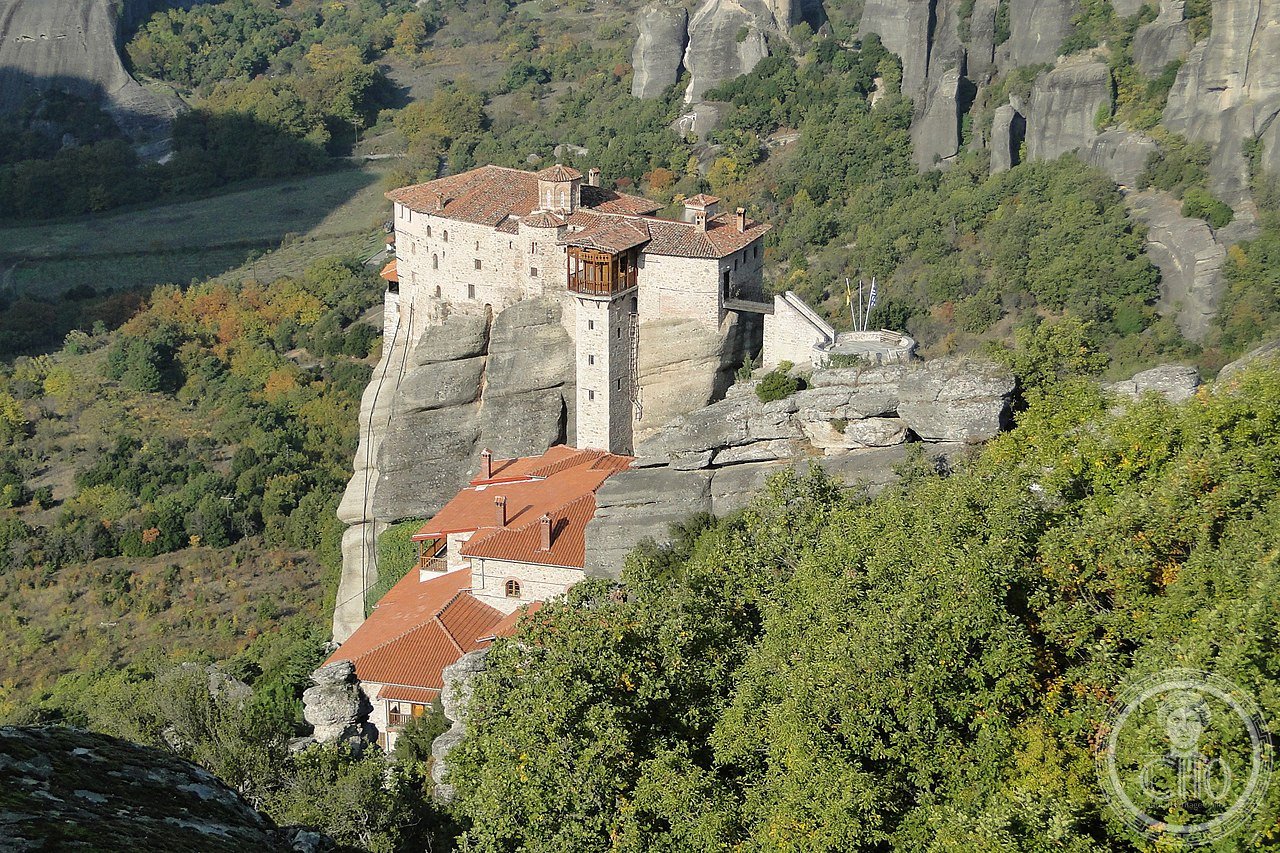
Built on a rock pinnacle of its own, reachable only across a small bridge from the pinnacle next to it, the monastery of Rousanou lived through almost two centuries of slow abandonment before German occupation troops looted it in 1940, during the Second World War. Restored after the war, since 1988 it has been a convent: today it is the only monastery at Meteora inhabited exclusively by nuns.
About Rousanou Monastery
Rousanou Monastery was founded in 1545 by the brothers Joasaph and Maximos of Ioannina, on the site of an earlier church, on one of the more modestly sized rock pinnacles at Meteora. In 1614 the monastery became subordinate to the larger Varlaam Monastery nearby. Its katholikon received frescoes in 1560, smaller in scale but stylistically related to those at Varlaam, executed in the mature style of the Cretan School of Byzantine painting. The monastery’s fortunes declined steadily over roughly two centuries leading up to the Second World War, and in 1940, during the German occupation of Greece, it was plundered by German forces. Following the war, restoration work was undertaken to repair the damage, and since 1988 Rousanou has been occupied by a community of Orthodox nuns, making it the only one of Meteora’s six surviving monasteries inhabited exclusively by a female religious community. The monastery is built across three storeys atop its rock pinnacle: the ground floor holds the Church of the Transfiguration, while the upper floors contain residential cells and guest facilities for the nuns. Access today is across a small bridge connecting the monastery’s rock to a neighbouring pinnacle, a modern replacement for the far more precarious rope-and-ladder systems once used to reach nearly all of Meteora’s monastic communities.
Key facts
- Foundation: 1545, by the brothers Joasaph and Maximos of Ioannina, on the site of an earlier church
- 1614: becomes subordinate to the nearby Varlaam Monastery
- 1560: katholikon decorated with frescoes in the mature Cretan School style
- Two centuries: steady decline leading up to the Second World War
- 1940: plundered by German occupying forces
- 1988: restored and reoccupied as a convent; the only Meteora monastery run exclusively by nuns
- Structure: three storeys — ground-floor Church of the Transfiguration, upper residential and guest floors
History
Rousanou’s near-two-century decline in the period before the Second World War, followed immediately by outright plundering during the 1940 German occupation, situates the monastery among the Meteora communities that suffered the most compounded institutional damage across the modern era, making its eventual mid-20th-century restoration and 1988 refoundation as a convent a particularly deliberate act of reconstruction rather than simple continuous habitation. Its status today as the only one of Meteora’s six active monasteries inhabited solely by nuns marks a notable structural distinction within the wider complex, where the surviving communities are otherwise exclusively male.
The monastery’s stylistic connection to Varlaam through its 1560 frescoes, executed by artists working in the same Cretan School tradition and on a smaller scale than at the larger neighbouring house, reflects Rousanou’s own subordinate status after 1614 and the close artistic and administrative ties that bound smaller Meteora foundations to their larger counterparts during the post-Byzantine period.
What you see
The Church of the Transfiguration on the ground floor holds Cretan School frescoes dating to 1560, related in style to the larger cycle at Varlaam Monastery. The monastery’s three-storey structure, with residential cells and guest quarters on its upper floors, occupies the entirety of its modestly sized rock pinnacle. The small bridge connecting the monastery to a neighbouring rock remains the only means of access, offering visitors dramatic views across the surrounding Meteora landscape.
Practical information
- Opening hours: open to visitors on a scheduled basis with seasonal variation; check current hours before visiting; admission fee applies; modest dress required
- Address: Ιερά Μονή Ρουσάνου, Μετέωρα – Καστράκι, 422 00 Kalambaka, Greece
Getting there
Rousanou Monastery is reachable by car or on foot from Kastraki or Kalambaka, in the Thessaly region, along the road connecting the Meteora monasteries. GPS: 39.7217° N, 21.6322° E.
Nearby
- Varlaam Monastery — the larger monastery Rousanou was historically subordinate to
- Great Meteoron Monastery — the largest and oldest of the six active Meteora monasteries
- Kastraki — the nearby village at the base of the Meteora rocks
Sources
- OrthodoxWiki — “Roussanou Monastery (Meteora)” (orthodoxwiki.org)
- VisitMeteora.travel — “Monastery Of Roussanou Meteora: History, Views & Visitor Guide” (visitmeteora.travel)
- Kalampaka.com — “Holy Monastery of Rousanou” (kalampaka.com)
Find it on the map
See this place and what’s around it →📷 Become a Cultural Heritage Online photographer
Share your photos of places: they stay published under your name as the author. The more they're seen, the more you get noticed — and soon a contest will reward the most appreciated photos.
Log in or sign up free to add a photo