

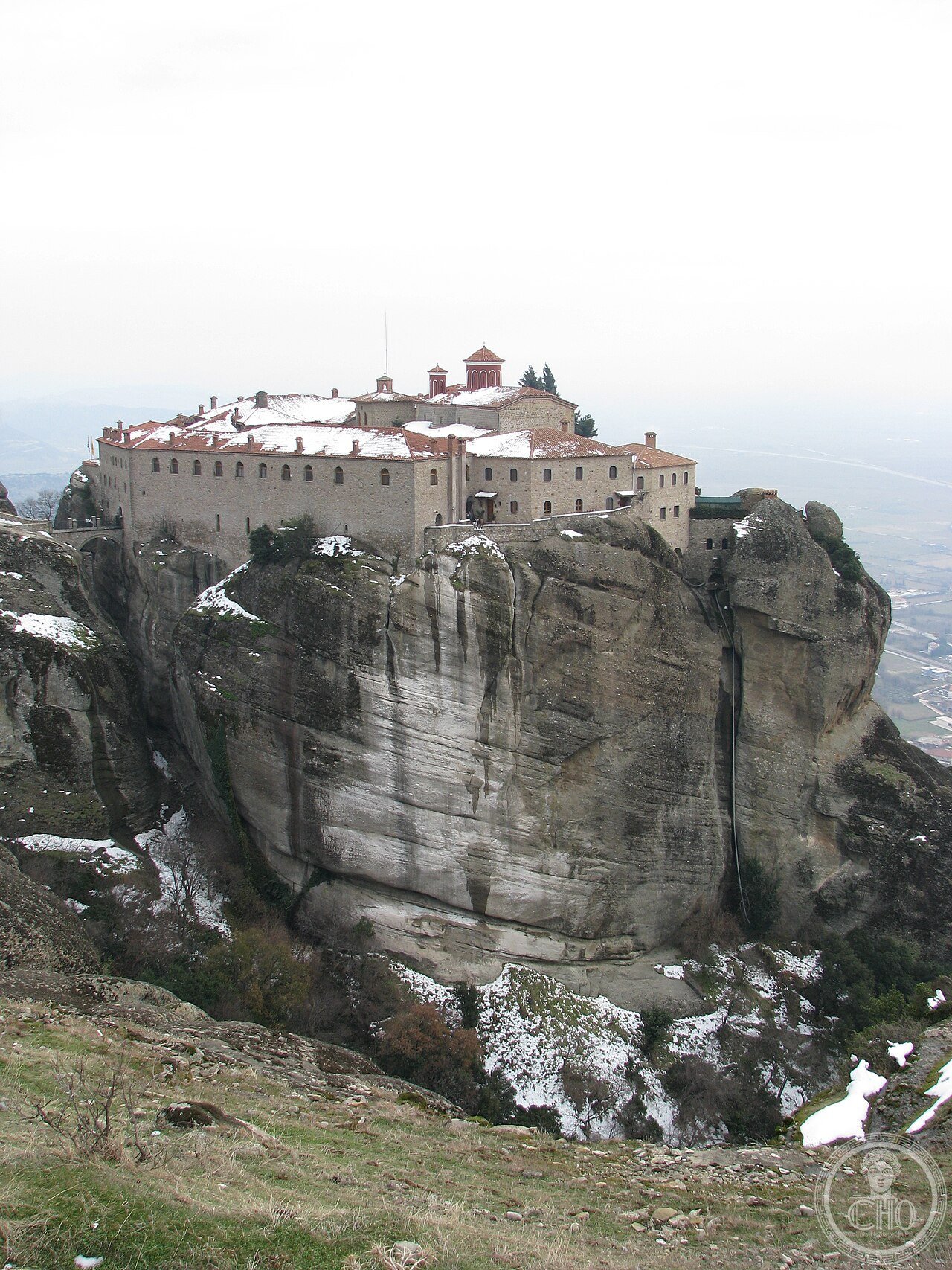
Unlike every other monastery at Meteora, Agios Stefanos does not stand on an isolated pinnacle but on the same accessible plateau, linked by a simple bridge: it is the only one that can be reached without climbing. That very ease of access made it vulnerable: during the Second World War the Germans bombed it believing it hid partisans, and in the civil war that followed communist rebels destroyed many of its frescoes. Abandoned until 1961, it is today a convent home to twenty-eight nuns.
About Agios Stefanos Monastery
Agios Stefanos Monastery was founded around 1400 by Saint Antoninus Cantacuzene, believed to have been a son of the Serbian ruler Nikephoros II of Epirus. The original church dedicated to St. Stephen was built in the 16th century, its wall paintings completed in 1545 by the priest Ioannis of Stagoi. The monastery’s main church, the katholikon dedicated to St. Haralambos, was built later, in 1798, and today houses among its relics the skull of St. Haralambos, given to the nuns by a Prince Vladislav of Wallachia. Unlike every other monastery at Meteora, Agios Stefanos was built directly on the Meteora plateau rather than atop an isolated rock pinnacle, connected to the surrounding land by a simple bridge rather than requiring the rope hoists, removable ladders, or rock-cut staircases that access to the other monasteries once demanded; it remains, as a result, the only monastery in the complex visible directly from the town of Kalambaka and the easiest to reach. This same accessibility made it more vulnerable during the turbulent 20th century: during the Second World War, Nazi forces shelled and damaged the monastery, believing it was sheltering insurgents, and it was subsequently abandoned; during the Greek Civil War that followed, communist rebels desecrated the site further, destroying many of its frescoes. The monastery remained essentially abandoned until 1961, when a community of nuns took possession of the buildings and began restoring them; today it is home to 28 nuns, led by an abbess, and remains one of the most welcoming and accessible of Meteora’s six surviving monastic communities.
Key facts
- c. 1400: founded by Saint Antoninus Cantacuzene, believed a son of Nikephoros II of Epirus
- 1545: the original church’s wall paintings completed by the priest Ioannis of Stagoi
- 1798: the katholikon dedicated to St. Haralambos is built
- Relic: the skull of St. Haralambos, gifted by a Prince Vladislav of Wallachia
- Unique access: the only Meteora monastery built at plateau level, requiring no climbing
- 1940s: shelled and damaged by Nazi forces in WWII; frescoes destroyed by communist rebels during the Greek Civil War
- 1961: a community of nuns takes possession and restores the site; today home to 28 nuns
History
Agios Stefanos’s unusual plateau-level location, which spared its community centuries of the perilous rope-and-ladder access that defined life at Meteora’s other monasteries, ironically became a liability precisely when physical isolation would have offered genuine protection: its comparative accessibility made it a plausible hideout for insurgents in the eyes of occupying Nazi forces, and later exposed it directly to the destructive attentions of communist rebels during the Greek Civil War, in a way the more physically remote cliff-top monasteries largely escaped. The double trauma of Axis shelling followed by Civil War desecration, compressed into little more than a single decade, left the monastery in a state of abandonment that persisted for over fifteen years before any restoration began.
The 1961 arrival of a community of nuns to rebuild Agios Stefanos from this abandoned and desecrated state, rather than simply reoccupying an intact building, represents one of the more thoroughgoing 20th-century monastic revivals at Meteora, transforming a war-damaged ruin into what is today one of the complex’s most visited and welcoming active communities.
What you see
The katholikon dedicated to St. Haralambos, built in 1798, houses the saint’s skull relic among its treasures. The older 16th-century church of St. Stephen preserves what remains of its 1545 wall paintings, following the losses inflicted during the Civil War. As the only Meteora monastery built at plateau level, Agios Stefanos offers direct views over Kalambaka below, connected to the mainland by a straightforward bridge rather than the dramatic staircases or hoisting systems required at the complex’s other monasteries.
Practical information
- Opening hours: open to visitors on a scheduled basis with seasonal variation; check current hours before visiting; admission fee applies; modest dress required
- Address: Ιερά Μονή Αγίου Στεφάνου, 422 00 Kalambaka, Greece
Getting there
Agios Stefanos is reachable by car directly from Kalambaka, in the Thessaly region, without any climbing required. GPS: 39.7091° N, 21.6386° E.
Nearby
- Kalambaka — the town directly below the monastery, the only Meteora monastery visible from it
- Rousanou Monastery — another active monastery, run by nuns, within the wider Meteora complex
- Great Meteoron Monastery — the largest and oldest of the six active Meteora monasteries
Sources
- OrthodoxWiki — “St Stephen Monastery (Meteora)” (orthodoxwiki.org)
- Sacred Destinations — “Agios Stefanos Monastery, Meteora, Greece” (sacred-destinations.com)
- Greeka.com — “Monastery of Agios Stefanos in Meteora, Greece” (greeka.com)
Find it on the map
See this place and what’s around it →📷 Become a Cultural Heritage Online photographer
Share your photos of places: they stay published under your name as the author. The more they're seen, the more you get noticed — and soon a contest will reward the most appreciated photos.
Log in or sign up free to add a photo