
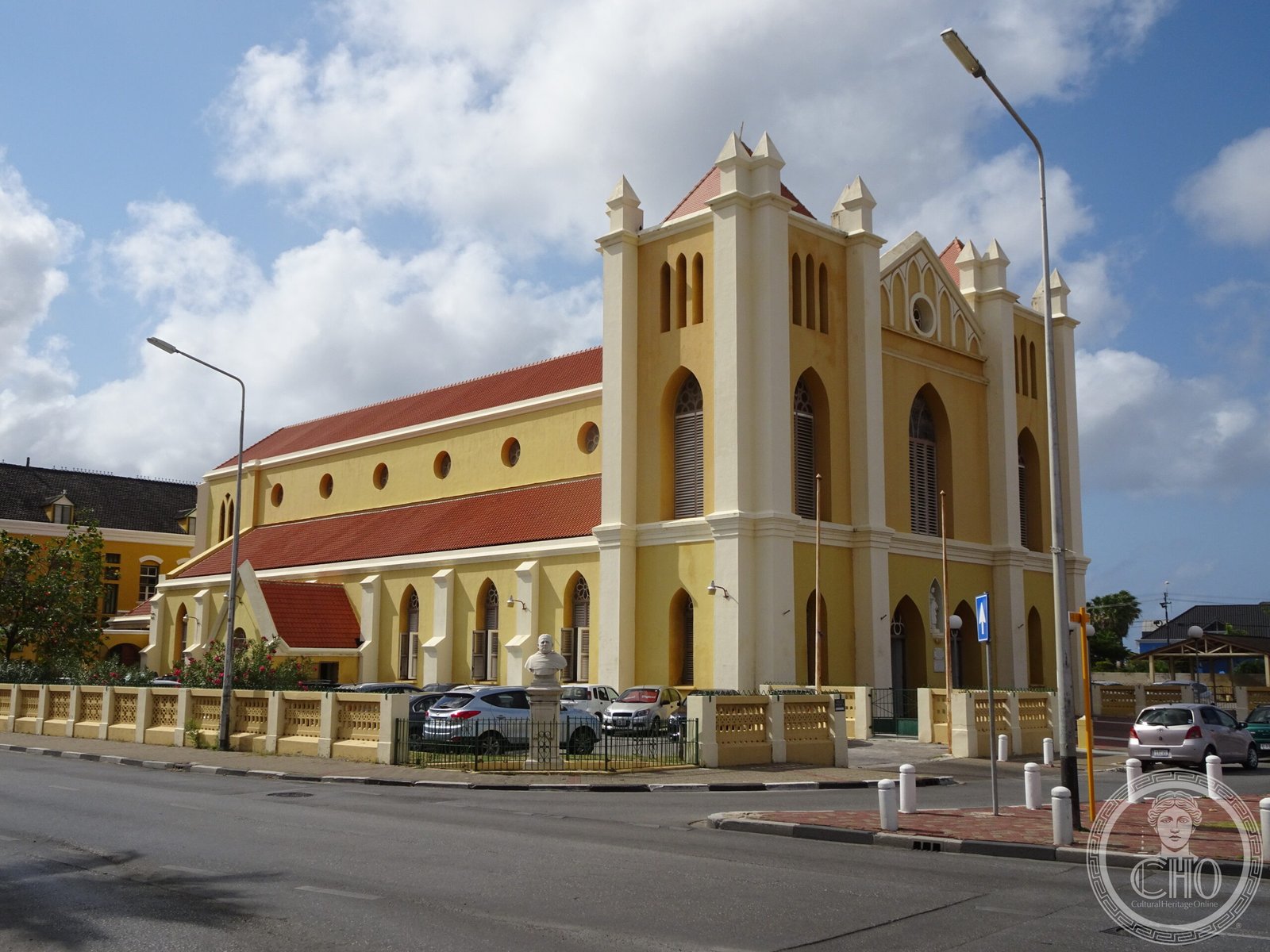
In the Pietermaai district, one of the three historic cores of Willemstad along with Punda and Otrobanda, the Cathedral of the Queen of the Most Holy Rosary is the true seat of the Catholic diocese of Willemstad, built in 1870 in neo-Gothic style and painted in the typical yellow that marks much of the island’s Dutch colonial architecture. It should be distinguished from the better-known Basilica of St. Anne, in Otrobanda, on the other side of Sint Anna Bay. St. Anne, founded in the eighteenth century (sources differ between 1734-1752 and 1751-1768 for the completion date), was the diocese’s co-cathedral and was raised to a minor basilica by Pope Paul VI in 1975, but it is not the main diocesan seat. Curaçao was colonised by the Dutch in 1634 as a Protestant possession, but Catholicism, already introduced in 1525 by the Spaniard Juan Martínez de Ampiés, prevailed numerically in the following centuries. The Dutch Reformed colonists, concentrated around the fort church (Fort Church, still active today at Fort Amsterdam, built around 1635), did little missionary work, leaving the conversion of the enslaved and local population to Catholic missionaries. Today the island’s Catholic population ranges, according to the sources, between 68 and 73% of the total. Willemstad’s historic centre, which includes Punda, Otrobanda and Pietermaai together with the harbour, was declared a UNESCO World Heritage site in 1997, partly because of this religious layering. In nearby Punda stands the Mikvé Israel-Emanuel synagogue, among the oldest in the Americas still in use, founded in 1651 and completed in 1732, a testament to the Sephardic Jewish community that arrived on the island fleeing the Inquisition.
About the Cathedral
The Queen of the Most Holy Rosary Cathedral, in the Pietermaai district of Willemstad, Curaçao, is the seat of the Roman Catholic Diocese of Willemstad, built in 1870 in Gothic Revival style. It stands distinct from the better-known Basilica of St. Anne across the bay in Otrobanda, which is a co-cathedral rather than the diocese’s primary seat.
Key facts
- 1870: cathedral built in the Pietermaai district.
- Seat of the Roman Catholic Diocese of Willemstad, covering Curaçao and the wider Dutch Caribbean.
- Distinct from the Basilica of St. Anne, Otrobanda, a co-cathedral raised to minor basilica status in 1975.
- 1634: Dutch colonization of Curaçao as a Protestant possession; Catholicism, introduced by the Spanish in 1525, nonetheless became the majority faith over time.
- Curaçao’s population is estimated at roughly 68–73% Catholic today.
- 1997: Willemstad’s historic core, including Pietermaai, inscribed as a UNESCO World Heritage Site.
History
Built in 1870 to serve as the seat of Curaçao’s Catholic diocese, the cathedral reflects a demographic reversal typical of the Dutch Caribbean: the island’s Dutch Reformed colonizers did comparatively little missionary work, leaving the conversion of the enslaved and local population largely to Catholic clergy, so that a colony founded as Protestant became majority Catholic. The cathedral shares Willemstad’s UNESCO-listed historic core with the older Basilica of St. Anne in Otrobanda and one of the oldest continuously used synagogues in the Americas, Mikvé Israel-Emanuel, in nearby Punda — together reflecting the religious plurality of a small Caribbean trading port.
What you see
A Gothic Revival facade in the pale-yellow tones typical of Willemstad’s Dutch colonial architecture, with pointed-arch windows and a bell tower, standing among the pastel-painted townhouses of the Pietermaai waterfront district.
Practical information
- Opening hours: generally open outside services; check current hours before visiting.
- Address: Pietermaai district, Willemstad, Curaçao.
Getting there
The cathedral stands in the Pietermaai district of Willemstad, east of the historic Punda core. GPS: 12.1037°N, 68.9248°W.
Nearby
- Basilica of St. Anne, Otrobanda — the diocese’s older co-cathedral, across St. Anna Bay, a minor basilica since 1975.
- Mikvé Israel-Emanuel Synagogue, Punda — one of the oldest continuously active synagogues in the Americas, founded 1651, completed 1732.
Sources
- Wikipedia — “Queen of the Most Holy Rosary Cathedral, Willemstad,” “Basilica of St. Anne, Willemstad,” “Religion in Curaçao,” “Mikvé Israel-Emanuel Synagogue”
- GCatholic.org — Diocese of Willemstad records.
- CuracaoHistory.com — Basilica of St. Anne construction history.
Find it on the map
See this place and what’s around it →📷 Become a Cultural Heritage Online photographer
Share your photos of places: they stay published under your name as the author. The more they're seen, the more you get noticed — and soon a contest will reward the most appreciated photos.
Log in or sign up free to add a photo