
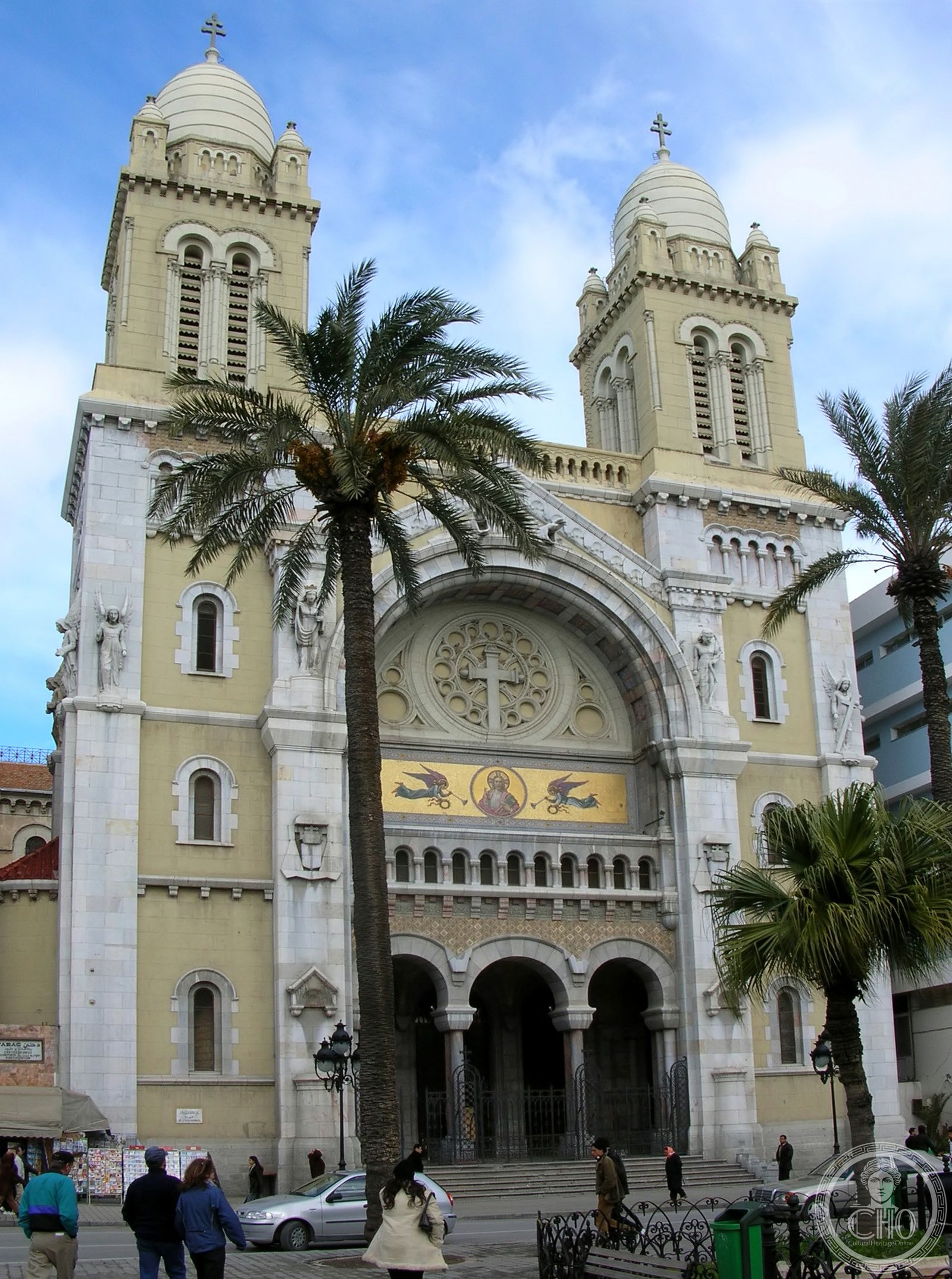
On place de l’Indépendance, in Tunis, the cathedral of Saint Vincent de Paul is the seat of the Catholic archdiocese of Tunis. It stands at the crossing of avenue Habib Bourguiba and avenue de France, opposite the French embassy. Work began in 1893, after the foundation stone was laid in 1890, and the church opened for worship at Christmas 1897, still without its bell towers for want of funds. The two twin towers, crowned by white ribbed domes in a style that blends Moorish, neo-Romanesque and neo-Byzantine influences, were added in 1910, using the Hennebique technique of reinforced concrete. An earlier place of worship had been begun further along the same avenue in 1881 by Cardinal Charles Lavigerie, but the state of the ground made it necessary to replace it. Lavigerie himself, already archbishop of Algiers, had obtained in 1884 from Pope Leo XIII the restoration of the ancient archdiocese of Carthage, of which he became primate of Africa, and had a cathedral built between 1884 and 1890 dedicated to Saint Louis IX of France on the hill of Byrsa, at Carthage, on the spot where the crusader king died in 1270. In 1964, alongside the signing of a modus vivendi between Tunisia and the Holy See which recognises the Catholic Church but forbids the building of new churches, the ringing of bells and any political activity by the Church, the archiepiscopal seat was in effect moved from Carthage to this cathedral in Tunis, which became a territorial prelature. The building at Carthage passed to the Tunisian state and is used today as a concert hall under the name of Acropolium. The circumscription returned to being a diocese in 1995 and was raised again to an archdiocese on 22 May 2010. The Tunisian Catholic community, which counted about 255,000 Europeans, largely Catholic, before independence in 1956, with about two thirds of them emigrating between 1955 and 1959, has shrunk today to about 30,000 people by the most recent estimates. It is made up largely of foreign residents, diplomats, students and sub-Saharan migrant workers, rather than of a native Tunisian Catholic population, out of a national population of about 11.85 million. Since 8 June 2024 the archbishop of Tunis has been Monsignor Nicolas Lhernould, appointed by Pope Francis on 4 April of the same year. According to some tourist sources, not fully borne out, Pope John Paul II visited this cathedral and made an appeal for Christian-Muslim dialogue in North Africa, although the sources differ on the exact year of the visit.
About the Cathedral
The Cathedral of St. Vincent de Paul, on Avenue Habib Bourguiba in central Tunis, is the seat of the Archdiocese of Tunis and Tunisia’s only functioning Catholic cathedral. Built 1893–1897 with twin bell towers added in 1910, it blends Moorish, Neo-Romanesque and Neo-Byzantine architectural influences.
Key facts
- 1893–1897: built, opened for worship at Christmas 1897 without bell towers for lack of funds.
- 1910: twin domed bell towers added using reinforced-concrete construction.
- 1884: Cardinal Charles Lavigerie revives the ancient Archdiocese of Carthage, becoming its Archbishop and Primate of Africa.
- 1964: Tunisia–Holy See Modus Vivendi recognizes the Church but bans new church construction and bell-ringing; the archdiocesan seat effectively moves from Carthage to this cathedral.
- 22 May 2010: circumscription raised back to full Archdiocese of Tunis.
- Today serves an estimated 30,000 Catholics nationwide, mostly foreign residents, down from roughly 255,000 mostly-Catholic Europeans before Tunisian independence in 1956.
History
Built at the height of the French protectorate to serve Tunis’s large European Catholic population, the cathedral outlasted the near-total emigration of that community after independence and a 1964 agreement with the Holy See that froze the Church’s legal position in Tunisia — banning new churches while preserving the handful, including this cathedral, already standing. It absorbed the functional role of the archdiocese’s original, more historically resonant seat at Carthage, whose 1880s cathedral on Byrsa Hill is now a state-owned concert hall rather than a place of worship.
What you see
Twin white-domed bell towers with ribbed, Moorish-influenced cupolas flank a triple-arched entrance beneath a large rose window, faced in mosaic and marble; the interior holds a nave, apse, and stained glass largely intact from the building’s early-20th-century completion.
Practical information
- Opening hours: generally open outside services; check current hours before visiting, as access can vary.
- Address: Place de l’Indépendance, Avenue Habib Bourguiba, Tunis, Tunisia, opposite the French Embassy.
Getting there
The cathedral stands on Tunis’s central boulevard, Avenue Habib Bourguiba, at its junction with Avenue de France. GPS: 36°48′00″N, 10°10′44″E.
Nearby
- Acropolium of Carthage — the archdiocese’s original 1880s cathedral on Byrsa Hill in Carthage, now a state-owned concert venue.
- French Embassy, Tunis — directly opposite the cathedral on Avenue Habib Bourguiba.
Sources
- Wikipedia — “Cathedral of Saint Vincent de Paul,” “Archdiocese of Tunis,” “Archdiocese of Carthage,” “Acropolium of Carthage,” “European Tunisians”
- U.S. State Department — 2022 Report on International Religious Freedom, Tunisia.
- Catholic-Hierarchy.org and GCatholic.org — Archdiocese of Tunis records.
- Aid to the Church in Need (ACN International) — reporting on the Catholic Church in Tunisia.
- Vatican press bulletin — appointment of Archbishop Nicolas Lhernould, 4 April 2024.
Find it on the map
See this place and what’s around it →📷 Become a Cultural Heritage Online photographer
Share your photos of places: they stay published under your name as the author. The more they're seen, the more you get noticed — and soon a contest will reward the most appreciated photos.
Log in or sign up free to add a photo