
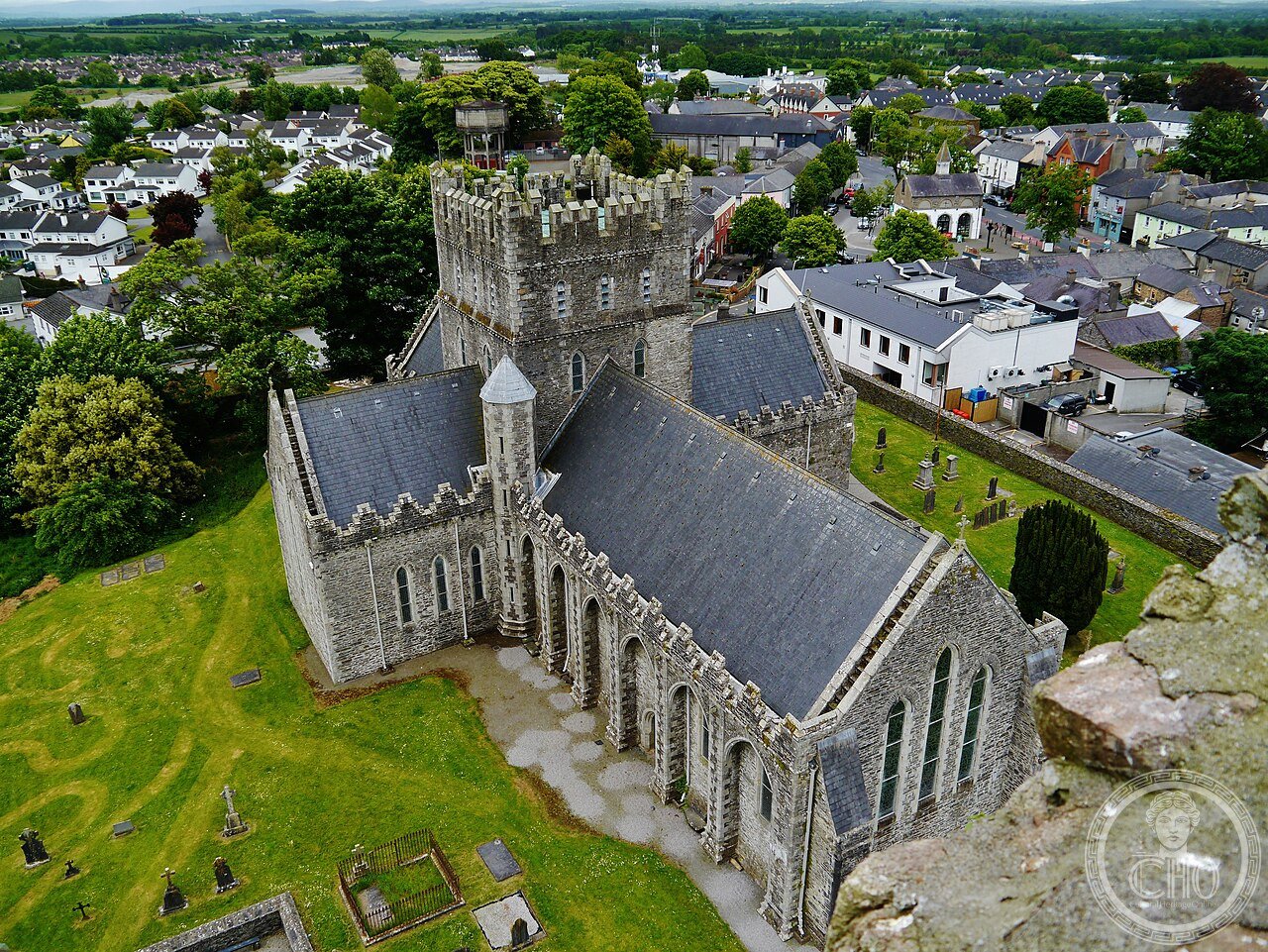
The hill of Kildare was sacred before Christianity arrived: pagan priestesses kept a ritual fire there in honour of the goddess Brigid, protector of the harvest and of poetry. When, around 480, Saint Brigid founded a double monastery of monks and nuns there, she kept that same fire burning — but as the new light of Christianity. Nineteen nuns took turns to guard it, one each night; on the twentieth night the flame was left to Brigid herself. The fire burned almost without interruption until the dissolution of the monasteries in the sixteenth century, and was relit in 1993.
About Saint Brigid’s Cathedral
The hill of Kildare held sacred significance long before the arrival of Christianity in Ireland; scholars suggest that pagan priestesses once gathered there to tend ritual fires while invoking a goddess named Brigid, associated with fertility, wisdom, poetry, and prophecy, in hopes of protecting their herds and securing a fruitful harvest. Around 480, Saint Brigid founded a renowned double monastery at Kildare, housing both monks and nuns under her own leadership as abbess, and the community quickly developed into a significant centre of learning, art — including metalwork and manuscript illumination — hospitality, and spirituality. Central to the monastery’s identity was its perpetual sacred fire, a direct continuation of the site’s earlier pagan fire-tending tradition, now reinterpreted by Brigid and her nuns as a symbol of the new light of Christianity that had reached Ireland’s shores in the early 5th century. In Brigid’s own time, nineteen of her nuns took turns tending the flame, one each night in rotation; on the twentieth night, the fire was left in Brigid’s own personal care. The sacred flame endured for many centuries afterward: the 12th-century Welsh chronicler Gerald of Wales, visiting Kildare, reported that the fire of Saint Brigid was still burning, tended by nuns of her order, and it appears to have continued burning, with only occasional interruptions, right up until the suppression of the Irish monasteries in the 16th century. The tradition lay dormant for centuries afterward, until 1993, when Sister Mary Teresa Cullen, then congregational leader of the Brigidine Sisters, formally re-lit the flame in Kildare’s Market Square; in 2005, Kildare County Council commissioned a dedicated sculpture — a twisted bronze column flourishing into large oak leaves cradling an acorn-cup flame holder — to house the reignited fire permanently in the town.
Key facts
- Pre-Christian era: Kildare hill already sacred to the pagan goddess Brigid
- c. 480: Saint Brigid founds a double monastery of monks and nuns
- The perpetual flame: tended in nightly rotation by nineteen nuns, with Brigid herself on the twentieth night
- 12th century: Gerald of Wales records the flame still burning
- 16th century: the flame’s burning ends with the suppression of the monasteries
- 10th century: the round tower built, Ireland’s second tallest at 33 metres
- 1993: the flame ceremonially re-lit by the Brigidine Sisters
History
The direct continuity between Kildare’s pre-Christian fire-tending rituals and Brigid’s later Christian reinterpretation of the same practice offers one of Irish Christianity’s clearest documented examples of pagan sacred sites and customs being deliberately absorbed and transformed rather than simply destroyed during the island’s conversion — a pattern of religious continuity that historians consider unusually well attested at Kildare compared to most other Irish holy sites. Brigid’s leadership of a double monastery housing both monks and nuns situates her among the most significant female religious leaders of early medieval Christian Europe, her authority over a mixed community reflecting a level of female ecclesiastical power rarely matched in the subsequent history of Western Christianity.
The flame’s documented survival across roughly a millennium, from its pagan origins through Gerald of Wales’s 12th-century eyewitness account to its eventual suppression in the 16th century, and its symbolic modern revival in 1993, gives Kildare an unusually long and continuously traceable thread of sacred fire-tending tradition, rare among European religious sites of any denomination.
What you see
The present cathedral, largely dating to the medieval and later periods, stands beside one of Ireland’s most significant surviving round towers, built in the 10th century and rising 33 metres — the second tallest in the country — with a raised doorway some four metres above ground level, surrounded by ornate Hiberno-Romanesque stonework, its lower courses built of Wicklow granite and its upper portions of local limestone. In Kildare’s Market Square, the modern bronze flame sculpture, commissioned in 2005, houses the re-lit perpetual flame of Saint Brigid.
Practical information
- Opening hours: generally open daily with seasonal variation; check current hours before visiting; small admission fee for the round tower climb
- Address: Market Square, Kildare, County Kildare, Ireland
Getting there
Saint Brigid’s Cathedral is located in the centre of Kildare town, County Kildare, Ireland, easily reachable on foot. GPS: 53.1579° N, -6.9116° E.
Nearby
- Solas Bhríde Centre — a modern centre dedicated to Brigidine spirituality, nearby
- Kildare Market Square — home to the modern flame sculpture
- The Curragh — the historic plain and racecourse near Kildare
Sources
- Solas Bhríde — “The Perpetual Flame” (solasbhride.ie)
- Wikipedia — “Brigid of Kildare” and “Kildare Cathedral” (en.wikipedia.org)
- Voices from the Dawn — “Kildare Round Tower and St. Brigid’s Fire Temple” (voicesfromthedawn.com)
Find it on the map
See this place and what’s around it →📷 Become a Cultural Heritage Online photographer
Share your photos of places: they stay published under your name as the author. The more they're seen, the more you get noticed — and soon a contest will reward the most appreciated photos.
Log in or sign up free to add a photo