
Two Norwegian industrial towns built at the dawn of the 20th century to harness hydroelectric power and fix atmospheric nitrogen — feeding the world, then nearly arming the Third Reich with an atomic bomb.
At a glance
The Rjukan-Notodden Industrial Heritage Site in Telemark County, central Norway, was inscribed as a UNESCO World Heritage Site in 2015. It preserves the complete infrastructure created by Norsk Hydro between 1905 and 1916 to produce synthetic nitrogen fertilizer using hydroelectric power from the Vestfjord and Mana rivers. The ensemble includes the Vemork Hydroelectric Plant (1911), the Notodden Electrolysis Plant, worker housing, railway connections, and the dramatic landscape of the Telemark highlands. Together they tell the story of how Norway industrialised almost overnight — and how one of those facilities became the most strategically vital target in Occupied Europe during the Second World War.
Key facts
- UNESCO inscription: 2015 (Cultural, criteria ii, iv)
- Location: Telemark County, Norway (municipalities of Tinn and Notodden)
- Period: 1905-1971 CE (industrial production); WWII heritage 1942-1944
- Key structure: Vemork Hydroelectric Plant, opened 1911; world’s largest power station at opening
- Scientific first: First industrial-scale electrolytic nitrogen fixation (Frank-Caro process), making synthetic fertilizer globally available
- WWII significance: Heavy water (deuterium oxide) produced at Vemork from the 1930s; used by Nazi Germany for nuclear reactor research; destroyed by Norwegian SOE commandos in Operation Gunnerside, February 1943
- Operator: Norsk Hydro (founded 1905); plant closed 1971
History
In 1905 the Norwegian-German partnership of Sam Eyde and Kristian Birkeland demonstrated that electric arc technology could fix nitrogen directly from the air. Norsk Hydro was founded the same year to scale this process industrially, and chose the Rjukan valley because the Vestfjord waterfall offered sufficient hydraulic head. The Vemork plant opened in 1911 and at once was the world’s largest power station, feeding an electrolysis hall where atmospheric nitrogen was converted into nitric acid and then into calcium nitrate fertilizer. Almost overnight, synthetic fertilizer became available to farmers across the globe — one of the decisive events in the demographic transition of the 20th century.
In the 1930s Vemork added a heavy water production unit as a by-product of its hydrogen generation process. By 1940, German forces had occupied Norway and recognised Vemork as Europe’s only significant source of deuterium oxide, then believed essential for building a nuclear reactor as part of their Uranprojekt (atomic weapons programme). The Allies launched three operations to deny Germany this resource. The first (Operation Freshman, November 1942) ended in disaster when two British gliders crashed in a snowstorm. The second, Operation Gunnerside (February 1943), succeeded: nine Norwegian SOE-trained saboteurs skied through the winter mountain plateau, descended the cliff face above the plant, and destroyed the electrolysis cells without firing a single shot. A subsequent USAAF bombing raid in November 1943 prompted the Germans to order the remaining heavy water evacuated to Germany. In February 1944, Norwegian resistance fighters sank the rail ferry SF Hydro on Lake Tinnsja, sending the last shipment of heavy water to the bottom — definitively ending the German nuclear programme’s access to Norwegian resources.
After the war Vemork was converted to a conventional hydroelectric station. It closed in 1971 and is now the Norwegian Industrial Workers Museum (Norsk Industriarbeidermuseum). The broader industrial landscape was preserved and submitted for UNESCO inscription, which was awarded in 2015 under criteria ii and iv.
What you see
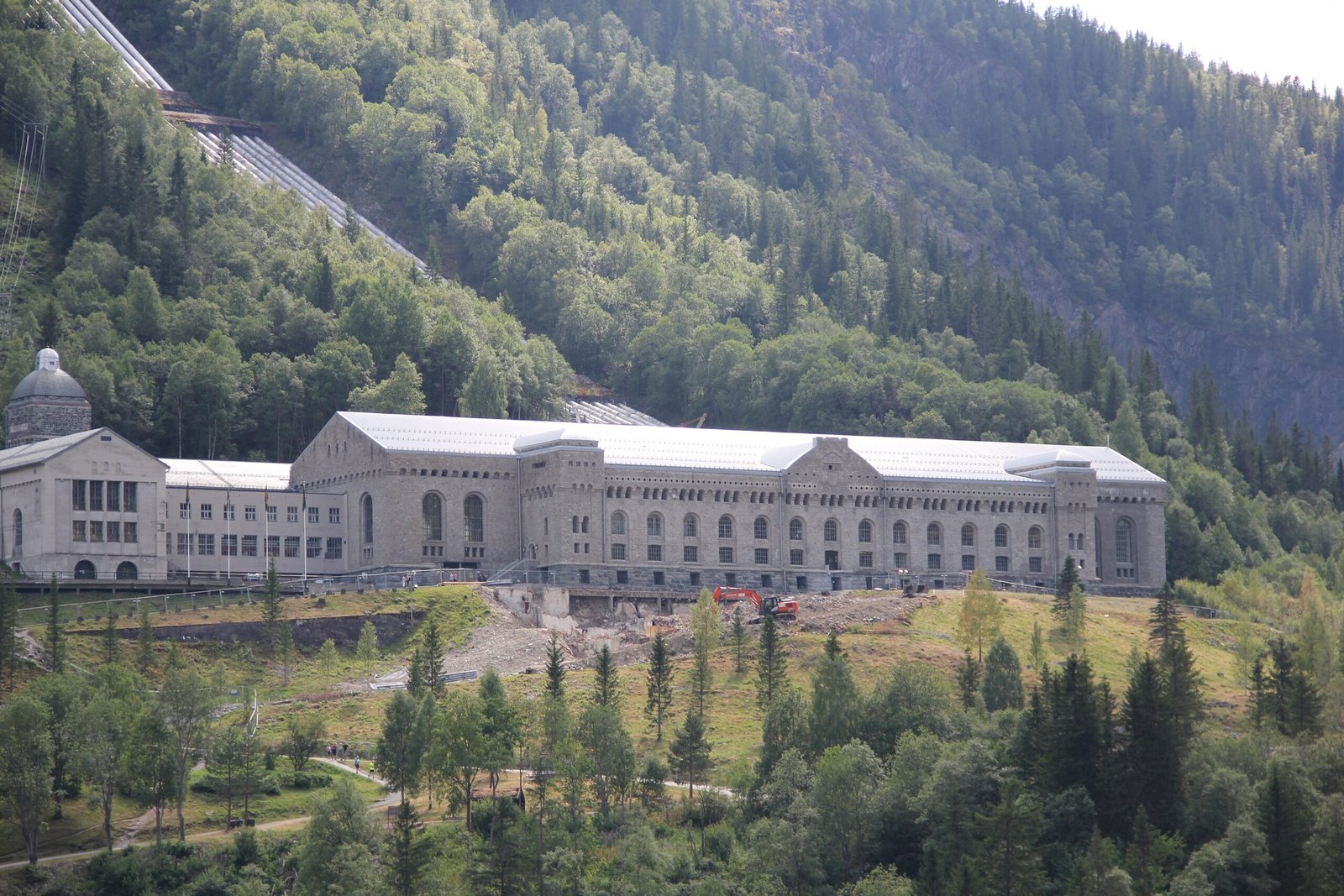
The Vemork plant is a monumental concrete building in a functional industrial style, set on a narrow ledge above the Mana River gorge. Its drama is entirely situational: the building is massive, the cliff is sheer, and the valley below is forested and austere. The original electrolysis hall is preserved inside the museum. The suspension bridge used by the Gunnerside saboteurs has been reconstructed. In Rjukan town itself, the workers’ housing designed by Norsk Hydro architect Haakon Boe survives — rows of company-built terraced houses that represent early 20th-century paternalistic industrial urbanism at its most complete. Notodden, 25 km west, preserves a second set of electrolysis halls (now converted to cultural uses) and the Heddal Stave Church 5 km away (the largest surviving stave church in Norway) adds a medieval counterpoint to the industrial landscape.
Practical information
- Museum: Norsk Industriarbeidermuseum at Vemork — open year-round, reduced winter hours
- Admission: Adults approx. NOK 120; guided tours available (advance booking recommended)
- Season: Best visited May-September; the valley is dramatic in all seasons; winter offers cross-country skiing on the Hardangervidda plateau used by the saboteurs
- Language: Exhibits in Norwegian and English
- Photography: Permitted throughout
Getting there
Rjukan is 175 km west of Oslo by road (E134 / Rv36). By public transport: train to Notodden or Kongsberg, then bus. There is no direct rail to Rjukan; the historic Tinnoset-Rjukan railway (part of the WHS) no longer carries passengers. The Vemork plant is 6 km west of Rjukan town centre; reachable by car or on foot along the old industrial road following the river gorge.
Nearby
- Hardangervidda National Park: The plateau above Rjukan — Norway’s largest national park and the terrain crossed by the Gunnerside commandos
- Gaustatoppen: Norway’s most visited mountain peak, visible from Rjukan
- Heddal Stave Church: 13th-century stave church, Norway’s largest, 30 km east near Notodden
- Lake Tinnsja: The lake where the SF Hydro ferry was sunk in 1944; divers have explored the wreck
Sources
- UNESCO World Heritage List — Rjukan-Notodden Industrial Heritage Site (2015)
- Norsk Industriarbeidermuseum — official site, vemork.no
- Bascomb, Neal. The Winter Fortress (2016) — narrative account of the heavy water sabotage
- Wikipedia EN — Rjukan-Notodden Industrial Heritage Site, Operation Gunnerside, Vemork
Find it on the map
See this place and what’s around it →Historical events at this place (1)
📷 Become a Cultural Heritage Online photographer
Share your photos of places: they stay published under your name as the author. The more they're seen, the more you get noticed — and soon a contest will reward the most appreciated photos.
Log in or sign up free to add a photo