
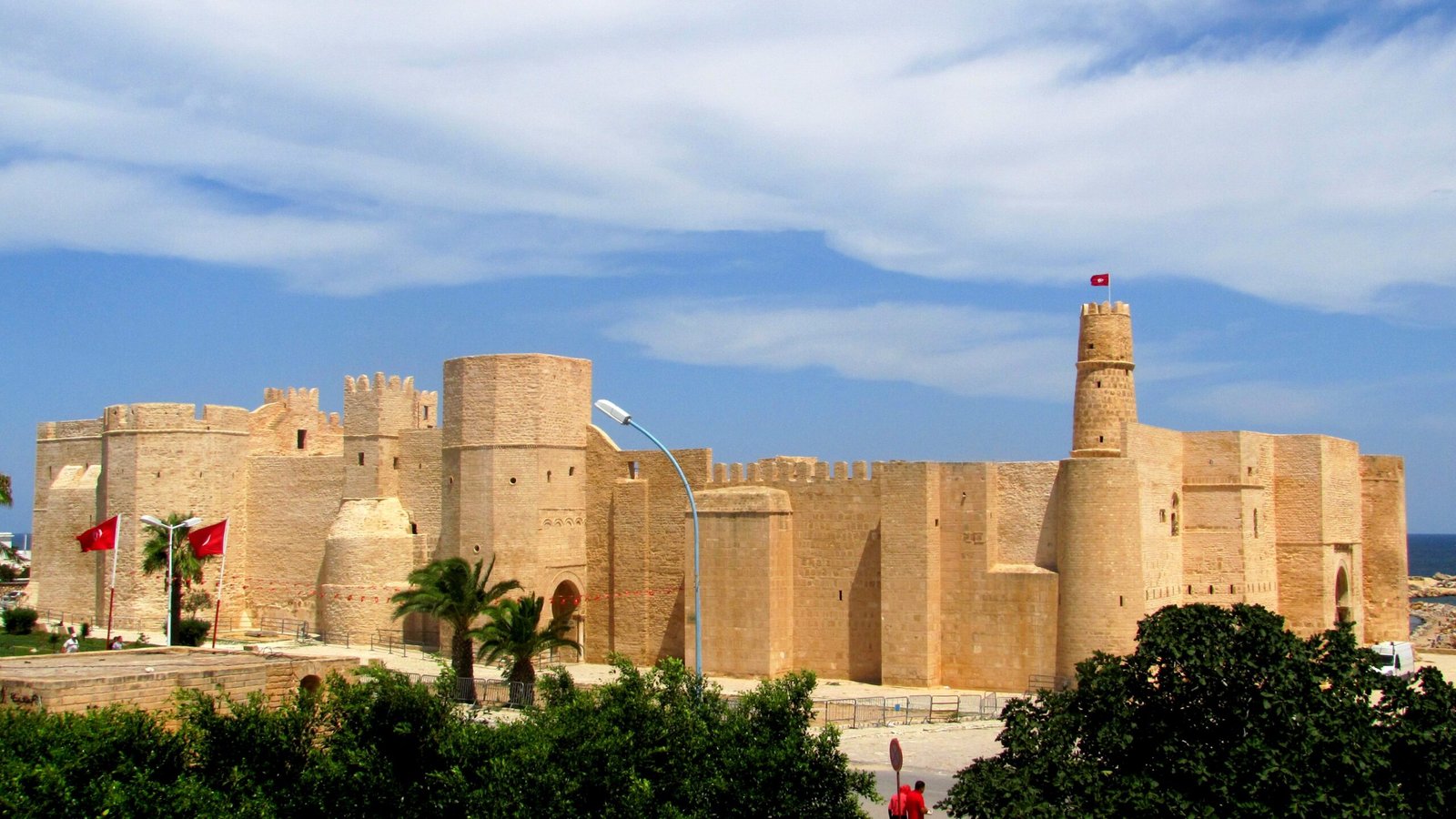
One of the oldest surviving Islamic military-religious fortresses in North Africa — founded in 796 AD as a warrior-monastery on the Byzantine frontier, it became the institutional model for the Crusader military orders, and an unlikely global icon when Terry Jones filmed Monty Python’s Life of Brian here in 1979.
At a glance
On the promontory overlooking the port of Monastir on the central Tunisian coast, the Ribat of Monastir is one of the finest surviving examples of a ribat — the specifically Islamic institution of a fortified monastery where volunteer warriors (murabitun) performed simultaneous military and religious duties, garrisoning the frontier against Byzantine naval raids from Sicily while engaging in prayer, Quranic study, and ascetic practice. Founded in 796 AD by the Abbasid governor Harthama ibn A’yan and significantly enlarged by the Aghlabid dynasty in the 9th century, the ribat preserves an exceptional collection of early Islamic architecture. It achieved a second, improbable form of global fame in 1979 when director Terry Jones used it as the primary location for the Roman Judaea sequences of Monty Python’s Life of Brian — one of the most celebrated comedy films in cinema history.
Key facts
- Founded: 796 AD by Harthama ibn A’yan, Abbasid governor of Ifriqiya
- Expanded: 9th century by Aghlabid dynasty; further works under Ziyarid and Hafsid rulers
- Structure: Rectangular fortress approximately 50 x 50 metres; central courtyard; cells for murabitun
- Tower: Circular nador watchtower approximately 19 metres high
- Film location: Monty Python’s Life of Brian (1979, dir. Terry Jones) and Jesus of Nazareth (1977, dir. Franco Zeffirelli)
- Heritage status: National monument, Tunisia; part of the Medina of Monastir protected zone
- Nearest comparable site: Ribat of Sousse, approximately 25 km north
History
The ribat as an institution emerged in the early Islamic period as a response to the military and spiritual demands of frontier life. Established at strategically critical coastal points, ribats combined the functions of garrison fort, lighthouse, prayer house, and ascetic retreat: the murabitun who garrisoned them were simultaneously soldiers and religious volunteers, earning spiritual merit through service on the frontier. The ribat system, of which Monastir and the neighbouring ribat of Sousse are the finest surviving examples, was the institutional model that historians believe inspired the Christian military orders — the Knights Templar, the Hospitallers, the Teutonic Knights — established during the Crusades: warrior-monks performing religious and military duties simultaneously on a frontier.
The Monastir ribat was founded in 796 AD by the Abbasid governor Harthama ibn A’yan as a defence against Byzantine naval raids from Sicily and the islands, which periodically threatened the North African coast. The Aghlabid dynasty, which ruled Ifriqiya (modern Tunisia) from 800 to 909 AD, significantly enlarged and improved the structure, adding towers, expanding the courtyard cells, and enriching the interior with carved stucco decorations in the sophisticated Aghlabid vocabulary that also produced the Great Mosque of Kairouan. Subsequent rulers including the Ziyarids and Hafsids maintained and modified the complex, and the ribat has survived largely intact to the present day, making it an exceptional witness to early Islamic architecture in North Africa.
Architecture and film legacy
The ribat is a rectangular structure approximately 50 x 50 metres with a central courtyard surrounded on all sides by cells — the individual rooms used by the murabitun warriors for sleeping, prayer, and study. The dominant feature is the circular nador watchtower, approximately 19 metres high, from which the garrison could observe approaching ships and signal the fleet; the tower offers panoramic views over the harbour and the Mediterranean coastline. The interior architectural vocabulary — pointed arches, horseshoe-arch doorways, carved stucco panels — is among the best-preserved examples of Aghlabid Islamic design in North Africa, predating by only a few decades the construction of the Great Mosque of Kairouan in its current form.
The ribat’s crenellated walls, towers, and courtyard achieved unexpected global recognition when director Terry Jones selected Monastir as the primary location for Monty Python’s Life of Brian (1979). The film’s version of Roman Judaea — including the exterior of the Antonia Fortress, the city streets and marketplace, and the crucifixion sequence — was filmed almost entirely at the Ribat of Monastir and the medina of Sousse, with the ribat’s battlements serving as the film’s most recognisable visual backdrop. Two years earlier, Franco Zeffirelli had used the same location extensively for Jesus of Nazareth (1977). The ribat’s architectural ambiguity — formally Islamic but visually evocative of the ancient Mediterranean world — made it uniquely suited to both productions.
Practical information
- Entry: Paid admission; reduced rates for students and children
- Opening hours: Daily, approximately 8:00 to 17:00 (varies seasonally)
- Location: Central Monastir, directly on the seafront; 5 minutes walk from the medina
- Combined visit: Pair with the Great Mosque of Monastir and the Mausoleum of Bourguiba, both within walking distance
- Nearest airport: Monastir Habib Bourguiba International Airport, approximately 8 km
Getting there
Monastir is directly accessible by air from most European cities via Monastir Habib Bourguiba International Airport. From Sousse (approximately 25 km north), local buses and the TGM light rail connect to Monastir frequently. Within the town, the ribat is the dominant landmark on the seafront promontory at the centre of the old city; it is signposted from all approaches and visible from the port and the beach.
Nearby
- Great Mosque of Monastir — Aghlabid foundation, 9th century, adjacent to the ribat
- Mausoleum of Habib Bourguiba — landmark mausoleum of independent Tunisia’s first president, central Monastir
- Ribat of Sousse — companion ribat, approximately 25 km north; also well-preserved
- Medina of Sousse — UNESCO World Heritage Site, used as additional film location for Life of Brian
Sources
- Creswell, K. A. C. (1952). The Muslim Architecture of Egypt. Oxford; foundational comparative study of early Islamic military architecture.
- Marçais, G. (1954). L’Architecture musulmane d’Occident. Paris: Arts et Métiers graphiques.
- UNESCO World Heritage Tentative List: Ribat of Monastir and coastal ribat system of Ifriqiya.
- Chapman, G. et al. (1979). Monty Python’s Life of Brian (film). HandMade Films.
- Institut National du Patrimoine, Tunisia: official site documentation.
Find it on the map
See this place and what’s around it →Historical events at this place (2)
📷 Become a Cultural Heritage Online photographer
Share your photos of places: they stay published under your name as the author. The more they're seen, the more you get noticed — and soon a contest will reward the most appreciated photos.
Log in or sign up free to add a photoIs this page about you?
This page is read by travellers and heritage enthusiasts who find it on Google. Tell us how you are connected to this place and we will take it from there.