
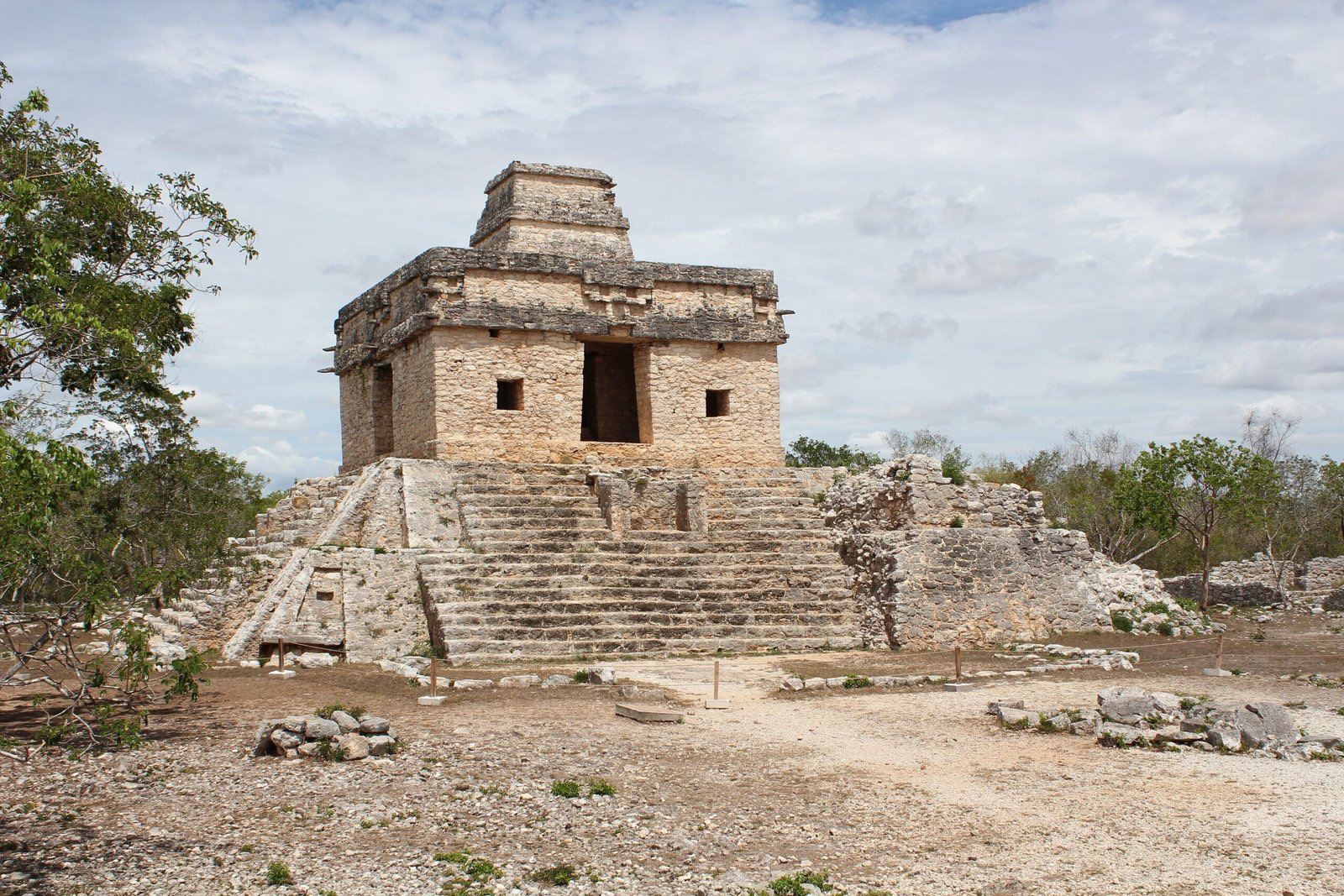
One of the largest and longest-occupied Maya cities ever discovered, Dzibilchaltun is home to the Temple of the Seven Dolls — a structure built so precisely that at every spring and autumn equinox, the rising sun passes directly through its eastern doorway and out through the western one in a perfect astronomical alignment witnessed by thousands of visitors each year.
At a glance
Dzibilchaltun (“place where there is writing on flat stones” in Yucatec Maya) lies approximately 15 km north of Merida in the northern Yucatan Peninsula of Mexico. It was continuously inhabited for over 2,100 years — from around 600 BC until the Spanish colonial period in the 1540s — making it one of the most persistently occupied settlements in the ancient Maya world. The site covers approximately 19 square kilometres and contains over 8,000 mapped structures, ranging from monumental temples and plazas to the residential platforms of ordinary people. A cenote (natural limestone sinkhole) at the site centre provided fresh water throughout its long occupation and served simultaneously as a ritual offering site.
Key facts
- Location: 15 km north of Merida, Yucatan state, Mexico
- Occupied: c. 600 BC to c. 1540 AD — over 2,100 years of continuous occupation
- Size: approx. 19 sq km; over 8,000 mapped structures
- Key monument: Temple of the Seven Dolls — equinox-aligned Early Classic temple (c. 350–600 AD)
- Name origin: Seven ceramic figurines found buried beneath the temple floor during 1958 excavations
- Equinox event: Spring equinox sunrise (~21 March) pierces the temple eastern door and exits the western door in exact alignment
- On-site museum: Museo del Pueblo Maya houses artefacts including the seven dolls themselves
History
The Maya began settling the Dzibilchaltun area around 600 BC during the Preclassic period, drawn by a large cenote that provided reliable fresh water in the otherwise arid limestone plain of northern Yucatan. The site grew steadily through the Classic period (approximately 250–900 AD) into one of the most densely populated cities in the Maya world, with estimates suggesting a peak population of around 20,000 people. During the Early Classic period (c. 350–600 AD), the Temple of the Seven Dolls was constructed at the eastern end of a 420-metre-long sacbe (raised limestone causeway), its architecture deliberately oriented to frame the equinox sunrise. For reasons not fully understood, the temple was subsequently buried under a later construction and lay hidden until its rediscovery in 1958.
Dzibilchaltun survived the broader Maya collapse of around 900 AD that emptied many southern lowland cities, continuing as a regional centre through the Postclassic period. It was still inhabited when the Spanish arrived in Yucatan in the 1520s and 1540s, at which point the city ceremonial life was suppressed and its population absorbed into the colonial order. Systematic archaeological work began in the 1950s under E. Wyllys Andrews IV of Tulane University; the site opened as a national park in 1987.
During the 1958 excavations, archaeologists discovered the seven ceramic figurines buried beneath the floor of the Temple of the Seven Dolls, which gave the temple its modern name. The figurines are bizarrely deformed human representations — curved spines, distended abdomens, crossed eyes, limb abnormalities — interpreted as depictions of people with physical disabilities, deities associated with illness, or votive healing offerings. The originals are displayed in the on-site Museo del Pueblo Maya.
What you see
The Temple of the Seven Dolls is architecturally unusual within the Maya canon. Unlike the typical Maya temple — a solid pyramid crowned by a single-doorway shrine with a roof comb — the Dzibilchaltun temple has doorways on all four cardinal sides, windows in its walls (a rare Maya feature), and a hollow square tower on its roof rather than a solid comb. These features together create a structure that functions as both a solar observatory and a processional shrine: on the equinoxes, the rising sun enters the eastern door and exits through the western door, flooding the temple axis with light. The 420-metre sacbe leading to the temple from the main plaza amplifies the effect by providing a straight sightline for the approaching worshippers.
The main plaza at the site centre is one of the largest in the Maya world, surrounded by administrative and ceremonial platforms and pierced by the Xlacah cenote — 44 metres deep and still filled with clear water, used today as a public swimming area. The cenote yielded thousands of ritual offerings during excavations: jade, obsidian, ceramics, and human skeletal remains dating across many centuries of use. The Museo del Pueblo Maya at the site entrance displays the seven dolls, ceramics, jade ornaments, and architectural fragments recovered from decades of excavation.
Practical information
- Opening hours: Daily 08:00–17:00 (last entry 16:30)
- Entry fee: Approx. 80–95 MXN; cenote swimming included
- Equinox visits: Crowds of several thousand gather before sunrise on ~21 March; arrive by 05:30; no extra ticket required
- On-site museum: Museo del Pueblo Maya — open same hours; included in entry fee
- Facilities: Parking, toilets, small snack stand; no on-site restaurant
- Photography: Permitted throughout; no flash inside museum
Getting there
Dzibilchaltun is approximately 15 km north of Merida along the road to Progreso (Carretera Merida-Progreso). By car: take the Prolongacion Paseo de Montejo north, watch for the signed turnoff to the right after approximately 14 km; the site entrance is about 1 km off the main road. By bus: colectivos toward Progreso depart from the Noreste terminal in Merida (Calle 67 x 50); ask the driver to stop at the Dzibilchaltun crossroads, then walk or take a mototaxi. Taxis from Merida centre cost approximately 200–300 MXN one-way.
Nearby
- Uxmal — Puuc-style Maya city, UNESCO World Heritage Site, 78 km south of Merida
- Chichen Itza — iconic Maya city with El Castillo pyramid and its own equinox light display, 120 km east of Merida
- Merida historic centre — colonial capital of Yucatan, 15 km south
Sources
- Andrews, E.W. IV & Andrews, E.W. V, Excavations at Dzibilchaltun, Yucatan, Mexico, Tulane University, Middle American Research Institute, 1980
- INAH (Instituto Nacional de Antropologia e Historia) — official site designation and visitor information
- Aveni, A.F., Skywatchers of Ancient Mexico, University of Texas Press, 1980
- Wikipedia, “Dzibilchaltun” — general overview and bibliography
- Sprajc, I., “Astronomical alignments at Mesoamerican sites”, Journal for the History of Astronomy, 2001
Find it on the map
See this place and what’s around it →📷 Become a Cultural Heritage Online photographer
Share your photos of places: they stay published under your name as the author. The more they're seen, the more you get noticed — and soon a contest will reward the most appreciated photos.
Log in or sign up free to add a photo