
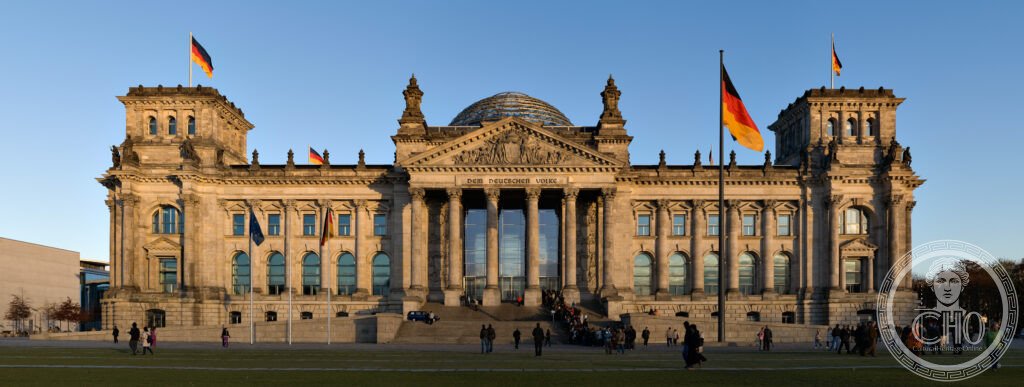
Paul Wallot’s 1894 neo-Renaissance imperial parliament, burned in 1933 and used as a Nazi pretext, then wrapped in silver fabric by Christo in 1995, then crowned with Norman Foster’s glass dome in 1999 — the Reichstag is Europe’s most politically charged building.
At a glance
The Reichstag stands on the Platz der Republik at the bend of the Spree River in central Berlin, its four corner towers and Renaissance Revival facade crowned since 1999 by Norman Foster’s glass dome — a transparent cupola from whose internal spiral ramps visitors look directly down into the Bundestag chamber below. Designed by Paul Wallot and completed in 1894, the building was gutted by fire on 27 February 1933 — an event the Nazis used to suspend civil liberties and consolidate power. Restored in simplified form for the East German period, it was the site of the declaration of German reunification in 1990. Foster’s transformation for the reunified Bundestag (1995–1999) inserted the glass dome as a symbol of democratic transparency: citizens can always look down on their representatives. The dome is open to the public free of charge and is the most visited attraction in Germany.
Key facts
- Original architect: Paul Wallot (1841–1912); Wilhelmine neo-Renaissance; the original dome was destroyed in WWII
- Built: 1884–1894; opened 5 December 1894
- Reichstag fire: 27 February 1933; used by the Nazi government to justify the Reichstag Fire Decree suspending civil liberties
- Christo wrapping: June–July 1995; 100,000 m² of fabric; 5 million visitors in two weeks
- Foster renovation: 1995–1999; glass dome added; plenary chamber rebuilt; officially reopened 19 April 1999
- Glass dome: 23.5 metres in diameter, 47 metres above ground; 360° viewing platform with mirrored light funnel; open daily to the public (free, reservation required)
- GPS: 52.5186° N, 13.3762° E
History
Germany’s first unified imperial parliament building was the product of two decades of political and architectural controversy. After the proclamation of the German Empire in 1871, a competition for a parliament building was held, won by Wallot; construction was delayed repeatedly by Bismarck’s hostility to parliamentary power and Kaiser Wilhelm II’s contempt for the project. The building finally opened in 1894, its neo-Renaissance mass and four-corner tower composition expressing the ambiguous compromise between imperial authority and parliamentary pretension that characterised the German Empire. The inscription above the portico — “Dem Deutschen Volke” (To the German People) — was added not at opening but in 1916, under the pressure of the First World War.
The Reichstag fire of 1933 — whether arson or accident remains disputed by historians — gave the Hitler government the pretext it needed. The Reichstag Fire Decree, issued the next day, suspended the fundamental rights of German citizens and enabled the arrest of political opponents. The building itself was not used again as a parliament until 1990. During the Nazi period it was used for propaganda exhibitions; during the Allied advance it was a fortified military target; after the war it stood half-ruined on the western side of the Berlin Wall, its gutted dome removed and its interior simplified.
The decision to move the German parliament from Bonn back to Berlin after reunification meant that the Reichstag required complete rebuilding for its new function. Foster + Partners won the competition; their solution preserved Wallot’s exterior facade largely intact while reconstructing the interior and adding the glass dome. The dome’s cone of mirrors reflects natural light down into the plenary chamber; visitors on the spiral ramps look through the floor into the chamber where the Bundestag sits. The symbolism was explicit: transparency and public oversight as architectural programme.
What you see
The west facade on the Platz der Republik presents Wallot’s original composition intact: a central projecting pavilion with four Corinthian columns and a triangular pediment, flanked by long wings terminating in four-storey corner towers. The rusticated base, the arched windows of the main floor, and the attic storey with its sculptural programme are all 1894 fabric. Above this rises Foster’s dome — glass and steel, its double helix of ramps visible through the transparent skin, the whole glowing like a lamp after dark.
Inside the dome, the ramps spiral to a viewing platform at the top; the mirrored cone at the centre bounces sunlight down into the chamber and acts as a thermal exhaust chimney. From the ramp, the view through the glass floor into the plenary chamber is the building’s essential democratic gesture. Surrounding Berlin — the Brandenburg Gate 200 metres west, the Spreebogen government quarter, the Tiergarten — is visible in a 360-degree panorama. Admission to the dome is free but requires a reservation made through the Bundestag website.
Practical information
- Address: Platz der Republik 1, 11011 Berlin, Germany
- Dome visits: open daily 8 am–midnight (last entry 10 pm); free but reservation required at bundestag.de/en/visitthebundestag
- Guided tours: guided visits of the plenary chamber and building available; book well in advance (weeks to months for English tours)
- Security: document check and airport-style security for all visitors; bring passport or national ID
- Time needed: 45–75 minutes for dome visit; 2–3 hours for guided tour
Getting there
The Reichstag is on the Platz der Republik, five minutes on foot from the Brandenburg Gate. S-Bahn and U-Bahn: Brandenburger Tor station (S1/S2/S25/U55) is a ten-minute walk. Bus 100 and 200 stop at the Brandenburg Gate. Berlin Brandenburg Airport (BER) is 30 km south-east; S-Bahn takes 45 minutes to city centre. GPS: 52.5186, 13.3762.
Nearby
- Brandenburg Gate — the 1791 Neoclassical gateway, the symbol of Berlin and German reunification; five minutes on foot west
- Holocaust Memorial (Memorial to the Murdered Jews of Europe) — Peter Eisenman’s 2005 field of 2,711 concrete stelae; ten minutes on foot south
- Tiergarten — Berlin’s central park, adjacent west; the Victory Column (Siegessäule) is 15 minutes on foot
- Museum Island (Museumsinsel) — Berlin’s UNESCO WHS museum complex (Pergamon, Bode, Neues Museum, etc.); 20 minutes east on foot or by tram
Sources
- Wikipedia, Reichstag building, accessed June 2026
- Official Bundestag visitor information: bundestag.de
- Foster + Partners, Reichstag project documentation, 1999
- Ian Buruma, The Wages of Guilt: Memories of War in Germany and Japan, 1994 — on German political memory and the Reichstag
Find it on the map
See this place and what’s around it →📷 Become a Cultural Heritage Online photographer
Share your photos of places: they stay published under your name as the author. The more they're seen, the more you get noticed — and soon a contest will reward the most appreciated photos.
Log in or sign up free to add a photoIs this page about you?
This page is read by travellers and heritage enthusiasts who find it on Google. Tell us how you are connected to this place and we will take it from there.