
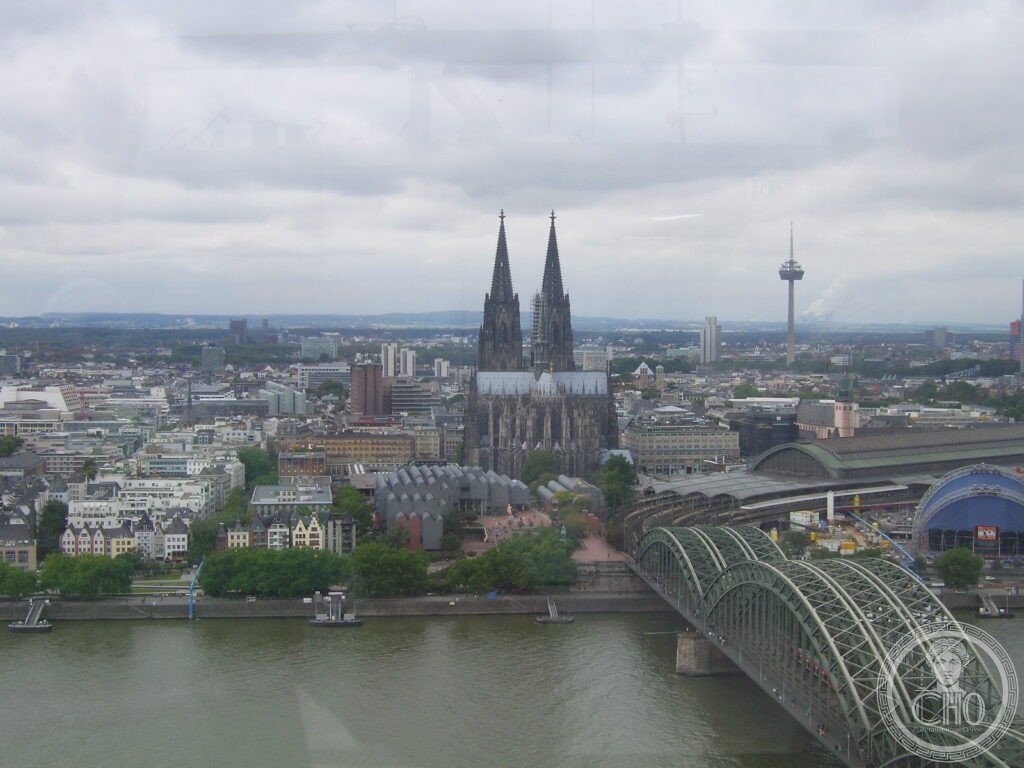
Six centuries and 32 years in the making — Cologne Cathedral began in 1248, stalled for 300 years as Europe ran out of money and ambition, resumed in 1842 at the height of the Gothic Revival, and finally finished in 1880 to become, briefly, the tallest building on earth.
At a glance
The Cologne Cathedral (Kölner Dom) rises above the Rhine on the west bank at Cologne’s central station, its twin spires reaching 157 metres and constituting the largest Gothic cathedral facade in the world. Construction of the current building began in 1248 under Master Gerhard, who designed the choir in the French High Gothic tradition of Amiens and Beauvais; the choir was consecrated in 1322 and the south tower’s stump rose during the following two centuries before work halted entirely in 1560, leaving a construction crane sitting atop the incomplete tower for nearly 300 years. The building was completed between 1842 and 1880 using the original 13th-century plans, recovered in Vienna in 1814, as the Neo-Gothic movement provided both the ideological motivation and the engineering resources to finish the project. At its 1880 completion the twin spires were the tallest man-made structures in the world, a title held for four years until the Washington Monument was completed in 1884. The Cologne Cathedral was inscribed as a UNESCO World Heritage Site in 1996.
Key facts
- Construction: 1248–1322 (choir and south aisle); halted c. 1560; resumed 1842; completed 4 October 1880
- Total construction time: 632 years — the longest of any major Gothic cathedral
- Architects (original): Master Gerhard (choir, 1248); subsequent master builders through 1560
- Architects (completion): Ernst Friedrich Zwirner (1842–1861); Richard Voigtel (1861–1902); following 13th-century original plans
- Height: 157.4 metres (south spire); world’s tallest structure 1880–1884
- Style: High Gothic; choir directly influenced by Amiens Cathedral; twin-tower facade follows the original 13th-century design drawings
- Heritage: UNESCO World Heritage Site, inscribed 1996; on the World Heritage in Danger list 2004–2006
- GPS: 50.9413° N, 6.9583° E
History
The decision to build a new cathedral at Cologne was motivated in part by the acquisition in 1164 of what were presented as the relics of the Three Magi — the kings who visited the infant Christ — making Cologne a major pilgrimage destination. Archbishop Konrad von Hochstaden laid the foundation stone in 1248. Master Gerhard’s design drew directly on the French High Gothic at its peak: Amiens Cathedral (begun 1220) had established the vocabulary of soaring nave elevation, flying buttresses, and vast stained-glass windows that the Cologne choir developed further. The choir was consecrated in 1322; the south tower stump rose to about 59 metres during the 14th and 15th centuries before construction slowed and halted in 1560, when the resources of the Catholic Church — bankrupted by the Reformation and the subsequent religious wars — were no longer available for major building programmes.
The building sat incomplete for nearly three centuries, the construction crane on the south tower becoming a Cologne landmark in its own right. In 1814, a researcher at the Paris Bibliothèque nationale discovered the original 13th-century architectural drawings for the west facade — a find of extraordinary significance that made it possible to complete the cathedral exactly as its original designers had intended. The Romantic movement’s enthusiasm for medieval architecture, combined with the political mobilisation of German nationalist feeling around the cathedral as a symbol of German unity, produced the necessary funding. Construction resumed in 1842, with state support from the Prussian government and public subscription.
The completion in 1880, marked by a ceremony attended by Kaiser Wilhelm I, made Cologne Cathedral the tallest structure in the world for the first time. The building survived the Second World War with remarkable intactness: Allied bombers, using the twin spires as a navigation landmark, deliberately avoided hitting the cathedral. The surrounding city was almost entirely destroyed; the cathedral stood in a field of rubble. Post-war repairs restored the medieval interior; the UNESCO listing in 1996 recognised the building’s exceptional cultural significance, and the building was added to the Danger list in 2004 when the city proposed tall buildings in the cathedral’s viewshed — a threat withdrawn after the listing.
What you see
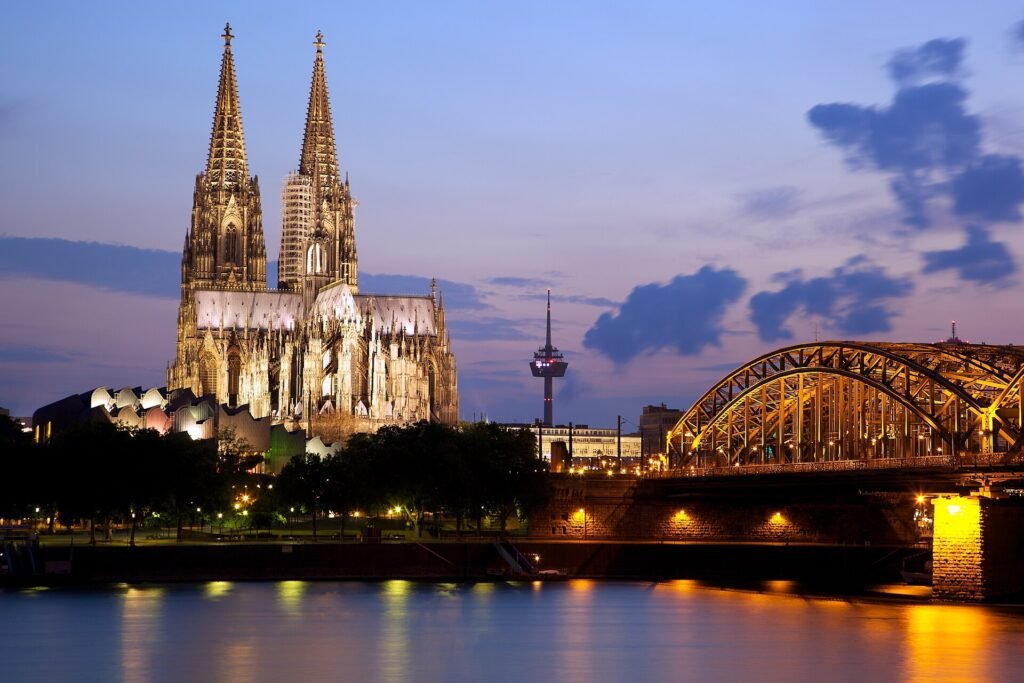
The west facade — the most photographed in Germany — presents twin spires of openwork stone tracery, their surfaces covered in Gothic pinnacles, crockets, and foliate carving. The central portal between the towers carries a 19th-century carved tympanum above three deeply recessed archivolts; the tympanum programme depicts the Last Judgment, Christ enthroned, and the Virgin. The nave exterior, visible from the south approach from the Rhine, presents the system of double flying buttresses that allow the nave walls to be almost entirely window — the High Gothic solution to the problem of creating maximum glass surface without structural failure.
Inside, the nave is 144 metres long, 45 metres wide, and 43 metres high — the proportions of a French High Gothic cathedral replicated exactly in 19th-century German stone. The clerestory windows, 19 metres high, filter the light to a cool, even grey-blue characteristic of Gothic interiors with unpainted glass. The choir, the oldest part of the building, retains its original medieval stalls and the Shrine of the Three Magi — a 12th-century gold reliquary considered the largest golden shrine in the western world. The south transept houses the famous Gero Cross, a 10th-century large-scale crucifix that is among the oldest monumental sculptures of Christ in existence.
Practical information
- Address: Domkloster 4, 50667 Cologne, Germany
- Hours: Cathedral open daily 6 am–9 pm (shorter hours during services); treasury and tower separate admission
- Admission: Cathedral free; treasury EUR 6; tower climb EUR 5 (533 steps to the south tower)
- Services: regular Catholic services throughout the day; silent prayer zones marked
- Time needed: 1–1.5 hours for interior; 2–3 hours with tower and treasury
Getting there
Cologne Cathedral is immediately adjacent to Cologne Hauptbahnhof (central station), one of the busiest railway junctions in Germany. ICE trains connect Cologne to Frankfurt (1 hour), Brussels (1.5 hours), Amsterdam (2.5 hours), and Paris (3 hours). Cologne/Bonn Airport is 17 km east; S-Bahn connects in 15 minutes. GPS: 50.9413, 6.9583.
Nearby
- Museum Ludwig — one of Europe’s leading collections of 20th-century art, including the largest Picasso collection outside Spain, five minutes on foot east of the cathedral
- Hohenzollern Bridge — the railway bridge over the Rhine covered in padlocks; view of the cathedral from across the river
- Old Town (Altstadt) — the medieval city centre with Romanesque churches, Brauhaus beer halls, and the Cologne Carnival; five minutes on foot south
- Chocolate Museum — the Lindt-Chocolate Museum on the Rhine promenade; ten minutes south on foot
More photographs
Sources
- Wikipedia, Cologne Cathedral, accessed June 2026
- Official cathedral website: koelner-dom.de
- UNESCO, Cologne Cathedral, WHS reference 292, inscribed 1996
- Otto von Simson, The Gothic Cathedral: Origins of Gothic Architecture and the Medieval Concept of Order, Princeton, 1956
Find it on the map
See this place and what’s around it →
📷 Become a Cultural Heritage Online photographer
Share your photos of places: they stay published under your name as the author. The more they're seen, the more you get noticed — and soon a contest will reward the most appreciated photos.
Log in or sign up free to add a photoIs this page about you?
This page is read by travellers and heritage enthusiasts who find it on Google. Tell us how you are connected to this place and we will take it from there.