

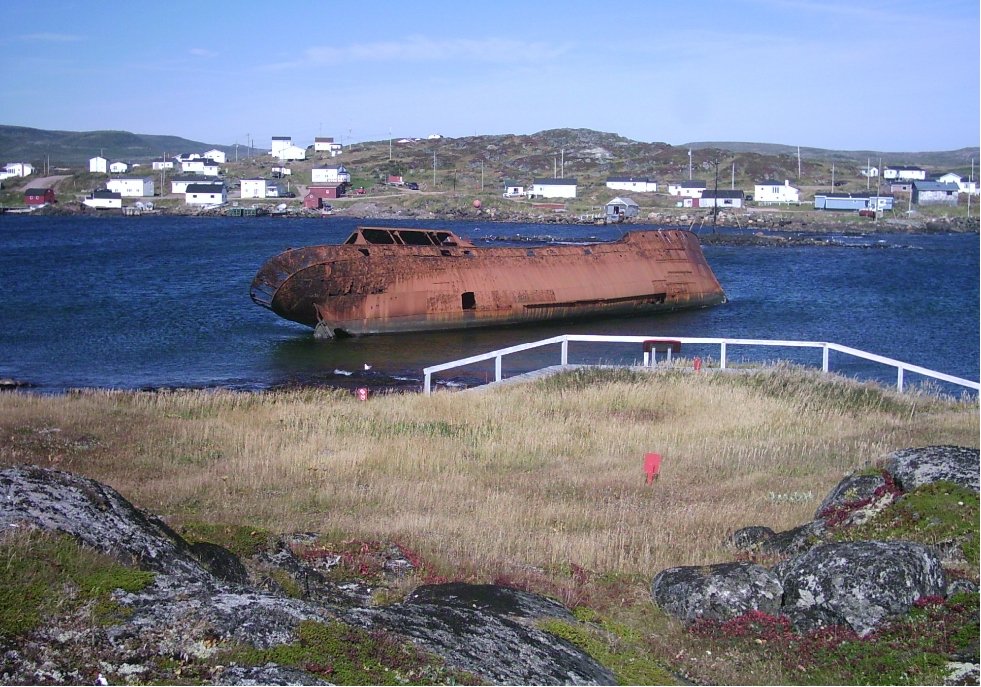
The best-preserved example of a 16th-century European industrial complex in the Americas — a Basque whaling station that employed over 1,000 workers each summer at its peak, operated the largest commercial enterprise in early North America, and sank into the icy harbour of Labrador in 1565 with its cargo of whale oil still sealed inside.
At a glance
Red Bay, on the Labrador coast of Newfoundland and Labrador, was the epicentre of the Basque whaling industry in the 16th century — an operation that was far larger, more organised, and more economically significant than historians had suspected before Parks Canada’s excavations began in 1977. At its peak around 1550–1590 CE, approximately 1,000 Basque workers arrived each summer from the fishing ports of the Basque Country (principally from the area around San Sebastian in what is now northern Spain and southern France) to hunt bowhead and right whales in the cold, whale-rich Strait of Belle Isle. The site was inscribed as a UNESCO World Heritage Site in 2013.
Key facts
- UNESCO inscription: 2013 (Cultural)
- Active period: c. 1530–1600 CE
- Peak workforce: ~1,000 Basque workers per summer
- Product: Whale oil (for lighting, lubrication, soap, and paint across Europe)
- Wrecks identified: 5 Basque galleons in the harbour (including the San Juan, 1565)
- Excavation began: 1977, Parks Canada
- Key artefact: Whale oil barrels still intact underwater in the San Juan wreck
- Administered by: Parks Canada
- Nearest town: Red Bay, Labrador (pop. ~200)
The forgotten industry that lit Europe
Before the 16th century, European demand for whale oil was modest and the industry small-scale. The Basques changed that. Skilled whalers from the fishing communities of the western Pyrenees — the same seafarers who had hunted whales in the Bay of Biscay for centuries — realised that the cold, nutrient-rich waters of the Strait of Belle Isle (between Newfoundland and Labrador) were filled with bowhead and right whales on their migration routes. By approximately 1530 CE, the first Basque whaling expeditions were making the crossing.
What they built at Red Bay was not a colony or a settlement in the conventional sense but a seasonal industrial operation of extraordinary scale. Ships arrived from the Basque Country in spring carrying workers, supplies, equipment, and the massive iron try-works — rendering furnaces — needed to process whale blubber into oil. Through the summer and early autumn, hunting crews in small open boats called chalupas would pursue and harpoon whales, tow them back to Saddle Island (the main processing site in Red Bay harbour), and render the blubber into oil in the try-works. The oil was stored in wooden barrels made on site by Basque coopers, then loaded into the galleons for the return crossing to Europe.
At its peak, the Red Bay operation was shipping approximately 500,000 litres of whale oil to Europe each year — oil that fuelled the streetlamps of Paris, London, and Antwerp; lubricated the machinery of the early industrial revolution; and went into the soap and paint used across the continent. Red Bay was, in a very real sense, the energy industry of 16th-century Europe.
The operation began to decline after 1580 CE. The whales were becoming scarce, the Spanish Armada disaster of 1588 devastated Basque seafaring, and competition from Dutch and English whalers was intensifying. By 1600 CE, the Red Bay station had been abandoned. For nearly four centuries, its existence was largely forgotten — reduced to references in old Basque port records and the name Buttes that 18th-century maps gave to the area around the Strait of Belle Isle.
The excavation
The rediscovery of Red Bay began in 1977 when Parks Canada archaeologist Selma Barkham, following references in Basque notarial archives, identified Red Bay as the site of a major 16th-century whaling station. The excavations that followed — both on land and underwater — produced one of the most significant archaeological discoveries in North American history.
Underwater, archaeologists discovered five Basque galleons on the harbour floor. The most intact, the San Juan (sunk 1565), was found with its cargo of whale oil barrels still sealed and intact underwater after four centuries — an archaeological miracle made possible by the cold, dark harbour conditions. The wreck yielded a complete picture of a 16th-century merchant vessel: hull construction, rigging, cargo arrangement, and personal possessions of the crew.
On Saddle Island, excavations revealed the try-works (the rendering furnaces, still showing heat damage in their stone bases), the cooperage where barrels were made, worker quarters, a cemetery with graves of Basque workers who died during the season (some showing evidence of whale-hunting injuries), and thousands of artefacts including pottery, tools, clothing fragments, and domestic objects brought from the Basque Country.
A memorial cross recovered intact from the site, dated 1550–1600 CE, represents one of the earliest European religious objects yet found in North America.
What you see today
The Red Bay National Historic Site visitor centre in the village of Red Bay presents the full archaeological story, with artefacts recovered from both the underwater and onshore excavations. A replica chalupa (the traditional Basque whaling boat) is displayed. The centre also shows the conserved remains of the San Juan wreck (the actual timbers, preserved after excavation).
Boat tours cross the harbour to Saddle Island, where Parks Canada maintains a walking trail past the site of the try-works, the cooperage, the worker quarters, and the cemetery. The stone bases of the try-works are visible; interpretive panels explain the whaling process at each location. The island’s position in the harbour — sheltered from the Atlantic swells but open to the cold Labrador current — makes it easy to understand why Basque captains chose this spot five centuries ago.
Practical information
- Visitor centre: Red Bay, Labrador; open mid-June to early October
- Hours: Typically 9:00–17:00 (confirm with Parks Canada)
- Entry fee: Yes (National Historic Site admission); check pc.gc.ca
- Saddle Island boat tours: Depart from the visitor centre; weather-dependent
- Best season: July–August (most services open, best weather)
- Administered by: Parks Canada — pc.gc.ca/redbay
Getting there
Red Bay is located on the Labrador coast of the Trans-Labrador Highway (Route 510), approximately 430 km east of Labrador City. The drive from Blanc-Sablon (the Quebec-Labrador border, accessible by ferry from St. Barbe, Newfoundland) takes approximately 2 hours on a gravel highway. There is no rail or bus service; a rental car or self-drive is essential. The nearest airports with scheduled service are Wabush (near Labrador City) and Blanc-Sablon. Most visitors approach via the Newfoundland ferry from the island’s Northern Peninsula.
Nearby
- L’Anse aux Meadows — the only confirmed Norse settlement in North America (UNESCO 1978), approximately 250 km south on the Great Northern Peninsula of Newfoundland
- Forillon National Park — Gaspé Peninsula, Quebec, across the Gulf of St. Lawrence
- Pinware River Provincial Park — Atlantic salmon fishing on the Labrador coast
- Battle Harbour — restored 19th-century saltfish trading post on a Labrador island; accessible by boat from Mary’s Harbour
Sources
- UNESCO World Heritage List — Red Bay Basque Whaling Station: whc.unesco.org/en/list/1412
- Parks Canada — Red Bay National Historic Site: pc.gc.ca/redbay
- Wikipedia — Red Bay Basque Whaling Station: en.wikipedia.org/wiki/Red_Bay_Basque_Whaling_Station
- Selma Barkham, The Documentary Evidence for Basque Whaling Ships in the Strait of Belle Isle, in C. Early (ed.), Early European Settlement and Exploitation in Atlantic Canada (1982)
Find it on the map
See this place and what’s around it →📷 Become a Cultural Heritage Online photographer
Share your photos of places: they stay published under your name as the author. The more they're seen, the more you get noticed — and soon a contest will reward the most appreciated photos.
Log in or sign up free to add a photo