

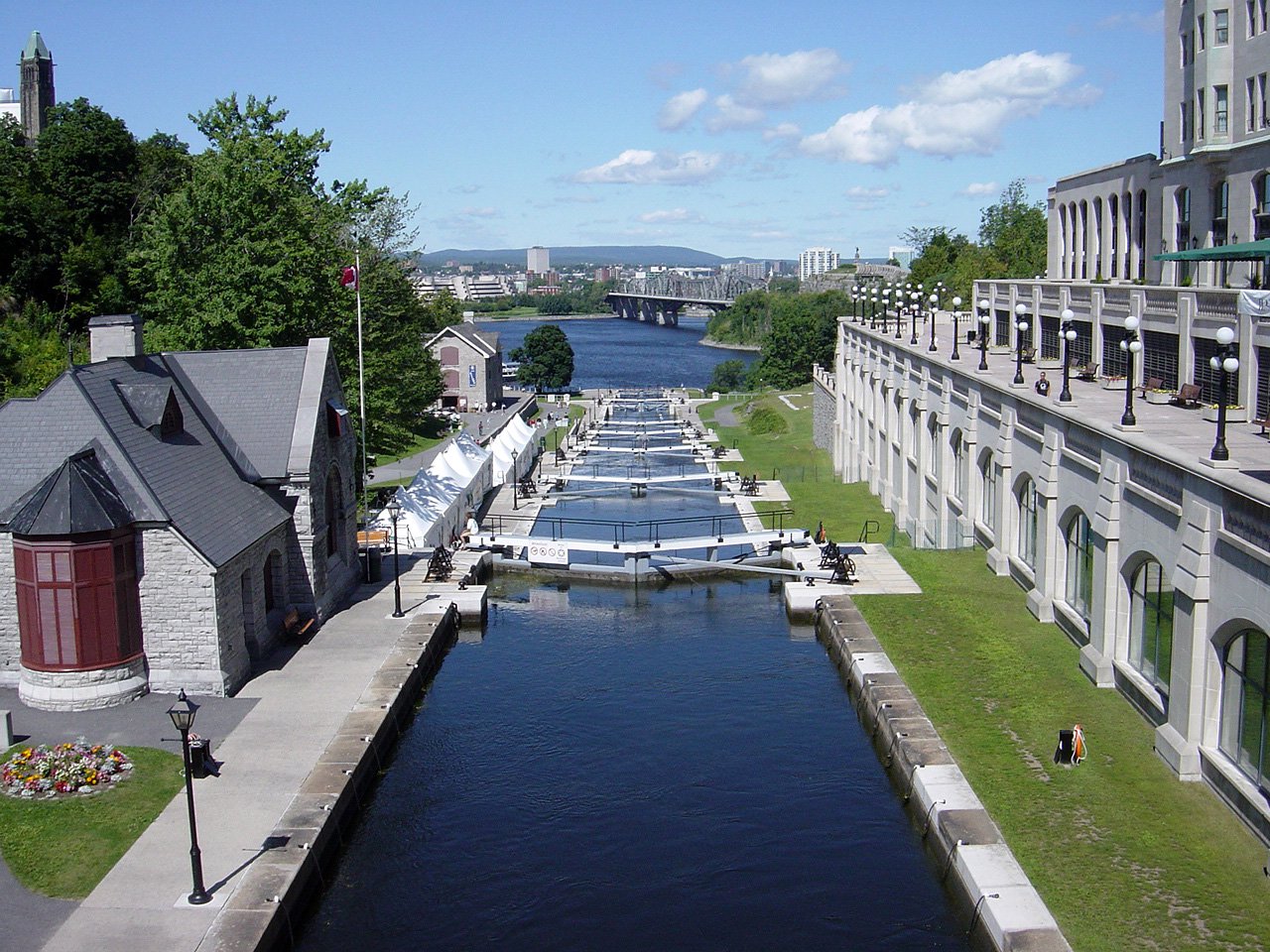
A 202 km military waterway built by the British Royal Engineers (1826–1832) that was never needed for war — and became instead one of North America’s great heritage corridors, culminating in the world’s largest naturally refrigerated skating rink.
At a glance
The Rideau Canal links Ottawa (Canada’s capital) to Kingston on Lake Ontario through 47 hand-operated locks, 24 control dams, and a chain of rivers and lakes stretching 202 km. Inscribed as a UNESCO World Heritage Site in 2007, it is the oldest continuously operating canal system in North America. Built in response to the vulnerability exposed during the War of 1812, it was never used for its intended military purpose — but served for over a century as a commercial artery for timber, grain, and passengers, and today draws visitors year-round.
Key facts
- UNESCO inscription: 2007 (Cultural)
- Total length: 202 km
- Number of locks: 47 (in 24 lock stations)
- Built: 1826–1832 CE
- Engineer: Lt. Col. John By, Royal Engineers
- Purpose: Military bypass route (War of 1812 aftermath)
- Winter attraction: 7.8 km skating rink (~1 million skaters/year)
- Operating since: 1832 — the same hand-operated mechanisms still in use
- Administered by: Parks Canada
Why it was built — and why it was never used
The War of 1812 exposed a critical weakness in British North America: the St. Lawrence River, the main supply line from the Atlantic to the interior, ran dangerously close to the US border. American raiders had demonstrated they could sever this artery at will. The British response was to commission an alternative route — an inland canal running north from Kingston through the interior of Upper Canada to the new town of Bytown (now Ottawa), then down the Ottawa River to the St. Lawrence above Montreal.
Lt. Col. John By of the Royal Engineers arrived in 1826 to begin the project. It was the largest construction undertaking in British North American history. Working with approximately 2,000 labourers per year — Irish and French-Canadian men — By’s teams carved locks out of solid granite, built masonry dams across rivers, and dug channels through wilderness. The human cost was severe: the low-lying sections near Kingston were malarial, and hundreds of workers died from swamp fever during construction.
The canal opened in 1832. By then, the strategic situation had changed completely. The Rush-Bagot Agreement (1817) had demilitarised the Great Lakes, and the prospect of renewed US-British conflict in North America had faded rapidly. The canal was never used militarily. John By returned to England, was called before a Parliamentary inquiry over cost overruns, and died in 1836 having never received the official recognition his achievement deserved.
Instead of military convoys, the canal carried timber rafts and grain barges. The town of Bytown grew up around the construction camps and the canal head; it was renamed Ottawa in 1855 and became the national capital in 1857. The Rideau Canal’s eight Ottawa locks — still hand-operated today — cascade up the hill directly below the Parliament Buildings, an extraordinary piece of living infrastructure at the heart of Canada’s capital.
What you see today
The Rideau Canal’s 47 locks are distributed across 24 lock stations along the 202 km route. Many are built of hand-cut limestone blocks; most retain their original 1830s machinery — wooden lock gates operated by hand-cranked mechanisms that visitors can watch (and sometimes help operate). The lock chambers are 41 metres long and 10 metres wide — designed for the largest vessels of the 1820s.
In Ottawa, the canal passes directly through the urban core. The eight Rideau Locks below Parliament Hill are the most photographed; in summer they are busy with pleasure boats, and the commissioner’s house (1827) nearby is the oldest surviving structure in Ottawa. The Bytown Museum beside the locks presents the canal’s construction history in detail.
Along the route, the canal passes through a varied landscape: the dramatic Rideau Falls where the Rideau River meets the Ottawa River; the limestone ridges and lakes of the Canadian Shield; the historic town of Merrickville (whose four-lift lock is one of the most complex on the system); and Kingston at the southern terminus, where the canal meets Lake Ontario at Kingston Mills.
In winter, the Ottawa section of the canal (approximately 7.8 km from the National Arts Centre to Dow’s Lake) is maintained as a skating rink — the world’s largest naturally refrigerated ice surface. The National Capital Commission floods the path, monitors the ice thickness, and installs warming huts and skate-rental facilities. On a clear February morning, Ottawa commuters skate to work past the spires of Parliament Hill in a scene that has become emblematic of the Canadian capital.
Why this canal matters
The Rideau Canal is an outstanding example of 19th-century canal technology and military engineering — one of the last great works of this kind built before the railway made canals obsolete. Its UNESCO inscription in 2007 recognised both its outstanding universal value as a piece of intact heritage infrastructure and its status as an exceptionally well-preserved example of a slackwater canal.
Unlike many canals that were converted, drained, or demolished when commerce shifted to rail, the Rideau has operated continuously since 1832 — using the same hand-operated lock mechanisms, maintained by the same federal agency (Parks Canada since 1972), still carrying boats through the same masonry chambers. The 202 km corridor also preserves significant natural heritage: the chain of lakes and wetlands along the route supports exceptional biodiversity, and the canal banks in Ottawa are among the most visited green spaces in Canada.
The canal also carries a political significance unique in heritage terms: it was built by one empire as a military weapon against another, and became instead the arterial infrastructure of a peaceful nation. The great irony — that the most expensive military construction project in British North American history was never used for military purposes — is part of its story.
Practical information
- Canal navigation season: Mid-May to mid-October (weather dependent)
- Skating season: Typically January–February (ice conditions permitting)
- Lock operating hours: 8:00–19:30 (summer season)
- Lockage fees: Required for boats transiting the canal; free for pedestrian viewing
- Bytown Museum: 1 Canal Lane, Ottawa; daily 10:00–17:00 (May–October)
- Skating entry: Free; skate rental available at Dow’s Lake and elsewhere
- Administered by: Parks Canada — parkscanada.gc.ca
Getting there
The canal’s Ottawa terminus is steps from the city centre. The Rideau Locks and Bytown Museum are located on the west bank of the canal below Parliament Hill, accessible on foot from Bank Street Bridge or from Major’s Hill Park. The nearest transit is O-Train Line 1 (Confederation Line) at Rideau Station (east bank) or Parliament Station (west bank, under construction). The Rideau Centre mall and the ByWard Market are immediately adjacent on the east bank.
For the full 202 km waterway experience, houseboat and cruiser rentals are available at multiple points along the canal in summer. Kingston Mills (the southern terminus, near Kingston) is accessible from Highway 15. Heritage boating cruises depart from Ottawa and from Merrickville. Heritage walking and cycling trails follow sections of the towpath.
Nearby
- Parliament Hill — directly above the Rideau Locks; Canada’s federal parliament buildings on the Ottawa bluffs
- ByWard Market — Ottawa’s historic market district, 10 minutes’ walk from the locks
- Canadian Museum of History — Gatineau, across the river; one of Canada’s foremost history museums
- Kingston — historic limestone city at the canal’s southern terminus; 19th-century fortifications, Queens University
- Merrickville — Jewel of the Rideau: a 19th-century canal town with blockhouse, heritage mills, and artists’ studios
Sources
- UNESCO World Heritage List — Rideau Canal: whc.unesco.org/en/list/1221
- Parks Canada — Rideau Canal National Historic Site: pc.gc.ca/rideau
- Wikipedia — Rideau Canal: en.wikipedia.org/wiki/Rideau_Canal
- Bytown Museum, Ottawa (interpretive content on Lt. Col. By and construction history)
Find it on the map
See this place and what’s around it →📷 Become a Cultural Heritage Online photographer
Share your photos of places: they stay published under your name as the author. The more they're seen, the more you get noticed — and soon a contest will reward the most appreciated photos.
Log in or sign up free to add a photo