
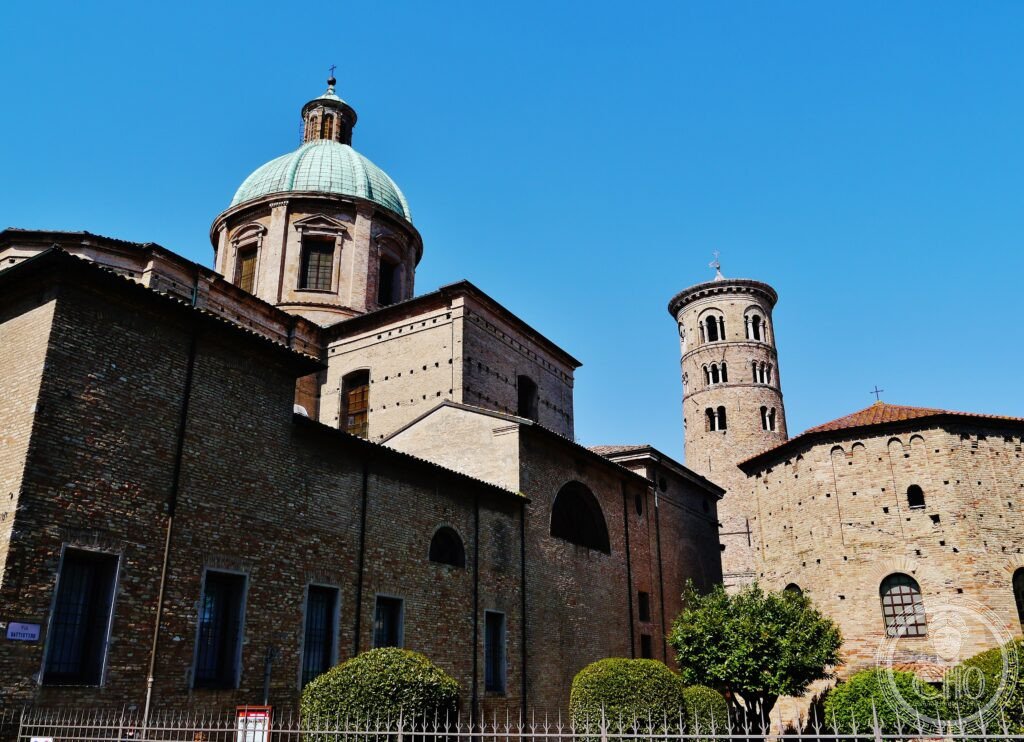
Ravenna: Mosaici Paleocristiani e Medievali

Ravenna mosaici paleocristiani medievali Galla Placidia San Vitale Giustiniano Teodora UNESCO 1996
Basilica di San Vitale, Via San Vitale 17, Ravenna, Emilia-Romagna, Italia. Il mosaico dell’abside (c.547 CE): la corte dell’Imperatore Giustiniano I (sinistra) e la corte dell’Imperatrice Teodora (destra); il pannello di Giustiniano (il più noto: Giustiniano al centro, in porpora imperiale, con il vescovo Massimiano di Ravenna alla sua sinistra (l’unico personaggio con il nome iscritto nel mosaico), i soldati a destra e il clero a sinistra; i piedi dei personaggi si sovrappongono a indicare gerarchia: l’imperatore avanza, gli altri seguono). UNESCO World Heritage Site 1996 (riferimento 788: Early Christian Monuments of Ravenna). Foto via Wikimedia Commons.
Ravenna, Emilia-Romagna, Italia · 8 edifici UNESCO (5th–6th sec. CE); Mausoleo di Galla Placidia c.430 CE; Battistero degli Ariani c.500 CE; Basilica di Sant’Apollinare Nuovo 493–526 CE; San Vitale 547 CE; Dante Alighieri sepolto 1321; UNESCO WHS 1996 (rif. 788)

Ravenna: Mosaici Paleocristiani e Medievali

I mosaici di Ravenna (UNESCO 1996) sono la più grande concentrazione al mondo di mosaici paleocristiani conservati — 8 edifici costruiti tra il 430 e il 547 CE nelle fasi di capitale dell’Impero Romano d’Occidente (402–476 CE), di regno ostrogoto (493–540 CE) e di esarcato bizantino (540–751 CE), che rendono Ravenna l’unica città al mondo a contenere mosaici di tutte e tre le grandi tradizioni dell’Antichità tardiva: la romano-imperiale, la teodericiana ostrogota, e la giustinianea byzantine.

At a glance

Ravenna mosaici (the most precisely Ravenna zone Ravenna Emilia-Romagna Italy 44.4153 N 12.2013 E UNESCO WHS 1996 reference 788: the 8 sites of the serial UNESCO inscription (the 8 buildings are: (1) the Mausoleo di Galla Placidia (c.430 CE; the oldest surviving mosaic programme of the 8; the philosopher’s sky (the deep blue starfield ceiling of the central crossing; the most reproduced mosaic interior in late antique history); (2) the Battistero Neoniano (the Orthodox Baptistery; c.458 CE; the dome mosaic: Christ’s baptism in the Jordan; 16 prophets and apostles in 2 concentric rings; the most complete 5th-century CE baptistery mosaic in existence); (3) the Basilica di Sant’Apollinare Nuovo (c.505–526 CE; built by Theodoric; the 2 processions: the 26 martyrs processing from the Classe harbour towards Christ enthroned (south wall) + the 22 virgins processing from Theodoric’s palace towards the Virgin enthroned (north wall); each procession 25 m long; the specific Theodoric edit: after the Byzantine reconquest (540 CE), the mosaic of the Theodoric palace was deliberately altered by the Byzantine mosaicists: Theodoric’s portrait (which had appeared in the palace loggia) was replaced with curtains — hands and draperies are all that survive of the original Ostrogothic programme); (4) the Battistero degli Ariani (c.500 CE; the Arian baptistery of Theodoric’s court; the dome: Christ’s baptism with the Apostles; a cruder mosaic programme than the Battistero Neoniano (the Arian heresy’s theological subordinationism means Christ’s baptism is shown without the dove of the Holy Spirit descending — the specific theological omission)); (5) the Cappella Arcivescovile (c.494–519 CE; the private chapel of the Archbishop of Ravenna; the vault: Christ as miles Christi (soldier of Christ): the only surviving mosaic showing Christ in armour rather than liturgical vestments); (6) the Basilica di San Vitale (547 CE; the centerpiece; the apse mosaics: Giustiniano + Teodora court panels; the most important surviving Byzantine court portraiture outside Constantinople); (7) the Mausoleo di Teodorico (c.520 CE; not a mosaic programme but included in the UNESCO inscription as the most important surviving Ostrogothic building; a 2-storey decagonal mausoleum in Istrian limestone blocks; the roof: a single monolithic Istrian limestone slab 10.7 m diameter × 3 m thick (weight approximately 300 tonnes); the engineering problem of lifting the slab to the top of the 15 m tower remains unresolved (no contemporary ancient engineering text describes the technique)); (8) the Basilica di Sant’Apollinare in Classe (c.549 CE; 5 km south of Ravenna in the village of Classe; the mosaic of the apse: the Transfiguration of Christ as a gold cross in a starfield (the most abstract early Christian depiction of the Transfiguration); the 24 m nave; the 19 m apse; the detached bell tower (campanile of the 9th–10th century CE: a cylindrical Romanesque tower 38 m tall, the most Italian thing possible as an anomalous visual counterpart to the early Christian apse)).

Key facts

  • The San Vitale Giustiniano mosaic (c.547 CE) and why the identification of the central figure as Giustiniano I is the key art-historical debate in late antique portraiture: the mosaic (the north apse panel: the Emperor Justinian I (527–565 CE) stands in the center; to his left (viewer’s right): Bishop Maximianus of Ravenna (the only figure with his name inscribed — “MAXIMIANVS” in white letters above his head); to Justinian’s right: 4 soldiers behind a shield with a Chi-Rho monogram; 2 deacons; a figure holding the book of the Gospels; the specific argument (the figure identified as Justinian has a long narrow face, large eyes, a short beard, and a gold halo (the Imperial nimbus); the comparison with other contemporary portraits of Justinian (the gold solidus coins of Justinian I (527–565 CE): the coin portraits show Justinian with a beard from the early 540s CE, consistent with the San Vitale mosaic (c.547 CE); the mosaic is therefore the most precisely dated portrait of Justinian and the closest in date to his legal and administrative reforms of the 530–540s CE)); the Theodora panel (the south apse panel: 13 figures; Theodora (c.497–548 CE) in the center with a gold crown and elaborate jewelry; to her left: 2 male dignitaries; to her right: a procession of court ladies; the specific detail: Theodora holds a chalice with gold decoration; the scene depicts the imperial couple offering gifts to the new Basilica di San Vitale at its consecration in 547 CE (Theodora died in 548 CE — this mosaic is the only contemporary portrait of her))
  • GPS (Basilica di San Vitale): 44.4216° N, 12.1963° E

History

Da capitale dell’Occidente a esarcato di Bisanzio a Dante all’UNESCO (the most precisely Ravenna zone history: the capital period (402 CE: the Emperor Honorius transferred the Western imperial court from Milan to Ravenna; the specific reason: Ravenna was surrounded on 3 sides by impenetrable swamps (the Po delta marshes) and on the fourth side by the Adriatic; the only land approach was a single causeway; the strategic logic proved sound: during the Visigothic sack of Rome (410 CE), Ravenna was untouched; during the Vandal sack of Rome (455 CE), Ravenna was untouched); Galla Placidia (the daughter of Theodosius I, sister of Honorius, mother of Valentinian III: she ruled as regent of the Western Empire from Ravenna 423–437 CE; her mausoleum (c.430 CE) was never actually used as a mausoleum — the sarcophagus inside is empty; Galla Placidia died in Rome in 450 CE and was buried there); the Ostrogothic period (493 CE: Theodoric the Great completed his conquest of Italy and established his court in Ravenna; the specific paradox: Theodoric was an Arian Christian (the Arian heresy denied the full divinity of Christ; it was declared heresy at the Council of Nicaea in 325 CE); however, Theodoric was also the most effective administrator that Italy had since the Antonine period; his buildings (Sant’Apollinare Nuovo, the Battistero degli Ariani, his own mausoleum) show no evidence of theological difference from orthodox building programmes except for the specific detail in the Battistero degli Ariani dome noted above; the Byzantine period (540 CE: the Byzantine general Belisarius (under Justinian I) reconquered Ravenna; the Exarchate of Ravenna (the Byzantine administrative district governing Italy from Ravenna; 584–751 CE); San Vitale was consecrated under Bishop Maximianus in 547 CE, 7 years after the Byzantine reconquest); the Dante period (1321 CE: Dante Alighieri died in Ravenna on 14 September 1321 CE, completing the last cantos of the Paradiso in the city; his tomb is in the Via Dante Alighieri; Florence requested the return of the body multiple times (1396, 1430, 1476, 1519, 1553, and 1865 CE) — Ravenna refused each time; the tomb (1780 CE: the current neoclassical tomb was built by Camillo Morigia; the inscription is Bernardo Canaccio’s “Iura monarchiae” epitaph of 1327 CE)); 1996 CE UNESCO inscription reference 788.

What you see

Il pass combinato per tutti e 8 i siti, il Mausoleo di Galla Placidia, San Vitale e Sant’Apollinare Nuovo (the most precisely Ravenna zone visit (1–1.5 days): the Ravenna card (the combined ticket for 5 of the 8 sites: Battistero Neoniano + Cappella Arcivescovile + Mausoleo di Galla Placidia + Battistero degli Ariani + Sant’Apollinare Nuovo; €12; available at the Cooperativa Mosaicisti or at the entrance of any included site; the Basilica di San Vitale is sold separately (€5) or combined with the Mausoleo di Galla Placidia as a premium ticket (€12 for both)); the recommended sequence (2.5–3 hours for the main sites): (1) Mausoleo di Galla Placidia (9 AM; 15 min; the philosopher’s blue ceiling: stand in the center and look up for 3 min before the light changes — the blue is the most intense early Christian gold-and-blue tesserae combination in existence; the natural light through alabaster windows (the original Byzantine windows: thin alabaster slabs instead of glass, which diffuse the light and give the ceiling its specific glow)); (2) San Vitale (9:30 AM; 30 min; the Justinian panel is on the north side of the apse — face left when approaching the altar; the orientation problem (the octagonal nave means that the liturgical east is rotated from the geographic east; visitors often face the wrong direction for the apse panels); the Melchizedek and Abel offering panel: the mosaics above the apse arch (Abel with the lamb, Melchizedek with the bread and wine: the prefiguration of the Eucharist — the standard theological programme of early Christian apse decoration, here at its most sophisticated)); (3) Battistero Neoniano (10:30 AM; 20 min; the dome: the apostles in a circle 30 m above; use the museum binoculars available at the entrance or bring 10× binoculars); (4) Sant’Apollinare Nuovo (11 AM; 25 min; the procession mosaics: the 25 m long south and north processions are the most legible and narrative mosaics of all 8 buildings — each figure is identifiable by name inscription; the Magi at the head of the south procession are the earliest surviving representation of the Three Wise Men with Phrygian caps (which became the canonical Oriental headgear for the Magi in all later Western art)); (5) Dante’s Tomb (11:30 AM; 10 min; Via Dante Alighieri; free; the Lanterna di Dante (the eternal flame of olive oil burning since 1908 CE: the olive oil is donated annually by the municipality of Florence as partial amends for the 1315 CE condemnation of Dante to death by burning)).

Practical information

  • Getting to Ravenna and the early morning lighting trick for the Mausoleo di Galla Placidia: transport (Trenitalia from Bologna: 1h (€8.35; direct; 2 trains/hour)); from Venice: 2h15 (€14.90; change at Ferrara or direct in summer); from Milan: 2h45 (€25; change at Bologna); from Florence: 2h10 (€18; change at Bologna); the alabaster window effect (the Mausoleo di Galla Placidia has 8 alabaster windows that filter the natural light; the effect is strongest between 9:30 and 11:30 AM in summer and between 10 AM and 12:30 PM in winter; the blue ceiling tesserae (approximately 3.5 million small tessera in the ceiling, each approximately 3–5 mm square) reflect differently under different light angles — the ceiling appears to shift from deep cobalt to turquoise to almost purple as the sun angle changes; arriving at opening time (9 AM) guarantees the best lighting and the smallest crowds (by 10:30 AM in summer the mausoleum queues reach 30 min)); the mosaic school (the Scuola Mosaicisti del Friuli… wait, the Ravenna mosaic school is the Scuola d’Arte Mosaico di Ravenna (corso Diaz 37); the 6-hour course (€120; offered Tue, Thu, Sat by appointment; includes materials; produces a 10 × 10 cm mosaic tile using genuine Roman-style tessera; the school teaches the direct method (opus tessellatum) vs. the indirect method (Ravenna method, sometimes called the “Venetian method”); the Ravenna method was standardized by the 20th-century mosaicist Severino Casadio)))

Getting there

Trenitalia da Bologna (1h, €8.35, 2 treni/ora). Da Venezia (2h15, €14.90). Ravenna Card per 5 siti: €12. San Vitale separata €5. Apertura 9am. GPS San Vitale: 44.4216, 12.1963.

Nearby

  • Ferrara: Centro Storico e Delta del Po — 75 km nord (UNESCO 1995/1999; Castello Estense; Palazzo dei Diamanti; bici nella city-of-bikes; Trenitalia da Ravenna 55 min €5.50)
  • Sant’Apollinare in Classe — 5 km sud (stessa serial UNESCO 1996; apse Trasfigurazione come croce aurea; campanile cilindrico 9-10 sec.; bus 4 da stazione Ravenna 15 min €1.30)

Sources

  • Wikipedia, Early Christian Monuments of Ravenna; Basilica of San Vitale; Mausoleum of Galla Placidia, accessed June 2026
  • UNESCO, Early Christian Monuments of Ravenna, WHS reference 788, inscribed 1996
  • Deichmann, Friedrich Wilhelm. Ravenna: Hauptstadt des spätantiken Abendlandes. Wiesbaden: Steiner, 1958–76 (the definitive 6-volume monograph on the Ravenna mosaics)

Hero image: Basilica di San Vitale, Ravenna, Emilia-Romagna, Italy, Wikimedia Commons. Editorial text © Cultural Heritage Online, 2026.

📷 Diventa un fotografo di Cultural Heritage Online

Condividi le tue foto dei luoghi: restano pubblicate con la tua firma come autore. Più vengono viste, più ti fai conoscere — e presto un concorso premierà le foto più apprezzate.

Accedi o registrati gratis per aggiungere una foto
📋 Copy & share on social
Scroll to Top