Assisi: Basilica di San Francesco

Assisi Basilica San Francesco Giotto Cimabue 1228 Umbria stigmate chiesa superiore inferiore UNESCO 2000
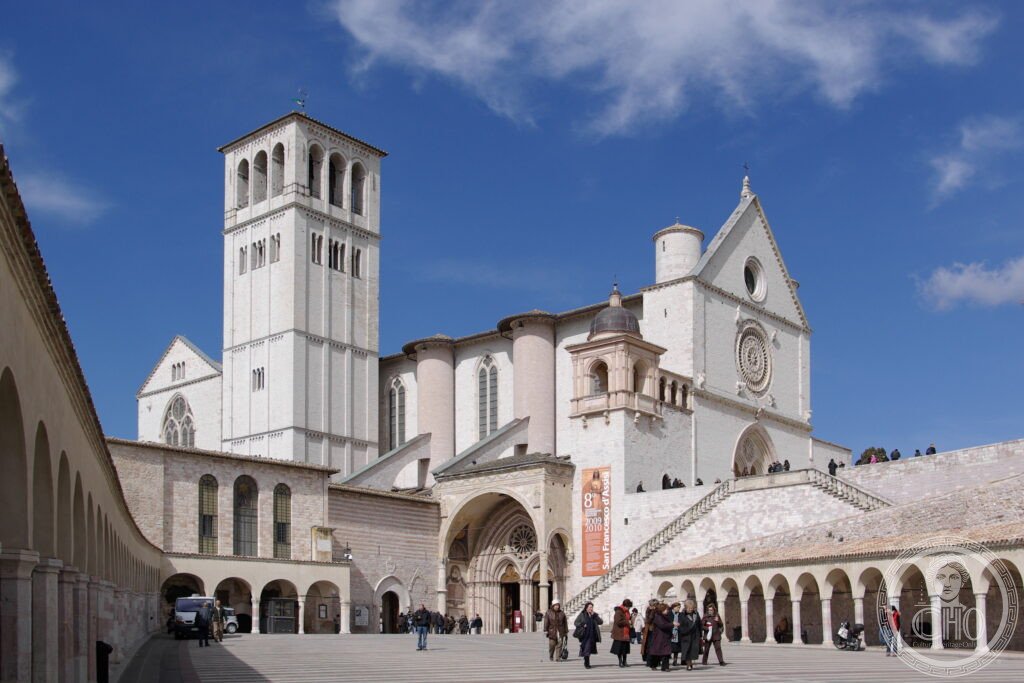
Basilica di San Francesco d’Assisi, Via San Francesco, Assisi, Province of Perugia, Umbria, Italia. La facciata della Chiesa Superiore (upper church; completed c.1253 CE; the Gothic facade; the 2 rose windows; the 2 doors; the campanile (bell tower; 1239 CE; 64 m; a separate free-standing structure to the north of the basilica)); the lower church entrance (the right side of the facade: the Gothic arched portal with the original wooden door (c.1284 CE)); the Sacro Convento (the large Franciscan friary that forms the southern platform of the basilica complex; the 13th-century CE crenellated walls give the complex its fortress-like skyline as seen from the Umbrian plain below). UNESCO World Heritage Site 2000 (reference 990: Assisi, the Basilica of San Francesco and Other Franciscan Sites). Photo via Wikimedia Commons.
Assisi, Province of Perugia, Umbria, Italia · Canonizzazione di Francesco 1228 CE; costruzione iniziata 1228 CE (Elias di Cortona); Cimabue c.1278–85; Giotto c.1295–1300 (28 scene Leggenda di San Francesco); 3–4 milioni visitatori/anno; UNESCO WHS 2000 (rif. 990)

Assisi: Basilica di San Francesco

La Basilica di San Francesco d’Assisi (UNESCO 2000) è il monumento fondativo dell’arte italiana medievale — il ciclo di Giotto delle 28 scene della Leggenda di San Francesco nella Chiesa Superiore (c.1295–1300 CE) è il primo ciclo narrativo pittorico coerente della storia occidentale in cui le figure mostrano emozioni realistiche, prospettiva spaziale e peso fisico, inaugurando la transizione dall’icona medievale alla narrazione rinascimentale che avrà il suo culmine con Masaccio e Piero della Francesca 150 anni dopo.

At a glance

Assisi Basilica (the most precisely Assisi zone Assisi Umbria Italy 43.0744 N 12.6051 E UNESCO WHS 2000 reference 990: the 2-level structure (the Basilica of San Francesco is actually 2 separate churches built on top of each other: the Chiesa Inferiore (lower church; the original; completed c.1230 CE; consecrated by Pope Gregory IX on 25 May 1230 CE, 2 years after the canonization of Francis; the crypt (where the tomb of St Francis is located; the grave was lost for 600 years (hidden in 1449 CE during a period of civil conflict; rediscovered 1818 CE during excavation work); the Lorenzetti frescoes (Pietro Lorenzetti, c.1315–20 CE: the Passion cycle in the left transept; the Simone Martini frescoes (c.1317–20 CE): the Chapel of St Martin; the earliest surviving work of Simone Martini; 10 scenes from the life of St Martin of Tours; each scene approximately 2.5 m × 2.5 m); and the Chiesa Superiore (upper church; begun c.1239 CE; completed c.1253 CE; the Gothic nave (58 m long × 13.5 m wide × 21 m high; a single nave with 4 bays + apse; one of the earliest Gothic buildings in Italy); the 28-scene Giotto cycle of the Legend of St Francis (the nave walls, lower register: 28 scenes from the Legenda Maior of Bonaventure of Bagnoregio (1263 CE); each scene approximately 2.7 m × 2.3 m; set above the 2 upper registers of Old and New Testament scenes by the “Roman workshop” (c.1278–95 CE: Cimabue (verified in the apse and transepts), Jacopo Torriti, and other unnamed Tuscan and Roman masters))); the earthquake of 1997 (26 September 1997 CE: the Umbria-Marche earthquake (magnitude 5.7 + 6.1 aftershock within 9 hours; the campanile and upper church vault collapsed; the frescoes of the Cimabue vault (the Angels and St Jerome) fell in 3,000–4,000 fragments; 4 people died (including 2 friars and 2 journalists who had entered the upper church after the first quake to report on the damage); the restoration (the fallen fresco fragments (1.2 tonnes of painted plaster) were individually recovered, catalogued, and reconstituted over 10 years (1997–2006 CE) using computer-vision pattern-matching software (the same technique used later in virtual reconstruction of the Palmyra Arch); the restored vault (approximately 70% of the original surface was recovered and repositioned))).

Key facts

  • The 28-scene Giotto cycle in the Upper Church and why it is the pivotal moment in Western art history: the attribution (the 28 scenes of the Life of St Francis in the nave of the upper church are attributed to Giotto di Bondone (c.1267–1337 CE); the attribution is the most debated in Western art history; Giorgio Vasari (1550 CE) attributed them to Giotto; Heinrich Wölfflin (1899 CE) attributed them to a different workshop; the current consensus (since approximately 1975 CE, following detailed technical analysis by Bellosi and Zanardi) is that Giotto painted the scenes in a workshop organization typical of the period (approximately 8–12 painters working simultaneously, with Giotto designing and executing the key figures personally)); the innovation (the specific novelties in the Giotto cycle compared to all preceding Western painting: (1) real spatial architecture (the buildings in scenes 6, 13, and 16 are painted as if they have depth and interior volume; no previous Western painter had painted a believable architectural interior space); (2) facial expression (the mourning friars in scene 20 (the Death of Francis) show genuine grief; the earlier Byzantine tradition showed grief through formal gestures (raised hands, torn garments) not facial distortion; Giotto’s mourners compress their mouths and furrow their brows in ways only found in his work at this date); (3) foreshortening (scene 15 (Francis preaching to the birds): the birds are shown from the front, from the side, and from partial rear angles in the same image — the first convincing multi-angle animal foreshortening in Western art); (4) weight and mass (the figures have physical presence; they cast shadows; they wear garments that fall with gravity; this contrasts with Byzantine figures that float on gold grounds with formulaic drapery folds))
  • GPS (Basilica di San Francesco): 43.0744° N, 12.6051° E

History

Da Francesco di Pietro di Bernardone alla canonizzazione alla costruzione della basilica all’UNESCO 2000 (the most precisely Assisi zone history: the life of Francis (c.1181/1182–1226 CE: the merchant’s son (Pietro di Bernardone, a cloth merchant) who renounced his inheritance (the precise scene reconstructed from the Legenda Maior: Francis stood before Bishop Guido of Assisi in the piazza, removed all his clothes, and said “until now I called you my father, but now I can freely say: Our Father who art in heaven”; his father took the clothes and disowned him; Bishop Guido covered Francis with his own cloak); the Franciscan Order (1209 CE: Pope Innocent III gave oral approval to Francis’s rule for a brotherhood of 12 friars; the specific oral approval (Innocent III is described in the sources as hesitant: the rule was considered too severe (the total poverty demanded) and too similar to the existing Humiliati and Waldensians who had been condemned as heretics; the crucial difference: Francis explicitly demanded absolute obedience to the Pope, which distinguished his movement from the heretical poverty movements); the stigmata (1224 CE: on 17 September 1224 CE, at La Verna (a mountain hermitage in Tuscany), Francis received the stigmata (the wounds of Christ: nail wounds in hands and feet, spear wound in the side) — the first documented stigmatization in Christian history; Francis kept the wounds hidden until his death; the friars who washed his body attested to the wounds); the canonization (1228 CE: Gregory IX canonized Francis on 16 July 1228 CE in Assisi, 2 years after his death; the day after the canonization, Gregory laid the first stone of the Basilica)); 2000 CE UNESCO inscription reference 990.

What you see

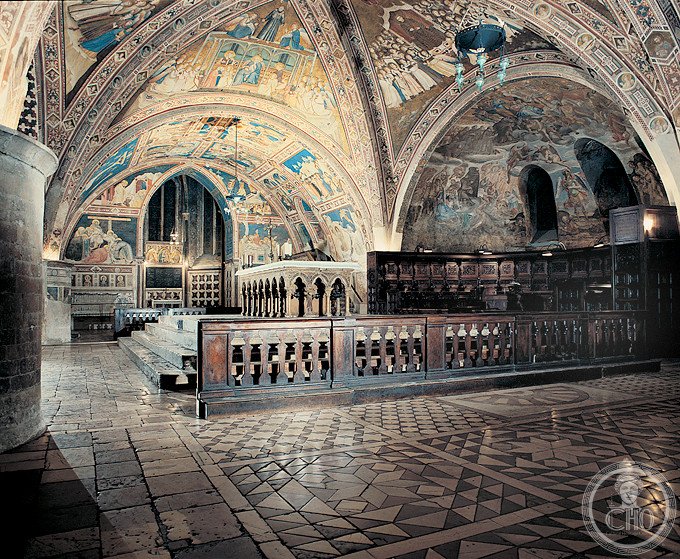
La cripta con la tomba di Francesco, la Chiesa Inferiore (Lorenzetti e Martini), e la Chiesa Superiore (Giotto) (the most precisely Assisi zone visit (2–3 hours): dress code (the basilica requires covered shoulders and knees for both men and women; the Franciscan friars at the entrance provide coverings; the code is strictly enforced — no exceptions are made); the recommended sequence: (1) Chiesa Inferiore (the lower church entrance is on the right side of the facade at piazza level; the specific visual order: (a) the Chapel of St Martin (Simone Martini, c.1317–20 CE; the first chapel on the left entering from the door: the 10 scenes of St Martin’s life; the specific observation (Martini’s color palette in Assisi is different from his Siena work: the blues are more vivid (a specifically Franciscan blue pigment (azurite + lapislazuli) used in the workshop)); (b) the Lorenzetti Passion cycle (left transept; Pietro Lorenzetti, c.1315–20 CE; the Crucifixion and Deposition: the finest expressionist religious painting in 14th-century Italy before the Black Death); (c) the crypt access stairs (the staircase descending from the central nave; the tomb: the gray stone sarcophagus of Francis (9th century CE reliquary container) on a stone bier in a Romanesque stone setting; the 4 Companions (Rufino, Angelo, Masseo, Leo: the earliest Franciscan companions, buried in the 4 niches at the corners of the crypt); the atmosphere (the crypt is always crowded on feast days; the best time for quiet reflection is 9:30–10:30 AM before the tour groups arrive)); (2) Chiesa Superiore (the entrance is the main portal on the facade; the orientation: the Giotto cycle begins on the right wall, third bay from the west, and continues clockwise around the nave; scene 1 (Francis giving his cloak to a poor knight) is the starting point; scene 28 (the canonization of Francis) is at the entrance wall; the viewing distance: the optimal distance for reading the facial expressions in the Giotto scenes is approximately 8–10 m from the wall; too close and the individual brushwork is visible but the scene is unreadable; the reading direction is left-to-right within each scene and left-to-right around the nave)).

Practical information

  • Getting to Assisi and combining with the other UNESCO sites in Umbria: transport (train (the Assisi station is 4 km below the hill town; bus service (the APM bus from the station to Porta San Pietro: 15 min; €1.30; runs every 30 min); or taxi (€12 from the station); from Perugia: Trenitalia (35 min; €4.10; 8 trains/day); from Rome: Trenitalia to Foligno (2h) then change for Assisi (15 min) or direct Intercity (2h30; €19.90); from Florence: Trenitalia (2h30; €17.90; change at Terontola); the Umbria combined tour (the classic Umbrian UNESCO circuit: Assisi (Basilica San Francesco) + Perugia (Palazzo dei Priori, Fontana Maggiore, Galleria Nazionale dell’Umbria) + Spello (Roman walls + Pinturicchio frescoes in the Cappella Baglioni, 1501 CE) + Spoleto (the Duomo (Filippo Lippi Dormition fresco, 1467–69 CE) + Ponte delle Torri (the 14th-century CE aqueduct bridge: 82 m high, 230 m long, 10 arches) + the UNESCO Longobard church of San Salvatore (6th century CE))); the Giotto crowd management (the peak crowd times in the upper church are: 10 AM–12 PM (tour groups from Rome and Florence arriving via coach); 2–4 PM (same groups returning from lunch); the best times: 9–10 AM (before the large groups) or 4:30–6 PM (last hour before closing; the light from the west windows illuminates the Giotto cycle at a different angle from the morning light)))

Getting there

Trenitalia da Perugia (35 min, €4.10); da Roma via Foligno (2h15); da Firenze (2h30, €17.90). Bus APM dalla stazione al centro (15 min, €1.30). Ingresso gratuito. Apertura 6am-7pm. GPS: 43.0744, 12.6051.

Nearby

  • Perugia: Centro Storico — 25 km ovest (Galleria Nazionale dell’Umbria (Piero della Francesca Polittico di Sant’Antonio; Perugino); Fontana Maggiore (Nicola Pisano 1277); Trenitalia da Assisi 35 min €4.10)
  • Spoleto: Duomo e Ponte delle Torri — 45 km sud (Filippo Lippi Dormizione 1467-69; Ponte delle Torri 82m/10 archi 14 sec.; Longobard San Salvatore UNESCO 2011; Trenitalia da Assisi via Foligno 1h €6.80)

Sources

  • Wikipedia, Basilica of Saint Francis of Assisi; Francis of Assisi; Giotto di Bondone, accessed June 2026
  • UNESCO, Assisi, the Basilica of San Francesco and Other Franciscan Sites, WHS reference 990, inscribed 2000
  • Bellosi, Luciano. La pecora di Giotto. Torino: Einaudi, 1985 (the monograph establishing the Giotto attribution for the Assisi cycle)

Hero image: Basilica di San Francesco d’Assisi, Umbria, Italy, Wikimedia Commons. Editorial text © Cultural Heritage Online, 2026.

📷 Diventa un fotografo di Cultural Heritage Online

Condividi le tue foto dei luoghi: restano pubblicate con la tua firma come autore. Più vengono viste, più ti fai conoscere — e presto un concorso premierà le foto più apprezzate.

Accedi o registrati gratis per aggiungere una foto
📋 Copy & share on social
Scroll to Top