
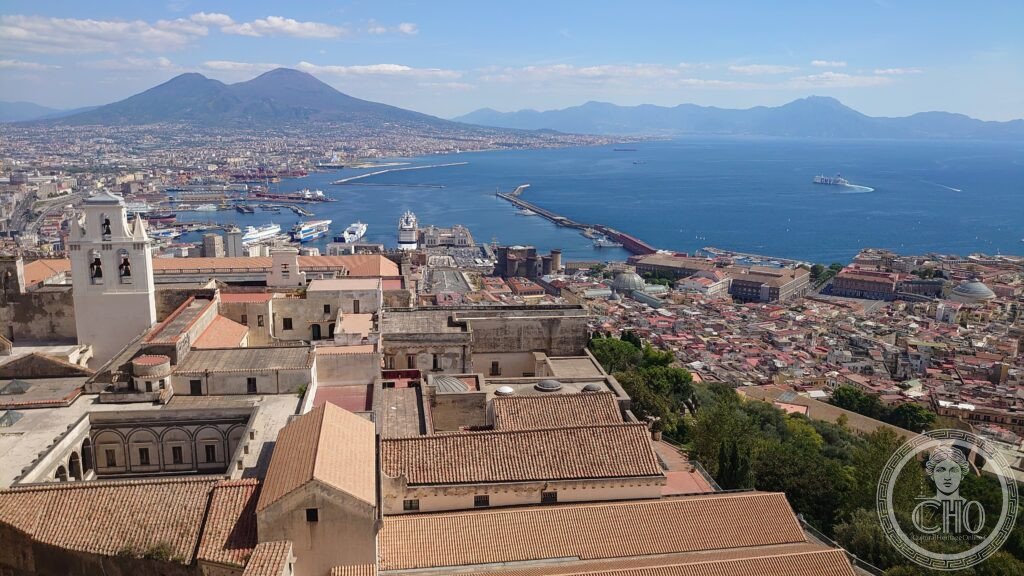
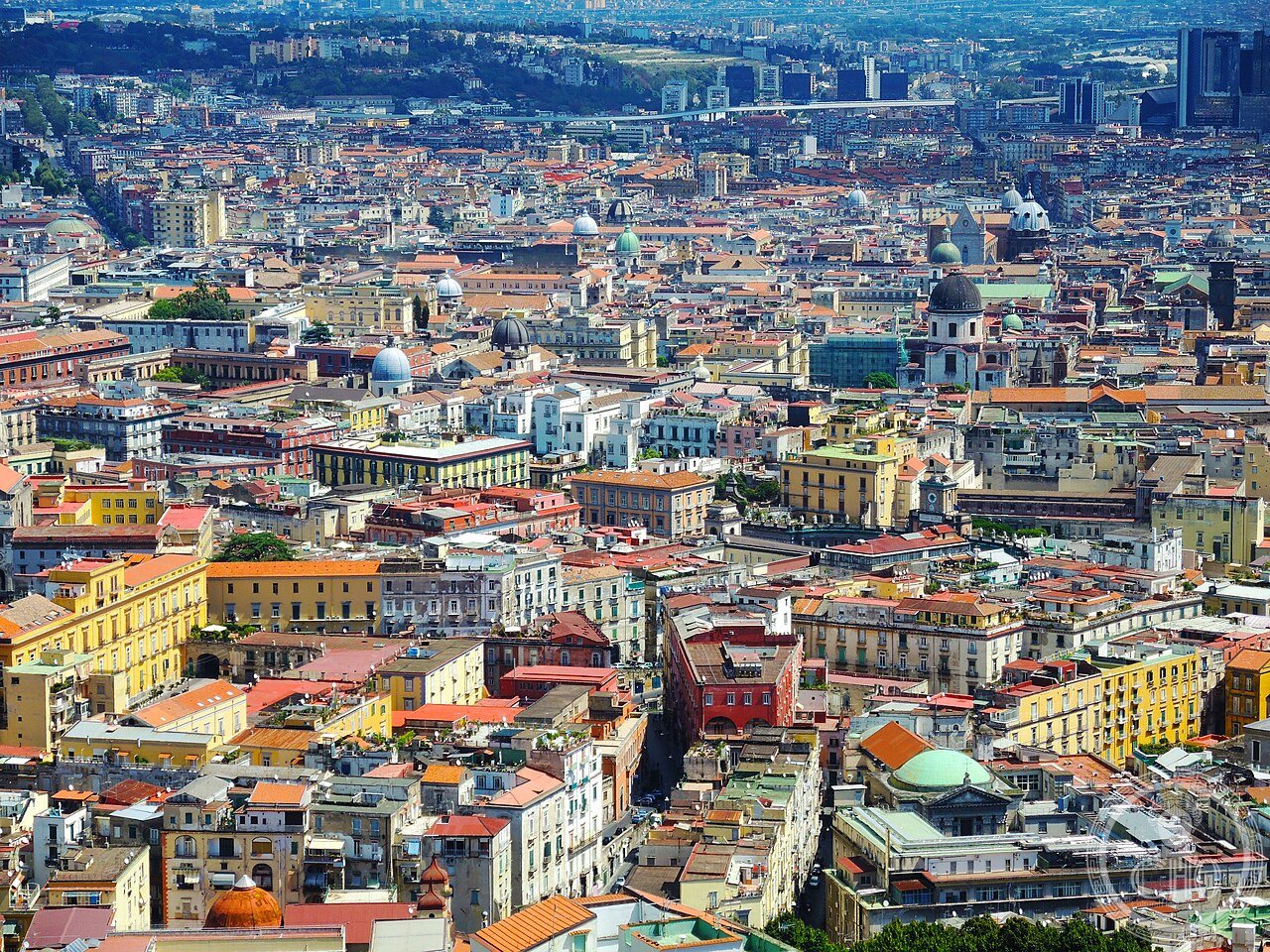
The historic centre of Naples is the largest surviving urban area of Greek origin in the world, its street grid unbroken since antiquity. Spaccanapoli, Via dei Tribunali and Via dell’Anticaglia still trace the old Greek decumani, threading past churches, cloisters and workshops that together form one of the densest concentrations of layered history in Italy.
At a glance
The centro storico of Naples preserves the Hippodamian grid laid out by Greek settlers in the fifth century BCE: three east-west decumani, now known as Via dei Tribunali, Spaccanapoli and Via dell’Anticaglia, still cross roughly forty narrow north-south alleys, the vicoli. The grid has been continuously inhabited for over two and a half thousand years, without the catastrophic destruction or wholesale rebuilding that erased comparable street patterns elsewhere.
The Encyclopaedia Britannica’s 1911 edition counted 448 churches within the historic centre, more than any other Italian city. This concentration reflects Naples’s long role as capital, first of the Kingdom of Naples and then of the Kingdom of the Two Sicilies, when Angevin, Aragonese, Spanish and Bourbon rulers each added to the fabric of the city.
Key facts
- Location: Napoli, Campania, coordinates approximately 40.8518° N, 14.2681° E
- UNESCO status: inscribed in 1995 as the Historic Centre of Naples (reference 726)
- Origins: Greek settlement of Parthenope, c.680 BCE, succeeded by Neapolis, founded by Cumaean Greeks around 470 BCE
- Street plan: three Greco-Roman decumani, Via dei Tribunali, Spaccanapoli and Via dell’Anticaglia, crossed by around forty vicoli
- Religious density: 448 churches recorded within the centre, more than in Rome or Venice
History
The site began as Parthenope, a Greek settlement on the Pizzofalcone hill where Castel dell’Ovo now stands. Around 470 BCE the Cumaeans founded Neapolis, the ‘new city’, on the flat ground to the east, and the older settlement became known as Palaiopolis. Naples surrendered to Rome in 326 BCE without being sacked, so its Greek street grid survived intact; the city retained Greek language, games and customs well into the Roman imperial period.
In 1266 Charles I of Anjou took Naples from the Hohenstaufen and moved his capital there from Palermo, beginning the Castel Nuovo and drawing figures such as Boccaccio and Petrarch to Robert of Anjou’s court. The Aragonese conquest of 1442 brought a humanist court under Alfonso, Ferrante and Alfonso II, home to Giovanni Pontano’s academy. Spanish viceroys governed from 1503 to 1713, and it was under Pedro de Toledo in the 1530s and 1540s that Via Toledo was laid out and the Quartieri Spagnoli built as a barracks district. Charles of Bourbon took the city from Austria in 1734, ushering in the period that produced the Teatro di San Carlo, opened in 1737 and among the oldest continuously operating opera houses in the world.
What you see
Spaccanapoli, the old Decumanus Inferior, runs straight through the centre for some three kilometres and carries an unusually high concentration of monuments along its length. The Gesù Nuovo presents a diamond-rusticated stone facade dating from a sixteenth-century Jesuit conversion of the earlier Palazzo Sanseverino. Santa Chiara, an Angevin Gothic church begun in 1310, holds a Bourbon-era cloister lined with majolica tiles depicting gardens, pastoral scenes and commedia dell’arte figures. Nearby, San Gregorio Armeno gives its name to the street of presepe workshops, where craftspeople still make traditional Nativity figures alongside modern ones depicting contemporary public figures, and its church ceiling carries Luca Giordano’s fresco of the Apotheosis of St Gregory the Illuminator.
Beneath Posillipo hill runs the Crypta Neapolitana, a Roman tunnel over seven hundred metres long. Above its entrance stands a Roman tomb traditionally, though not archaeologically, identified as the burial place of Virgil, visited by Petrarch in 1341.
Practical information
- Cappella Sansevero: Via Francesco De Sanctis 19R; check the site’s official channels for current opening times and booking arrangements
- Pizzeria Brandi: Salita Sant’Anna di Palazzo 1-2, trading since the eighteenth century and credited with the creation of the pizza Margherita in 1889
- Getting around: the centro storico is best explored on foot, as most streets are narrow pedestrian alleys
Getting there
The historic centre lies in the heart of Naples and is reached easily on foot from the main city thoroughfares, with Spaccanapoli and Via dei Tribunali as the principal orientation lines. Public transport within Naples connects the wider city to the edges of the centro storico, from where the old Greek streets are walked rather than driven.
Nearby
- Castel Sant’Elmo — overlooks the centro storico and the Gulf of Naples, with Vesuvius visible beyond
- Palazzo Reale di Caserta — around 30 km north, built from 1752 by Vanvitelli and separately inscribed by UNESCO in 1997
- Posillipo — the hillside district beneath which the Crypta Neapolitana and the tomb attributed to Virgil are found
More photographs

Sources
- Encyclopaedia Britannica (1911 edition)
Gallery
Find it on the map
See this place and what’s around it →
📷 Become a Cultural Heritage Online photographer
Share your photos of places: they stay published under your name as the author. The more they're seen, the more you get noticed — and soon a contest will reward the most appreciated photos.
Log in or sign up free to add a photo