
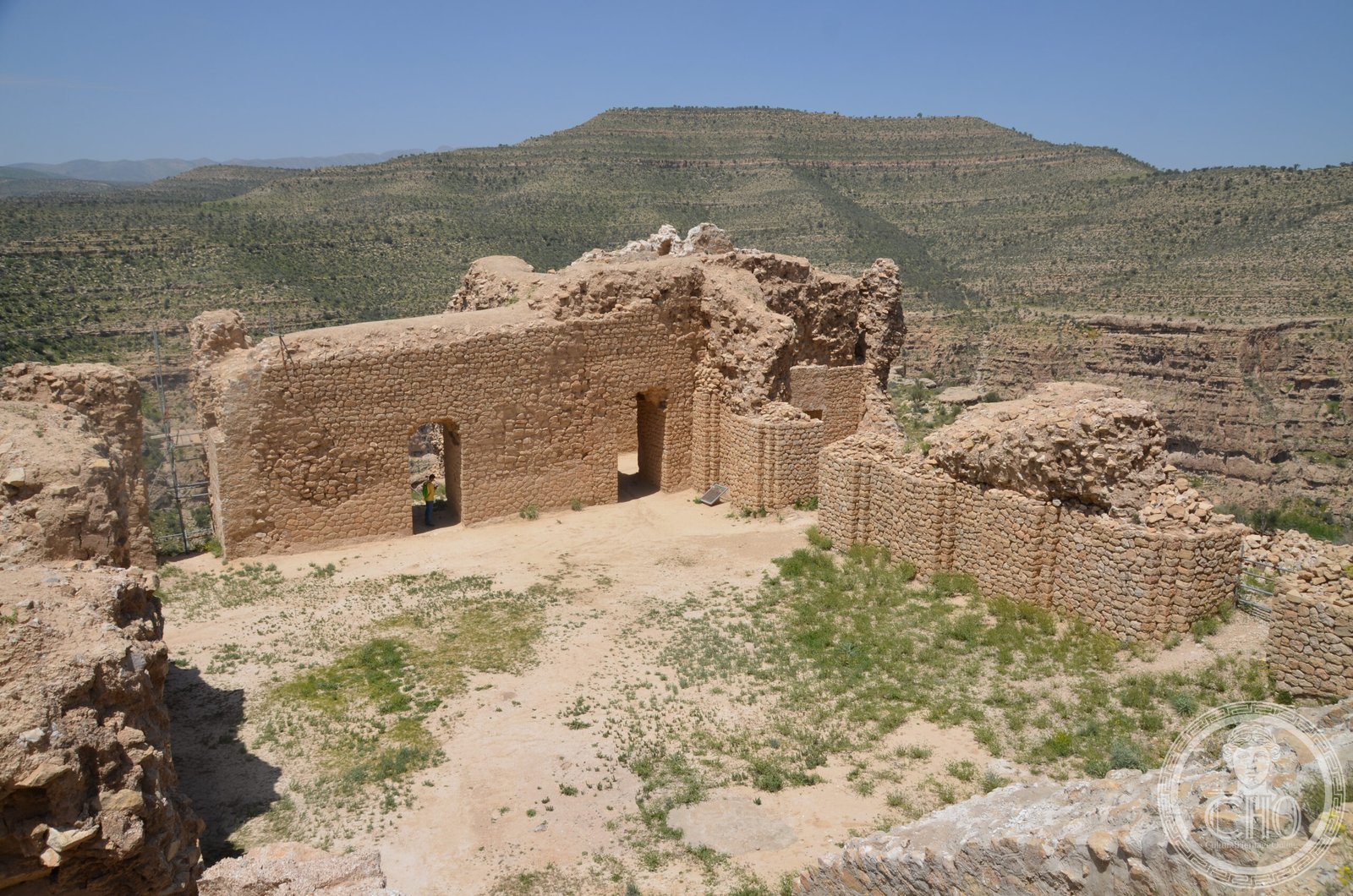
On a rocky spur commanding the gorge of the Tangab river in the province of Fars, Qal’eh Dokhtar — “the maiden’s castle” in Persian — is the founding monument of the Sasanian Empire: the first great work built by Prince Ardashir I around AD 224, before he had even defeated the last Parthian king Artabanus IV and founded the new empire. With its barrel vaults, its monumental propylaea and its domed throne hall, it represents the first flowering of the Sasanian architecture that would dominate the Middle East for four centuries. A UNESCO World Heritage site since 2018, as part of the Sassanid Archaeological Landscape of Fars Region.
At a glance
Qal’eh Dokhtar (“Maiden Castle” or “Daughter’s Castle”) is a Sassanid palace-fortress constructed by Ardashir I circa 209–224 AD on a rocky cliff above the Tangab River gorge, near Firuzabad, Fars Province, Iran. It is the earliest known major Sassanid architectural monument — predating the better-known Ardashir-Khwarrah palace in the valley below. UNESCO inscribed it in 2018 (ref. 1568) as part of the “Sassanid Archaeological Landscape of the Fars Region.” The site demonstrates the first crystallisation of the Sassanid architectural style, combining the Achaemenid palace tradition with Roman and Parthian influences into a new Persian imperial form.
Key facts
- UNESCO: World Heritage since 2018 (Sassanid Archaeological Landscape of the Fars Region, ref. 1568)
- Built by: Ardashir I (r. 224–242 AD), founder of the Sassanid Empire
- Date: c. 209–224 AD — before the defeat of the last Parthian king
- Architecture: barrel-vaulted halls, iwan (monumental arched hall), domed throne room, defensive towers
- Height: perched on a cliff at c. 100 m above the valley floor; accessible only via a narrow ridge path
- Relationship to nearby sites: companion site to the Ardashir-Khwarrah palace (in the plain below) and the Ardashir investiture relief at Naqsh-e Rajab
History
Ardashir I was a local Persian nobleman who rose to power in the province of Fars by overthrowing the Parthian governors. He built Qal’eh Dokhtar as a fortified palace around 209 AD, using it as his base of operations while he consolidated power. In 224 AD he defeated and killed the Parthian emperor Artabano IV at the Battle of Hormozdgān and proclaimed himself Shah of Shahs, founding the Sassanid Empire — the last great Persian empire before the Islamic conquest.
After his final victory, Ardashir built the larger Ardashir-Khwarrah palace in the plain below Firuzabad, but Qal’eh Dokhtar continued to be used as a fortress. The site’s architectural innovations — particularly the use of squinches to support circular domes over square chambers, and the fire temple integrated into the residential palace — established the Sassanid architectural vocabulary that influenced Byzantine and later Islamic architecture. Qal’eh Dokhtar was excavated by German and Iranian archaeologists in the 20th century.
What you see
The site is dramatically positioned: a triangular rocky outcrop above a deep river gorge, accessible by a narrow path carved into the cliff. The palace-fortress consists of three main platforms: the entrance zone with an iwan gateway, the middle residential and administrative level, and the upper fire temple and throne room. The dome of the throne room — one of the earliest squinch-supported domes in Iran — is partially intact and can be inspected up close.
The site is unexcavated below the cleared surface and untouristed: visitors are rare, admission fees minimal, and the experience of standing in the 3rd-century Sassanid founder’s throne room with no other tourists is extraordinary.
Practical information
- Access: 120 km south of Shiraz by road (2 hrs); the site is 4 km from Firuzabad town via a signed track
- Combination: combine with the Ardashir-Khwarrah palace (15 min drive) and the Ardashir reliefs at Naqsh-e Rajab (1.5 hrs north near Persepolis)
- Best time: October–April (temperatures manageable); summer can reach 40°C
- Guide: not required but a local guide from Firuzabad is useful for context
Getting there
From Shiraz: drive south on the Shiraz–Firuzabad road (120 km, 2 hrs). Firuzabad is accessible by bus from Shiraz. The site is 4 km outside Firuzabad. GPS: 28.92° N, 52.53° E.
Nearby
- Persepolis (UNESCO) — the great Achaemenid ceremonial capital, 130 km north of Firuzabad near Shiraz
- Ardashir-Khwarrah Palace — the larger Sassanid palace in the Firuzabad plain (not separately UNESCO inscribed, but included in the same landscape)
- Shiraz — the city of poetry (Hafez, Sa’di) and roses, 120 km north; gateway to all Fars heritage sites
Sources
- UNESCO World Heritage Centre — “Sassanid Archaeological Landscape of the Fars Region” (ref. 1568)
- Encyclopaedia Britannica — Ardashir I; Sassanid dynasty
- Dietrich Huff — archaeological reports on Qal’eh Dokhtar (German Archaeological Institute)
Find it on the map
See this place and what’s around it →📷 Become a Cultural Heritage Online photographer
Share your photos of places: they stay published under your name as the author. The more they're seen, the more you get noticed — and soon a contest will reward the most appreciated photos.
Log in or sign up free to add a photoIs this page about you?
This page is read by travellers and heritage enthusiasts who find it on Google. Tell us how you are connected to this place and we will take it from there.