
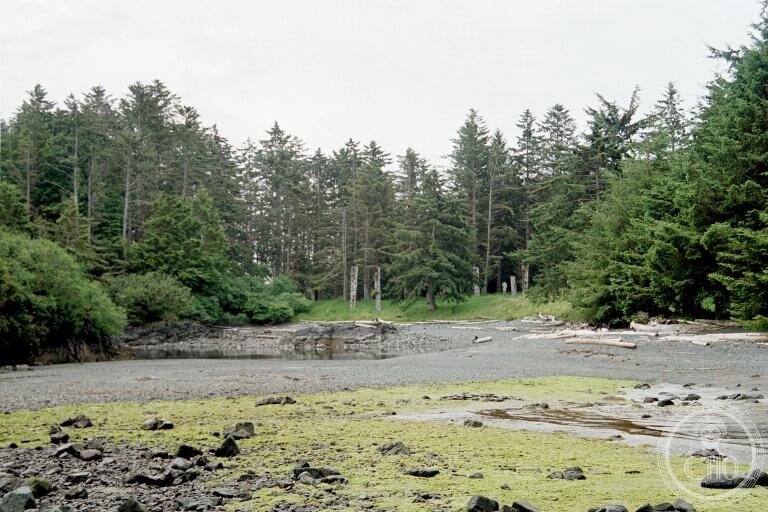
On Anthony Island — or SGang Gwaay in the Haida language, “the island on which the rumbling rises” — in the remote Gwaii Haanas chain at the southern tip of Haida Gwaii, British Columbia, the village of Ninstints is one of the most moving and silent places in Canada. Abandoned around 1870 after a smallpox epidemic that decimated the Haida, the village keeps in the coastal forest the remains of great communal houses and, above all, the world’s largest concentration of original totem and mortuary poles still standing on their original site. A UNESCO World Heritage site since 1981.
At a glance
SGang Gwaay Llnagaay (“Red Cod Island Town”), commonly called Ninstints, is an abandoned Haida village site on Anthony Island, within Gwaii Haanas National Park Reserve in southern Haida Gwaii, British Columbia, Canada. UNESCO inscribed it in 1981 (ref. 157) as the site of the world’s largest surviving collection of standing in-situ totem poles and mortuary poles from the Haida First Nation. The village was inhabited for centuries and abandoned around 1870 after smallpox epidemics reduced the Haida population from an estimated 10,000–15,000 to fewer than 600 people. It is accessible only by sea or floatplane and is closely guarded by Haida Watchmen.
Key facts
- UNESCO: World Heritage since 1981 (SGang Gwaay, ref. 157)
- Totem poles: the largest in-situ collection in the world; over 30 poles and house posts still standing (many now leaning, reclaimed by forest)
- Haida people: the village was a major centre of Haida culture; the Haida are renowned for their art, particularly totem-pole carving and sea-going canoes
- Abandonment: c. 1870, following a series of smallpox epidemics introduced by European contact; Haida population dropped by 90%
- Access: no roads; only accessible by charter boat (7 hrs from Prince Rupert) or floatplane; visitor numbers strictly controlled
- Haida Watchmen: Haida cultural guardians maintain a presence at SGang Gwaay May–September to interpret the site and protect the poles
History
The Haida people have inhabited Haida Gwaii (the “Islands of the People”) for at least 12,500 years. SGang Gwaay was one of a series of major villages on the islands, with a population of several hundred at its peak. The Haida were among the most artistically sophisticated peoples of the Pacific Northwest Coast, known for their monumental carving, complex social structure (divided into Eagle and Raven moieties), long-distance trading networks and formidable war canoes that could raid as far as California.
European contact began in 1774 (Spanish) and intensified after 1778 (British). The sea otter trade brought enormous wealth to the Haida but also introduced epidemic diseases for which they had no immunity. Smallpox struck repeatedly from the 1780s onward; the catastrophic epidemic of 1862–1863 alone killed an estimated 70% of the surviving population. By 1870 the remaining Haida of southern Haida Gwaii consolidated at the more northern village of Skidegate. SGang Gwaay was left to the forest and the ravens. The Canadian government and the Haida Nation jointly nominated the site for UNESCO inscription in 1981.
What you see
Walking into SGang Gwaay is one of the most emotionally charged heritage experiences in Canada. The poles — tall, carved with clan crests (ravens, bears, eagles, killer whales, thunderbirds) — stand at various angles, slowly tilting as the forest floor moves beneath them. Massive beam-ends mark the positions of the great cedar-plank longhouses (now collapsed). The totem poles were not built to last forever — in Haida tradition, they are expected to fall and return to the earth; their value was in the ceremony of raising them, not their permanence.
The isolation, the surrounding old-growth Sitka spruce and red cedar, the calls of ravens and bald eagles, and the constant sound of the Pacific combine to make the site uniquely affecting. Haida Watchmen guides provide context and storytelling; visitors cannot explore independently.
Practical information
- Permits: a Gwaii Haanas user fee is required; visitor numbers to SGang Gwaay are strictly limited
- Access: charter boat from Sandspit/Moresby Camp (7 hrs) or floatplane (1 hr); no independent access
- Tours: only with a licensed guide; Haida Watchmen present May–September
- Best time: June–August (calmer seas; Watchmen present; longest daylight)
Getting there
Fly to Sandspit Airport (Haida Gwaii) from Vancouver or Prince Rupert. From Sandspit, charter a boat or floatplane to SGang Gwaay (Anthony Island) through a licensed Gwaii Haanas operator. GPS: 52.10° N, 131.22° W.
Nearby
- Gwaii Haanas National Park Reserve — the protected wilderness of southern Haida Gwaii; also includes Hotspring Island with geothermal pools
- Skidegate — the main Haida community, with the Haida Heritage Centre and Bill Reid collection
- Prince Rupert — the gateway city on the BC mainland, with the Museum of Northern British Columbia
Sources
- UNESCO World Heritage Centre — “SGang Gwaay” (ref. 157)
- Parks Canada — Gwaii Haanas National Park Reserve and Haida Heritage Site
- Encyclopaedia Britannica — Haida people
Find it on the map
See this place and what’s around it →📷 Become a Cultural Heritage Online photographer
Share your photos of places: they stay published under your name as the author. The more they're seen, the more you get noticed — and soon a contest will reward the most appreciated photos.
Log in or sign up free to add a photo