
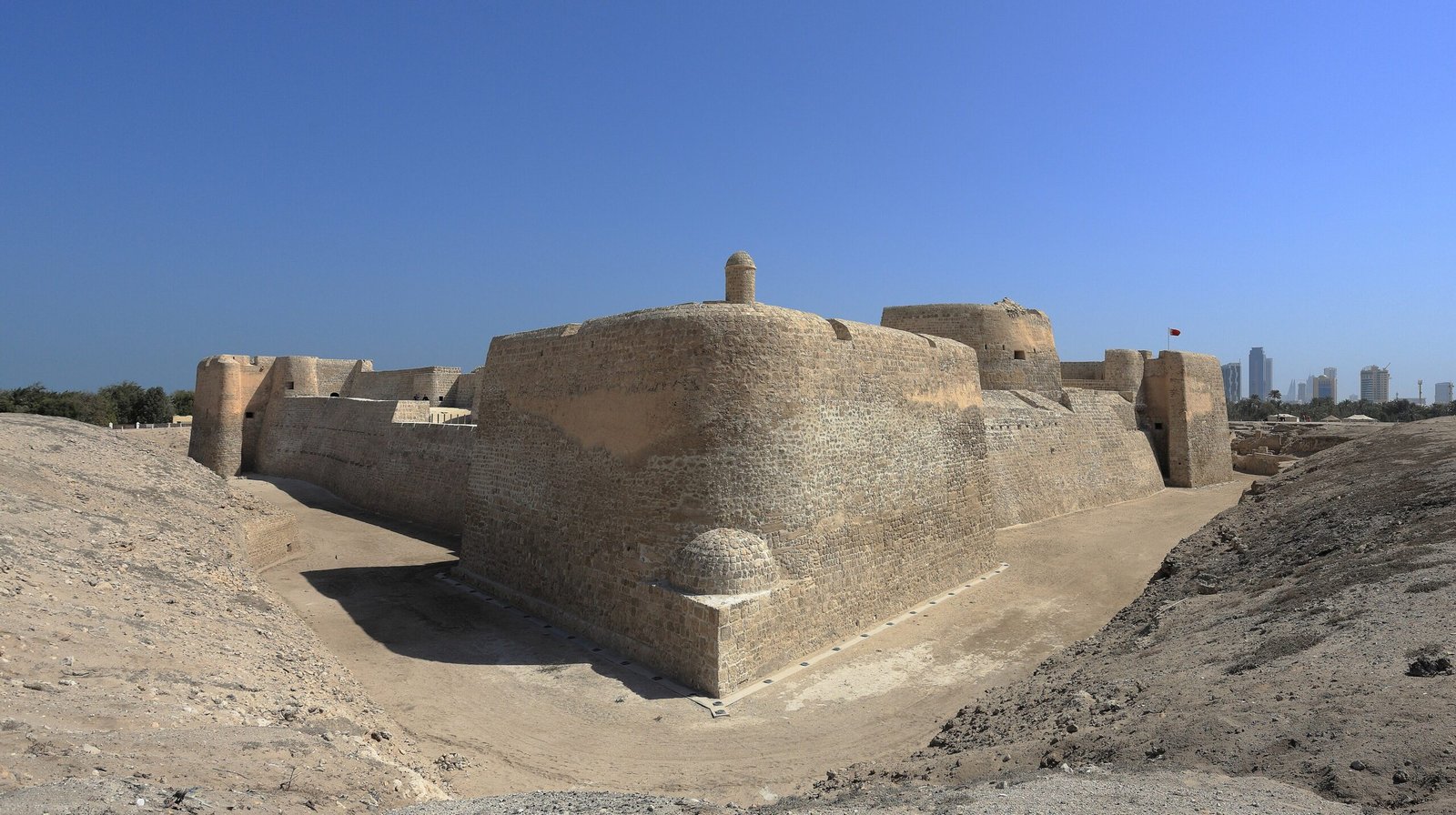
A tell mound rising from Bahrain’s northern shore, Qal’at al-Bahrain contains 21 archaeological layers spanning 4,500 years — from the Bronze Age capital of the Dilmun civilization, the ancient paradise-island trading empire of the Persian Gulf, to a Portuguese Renaissance fortress built on its summit in 1559 CE — making it one of the most stratified archaeological sites in the Arabian world.
At a glance
Qal’at al-Bahrain is a natural limestone tell (archaeological mound) on the northern coast of Bahrain island, designated a UNESCO World Heritage Site in 2005. The mound rises approximately 12 metres above sea level and covers some 17.5 hectares, its layers containing the accumulated debris of 45 centuries of continuous occupation. At the summit stands the Portuguese Fort — the best-preserved Renaissance-era military architecture in the Persian Gulf — built in 1559 CE directly on top of the ancient Dilmun city. Below the fort, excavations by Danish, French, and Bahraini archaeologists have revealed the streets, warehouses, temples, and harbour installations of the Dilmun capital.
Key facts
- UNESCO inscription: 2005 (World Heritage Site)
- Site area: ~17.5 hectares; tell height ~12 m above sea level
- Occupation span: c. 2300 BCE to the 18th century CE (~4,100 years)
- Archaeological layers: 21 distinct strata
- Dilmun civilization: Bronze Age trading culture, c. 2300–300 BCE
- Portuguese fort: built 1559 CE; best-preserved Renaissance fort in the Gulf
- Key excavators: Danish Archaeological Expedition (1954–1970s); CNRS (France); Bahrain Authority for Culture and Antiquities
- Location: Karbabad, Northern Governorate, Bahrain
- Coordinates: 26.2333° N, 50.5167° E
History
The Dilmun civilization that founded the city at Qal’at al-Bahrain is first mentioned in Sumerian cuneiform texts from Ur (c. 2000 BCE), which describe it as a paradise island at the “mouth of the rivers” — a mythological land of immortality and plenty, and source of copper, carnelian beads, and exotic hardwoods traded across the ancient world. Modern archaeology has confirmed that Dilmun was indeed a real, prosperous trading civilization: at Qal’at al-Bahrain, the lowest excavated layers contain Kassite-period (c. 1400 BCE) pottery and imported Mesopotamian goods alongside locally made Dilmun wares, evidence of sophisticated trade networks connecting Bahrain to southern Iraq, coastal Oman (ancient Magan), and the Indus Valley civilization.
The city changed hands repeatedly through the millennia. Hellenistic Greeks (the Tylos period, c. 300 BCE–300 CE) left imported Greek amphorae and coins in the upper layers. The Sasanian Persians occupied the island from the 3rd to 7th century CE. After the Islamic conquest, Bahrain became an important caliphate province. The Portuguese arrived in 1521 CE, incorporating Bahrain into their Estado da India, and in 1559 CE built the fort at the summit of the ancient tell. The Portuguese were expelled by Persian Safavid forces in 1602 CE. Modern rediscovery began with the legendary Danish Archaeological Expedition of 1954, led by P.V. Glob and Geoffrey Bibby, who linked Bahrain definitively to the ancient Dilmun of Mesopotamian texts.
What you see
The Portuguese Fort dominates the summit: a well-preserved Renaissance fortification with round corner towers, a central keep, and a sea-facing defensive wall. The fort’s stonework incorporates spolia from earlier structures, and its layout follows 16th-century Iberian military engineering principles adapted for the Gulf environment. At the base of the tell, excavated sectors reveal Dilmun-period warehouses and storage magazines built of limestone blocks, with drainage channels and loading bays facing the ancient harbour. Kassite-period streets and domestic structures are visible in section. A Dilmun temple complex (c. 2000 BCE) with a central courtyard and offering benches was excavated on the north side of the mound. The adjacent beach preserves traces of the ancient Dilmun harbour. The Qal’at al-Bahrain Site Museum at the base displays key finds from all excavation periods, including Dilmun stamp seals, Kassite pottery, Tylos-period Greek imports, and Portuguese military artefacts.
Practical information
- Open: Saturday–Thursday 08:00–18:00; Friday 14:00–18:00
- Entry fee: Nominal admission; free for Bahraini nationals
- Site museum: Open same hours; included in admission
- Best season: November–March (20–28°C); summer reaches 40°C+
- Guided tours: Available via Bahrain Tourism (btea.gov.bh)
- Language: Arabic; English widely spoken in Bahrain’s tourism sector
- Currency: Bahraini Dinar (BHD); cards widely accepted
Getting there
Qal’at al-Bahrain is located in Karbabad, Northern Governorate, approximately 5 km northwest of Manama city centre. From Bahrain International Airport (BAH): approximately 20 minutes by taxi or rideshare (Careem/Uber). From Manama: take the coastal road west along the northern shore; the site is signed from the main highway. By car from the King Fahd Causeway (from Saudi Arabia): approximately 30 minutes. Parking is available at the site museum.
Nearby
- Dilmun Burial Mounds (UNESCO 2019) — over 21,000 Bronze Age burial mounds across Bahrain island, including the Royal Mounds of A’ali; the world’s largest Bronze Age cemetery; several groups within 15–30 km
- Bahrain National Museum (Manama) — outstanding Dilmun collections; 6 km east
- Al-Ahsa Oasis, Saudi Arabia (UNESCO 2018) — world’s largest natural oasis, heartland of the Dilmun civilization; accessible via King Fahd Causeway (~90 km)
- Bab al-Bahrain — historic gateway to the old souk of Manama; 6 km east
Sources
- UNESCO World Heritage Centre — Qal’at al-Bahrain — Ancient Harbour and Capital of Dilmun (WHC nomination file, 2005)
- Wikipedia — Qal’at al-Bahrain (en.wikipedia.org/wiki/Qal%27at_al-Bahrain)
- Geoffrey Bibby, Looking for Dilmun (Knopf, 1969)
- Bahrain Authority for Culture and Antiquities (culture.gov.bh)
Find it on the map
See this place and what’s around it →📷 Become a Cultural Heritage Online photographer
Share your photos of places: they stay published under your name as the author. The more they're seen, the more you get noticed — and soon a contest will reward the most appreciated photos.
Log in or sign up free to add a photo