
Sull’isola di Samo, patria di Pitagora, due monumenti raccontano l’apice della civiltà ionica: l’antica città-porto fortificata di Pythagoreion, con il prodigioso tunnel di Eupalino scavato da entrambi i lati della montagna, e il colossale tempio di Era, l’Heraion, uno dei più grandi della Grecia.
At a glance
The island of Samos, in the eastern Aegean and the homeland of Pythagoras, holds two monuments of the height of ancient Ionian civilisation. Pythagoreion was a fortified port city, defended by walls and equipped with a harbour mole and the astonishing Tunnel of Eupalinos, an aqueduct driven through the mountain from both ends at once in the 6th century BC. Nearby stood the Heraion, the sanctuary and colossal temple of the goddess Hera, one of the largest in the Greek world. Together they were inscribed by UNESCO in 1992.
Key facts
- UNESCO: World Heritage since 1992 (Pythagoreion and Heraion of Samos)
- Homeland of Pythagoras: Samos was the birthplace of the philosopher
- Tunnel of Eupalinos: a 6th-century BC aqueduct dug through the mountain from both ends
- Pythagoreion: the fortified ancient port city and its harbour works
- The Heraion: a vast temple of Hera, among the largest in Greece
- Ionian apogee: monuments of the wealthy 6th-century BC tyranny of Polycrates
History
In the 6th century BC, under the tyrant Polycrates, Samos was one of the most powerful and inventive states of Ionia. The city, later called Pythagoreion after its most famous son, was protected by long walls and a harbour mole, and supplied with water through the Tunnel of Eupalinos — an engineering marvel driven by hand through the mountain from two ends that met in the middle, a feat of ancient surveying.
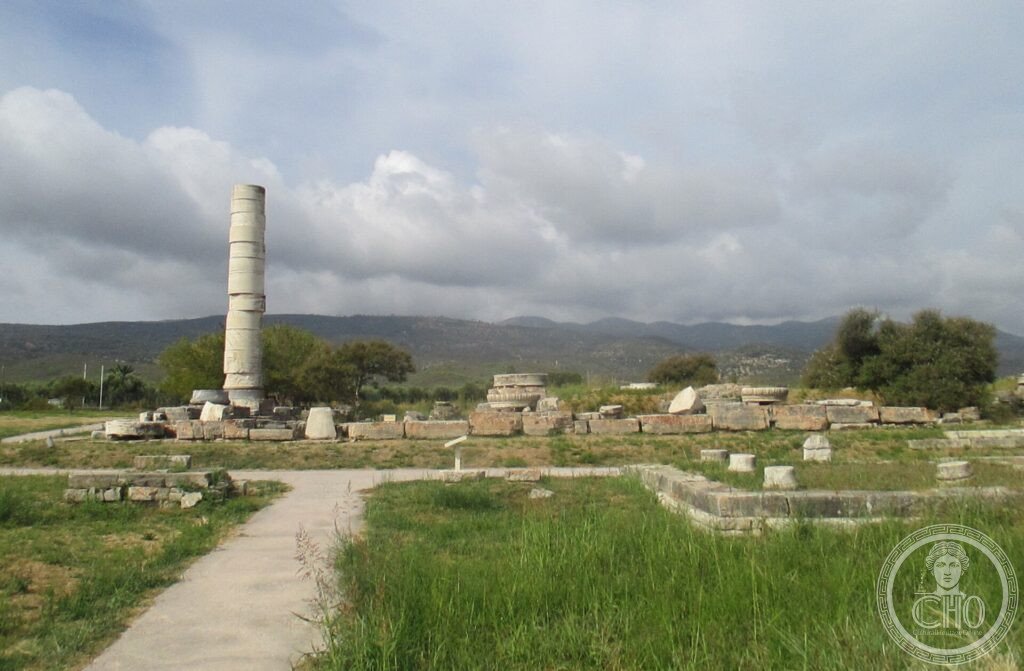
Outside the city the Samians built the Heraion, a sanctuary of their patron goddess Hera with an enormous temple, rebuilt ever larger as the island’s power grew. After antiquity the temple fell, leaving foundations and a single re-erected column, while the city and tunnel passed into ruin and rediscovery.
What you see
At the Heraion, foundations spread across the plain near the sea, with one tall column re-erected to suggest the scale of the lost temple, surrounded by the bases of altars and lesser shrines. At Pythagoreion, the harbour, walls and theatre survive, but the highlight is the Tunnel of Eupalinos, which can be entered to walk through the mountain along the ancient water channel.
The modern town of Pythagoreion sits on the ancient site by the sea.
Practical information
- Eupalinos Tunnel: open to visitors; a section can be walked
- Heraion: an archaeological site near the airport, with a museum in Samos town
- Time needed: a full day for both sites
- Setting: on the south coast of Samos in the eastern Aegean
Getting there
Samos is an island in the eastern Aegean, close to the Turkish coast. It has an airport and ferries from Athens (Piraeus) and other islands. Pythagoreion and the Heraion are on the south coast, a short drive apart. GPS (Heraion): 37.6722° N, 26.8856° E.
Nearby
- Pythagoreion town — the harbour town on the ancient site
- Tunnel of Eupalinos — the ancient aqueduct through the mountain
- Samos town (Vathy) — the island capital with its archaeological museum
Sources
- UNESCO World Heritage Centre — “Pythagoreion and Heraion of Samos” (ref. 595)
- Hellenic Ministry of Culture — official body
- Encyclopaedia Britannica — Samos; Eupalinos
Find it on the map
See this place and what’s around it →📷 Become a Cultural Heritage Online photographer
Share your photos of places: they stay published under your name as the author. The more they're seen, the more you get noticed — and soon a contest will reward the most appreciated photos.
Log in or sign up free to add a photo