
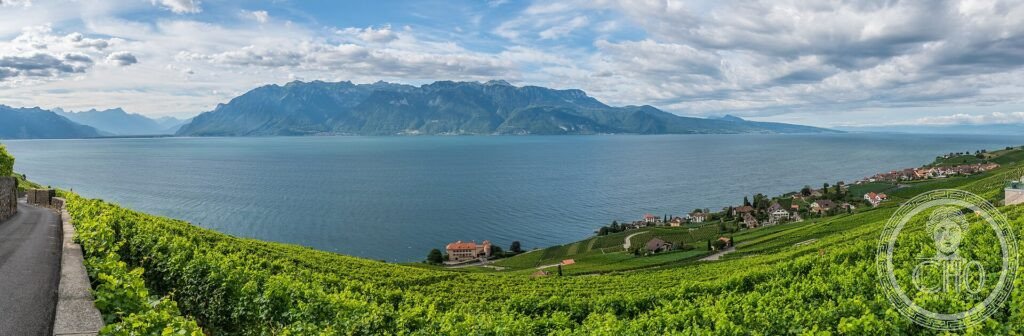
For almost a thousand years, on the steep slopes above Lake Geneva, farmers have built dry-stone walls and terraces to grow the vine. The result is Lavaux: thirty kilometres of stepped vineyards between the lake and the Alps, a landscape entirely shaped by human hands and the sun reflecting off the water.
At a glance
The Lavaux is a landscape of terraced vineyards stretching some 30 km along the steep northern shore of Lake Geneva, between Lausanne and the Château de Chillon. Cultivated since at least the 11th century, when Benedictine and Cistercian monks built the first terraces, it has been shaped over centuries into ranks of vines held by dry-stone walls, warmed by the sun, the lake and the walls themselves. An outstanding example of a wine-growing cultural landscape, it was inscribed by UNESCO in 2007.
Key facts
- UNESCO: World Heritage since 2007 (Lavaux, Vineyard Terraces)
- About 30 km: terraces along the north shore of Lake Geneva
- Since the 11th century: first terraced by Benedictine and Cistercian monks
- Three suns: a local saying — the sky, the lake’s reflection, the warm walls
- Dry-stone walls: the terraces are held by hand-built stone walls
- Wine villages: Saint-Saphorin, Epesses, Rivaz and others
History
Vines may have grown on these slopes in Roman times, but the terraced landscape took shape from the 11th century, when monks of the Benedictine and Cistercian orders, granted the land by the bishops of Lausanne and the Savoyards, built terraces and walls to tame the steep ground for the vine. Generations of growers extended and maintained them, creating the dense pattern of walls, paths and plots seen today.
The result is a landscape entirely made by human labour, where wine villages cling to the slope between the lake and the wooded heights. Protected from development by the local people, it endures as a living, working vineyard and a model of a cultural landscape.
What you see
The vineyards fall in steep terraces from the wooded ridge to the very edge of Lake Geneva, the rows of vines held by pale dry-stone walls, footpaths and old stairways threading between them. Stone wine villages — Saint-Saphorin, Epesses, Rivaz — sit among the vines, and across the water the Alps rise above the lake.
In autumn the terraces turn gold and red; in any season the interplay of vines, walls, water and mountains is the essence of the place.
Practical information
- Walking: marked paths cross the terraces between the wine villages
- Wine: village cellars offer tastings of Lavaux whites (Chasselas)
- Time needed: half a day to walk part of the terraces
- Access: trains and a little tourist train serve the villages
Getting there
Lavaux lies on the north shore of Lake Geneva in the canton of Vaud, Switzerland, between Lausanne and Vevey. Trains stop at lakeside villages such as Cully and Rivaz; boats and roads also serve the area. GPS: 46.48° N, 6.75° E.
Nearby
- Château de Chillon — the lakeside castle at the eastern end
- Lausanne — the city with its Gothic cathedral, to the west
- Vevey and Montreux — the lakeside Riviera towns
Sources
- UNESCO World Heritage Centre — “Lavaux, Vineyard Terraces” (ref. 1243)
- Lavaux UNESCO — official association
- Encyclopaedia Britannica — Lake Geneva; Vaud
Find it on the map
See this place and what’s around it →📷 Become a Cultural Heritage Online photographer
Share your photos of places: they stay published under your name as the author. The more they're seen, the more you get noticed — and soon a contest will reward the most appreciated photos.
Log in or sign up free to add a photo