

Giza Pyramid Complex

Pyramids of Giza Great Pyramid Sphinx Egypt UNESCO World Heritage
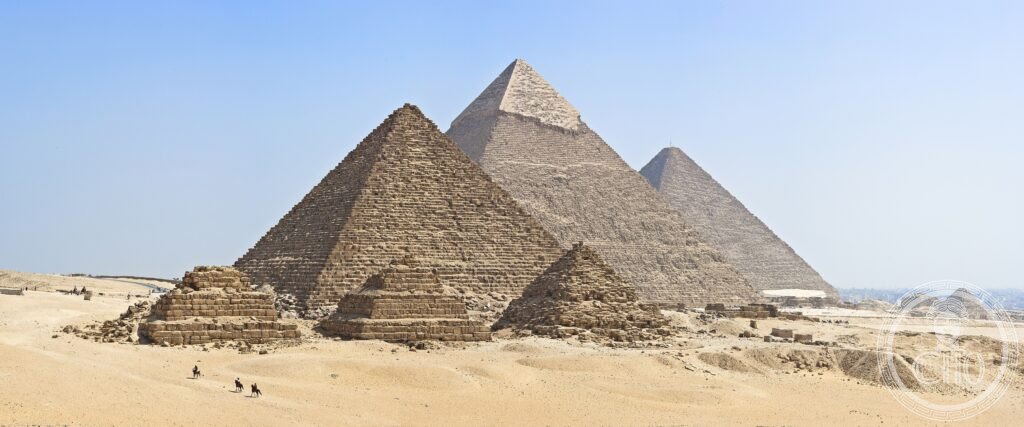
The Giza pyramid complex viewed from the south-west (the three main pyramids in descending order of height: the Great Pyramid of Khufu (Cheops; 146.5 m original height — the tallest man-made structure in the world for 3,800 years; the largest pyramid ever built; 2.3 million stone blocks averaging 2.5 tonnes each; the four faces of the Great Pyramid are aligned to the cardinal directions to an accuracy of 0.05° — the most precisely oriented large building in the history of architecture); the Pyramid of Khafre (136 m; still retains its original polished white Tura limestone casing at the apex — the finest surviving example of the smooth polished casing that originally covered all three Giza pyramids; the Sphinx stands in front of this pyramid on the same alignment axis (the Great Sphinx — 73 m long; 20 m tall; the oldest and largest monolithic statue in the world; the limestone head is carved from the same bedrock knoll as the base; the erosion debate (the water erosion hypothesis of John Anthony West and Robert Schoch (the most controversial single geological claim in Egyptology): that the weathering patterns on the Sphinx enclosure walls indicate ancient rain erosion inconsistent with the dynastic period; the orthodox view is that the Sphinx was built by Khafre c. 2500 BCE)); the Pyramid of Menkaure (65 m; the smallest of the three; the most finished in granite casing; the three satellite pyramids in the foreground), Giza Necropolis, Al Jizah Governorate, Egypt — UNESCO World Heritage Site 1979. Photo via Wikimedia Commons.
Giza Plateau, Al Jizah, Egypt · built c. 2560–2510 BCE (Old Kingdom; 4th Dynasty; pharaohs Khufu/Khafre/Menkaure); Great Pyramid (146.5m original; 138.8m today; 2.3M blocks avg 2.5t; aligned N-S-E-W to 0.05°; only wonder of the ancient world still standing); Sphinx (73m long; oldest monolithic statue in the world; eroded by Nile winds + sand over 4,500 years; the nose (broken c. 13th c. — most frequently misattributed vandalism in archaeology)); Solar Boat Museum; Light + Sound show nightly · UNESCO World Heritage 1979

Giza Pyramid Complex

The only surviving Wonder of the Ancient World and the most recognisable skyline in human history — the Giza Pyramid Complex, built on the west bank of the Nile in the 4th Dynasty of the Old Kingdom, is the culmination of 2,500 years of Egyptian funerary ambition: three perfect mountains of limestone that have silenced every visitor from Herodotus to Napoleon.

At a glance

The Giza Necropolis (UNESCO WHS 1979; the complex (the 3 main pyramids + the Great Sphinx + 8 smaller satellite pyramids + the workers’ village + the valley temples + the Solar Boat pit (the Khufu Ship: 43.6 m long; the finest ancient Egyptian boat in existence; the best-preserved wooden vessel from the ancient world; discovered in 1954 in a sealed pit at the foot of the Great Pyramid; reassembled from 1,224 pieces; now in the Grand Egyptian Museum)); the Great Pyramid of Khufu (the most precisely engineered large structure in the history of the world: the base is level to within 2.1 cm; the four sides are equal to within 58 mm; the alignment is within 0.05° of true north; all achieved without modern instruments — the most frequently cited engineering achievement in the absence of modern technology in any ancient monument); approximately 14 million visitors per year (the most visited archaeological site in Africa); the mythology (the Great Pyramid is associated with more pseudoscientific theories than any other monument in the world: alignment with Orion’s Belt; energy vortices; a second Sphinx; internal chambers yet to be discovered — the most productive site for alternative archaeology in the history of the genre; the orthodox Egyptological view (the scientific consensus) is that the pyramids were built as royal tombs by a workforce of approximately 20,000–30,000 skilled workers (not slaves as commonly believed) over approximately 20 years (the most misrepresented labour force in any ancient construction project)).

Key facts

  • The Great Pyramid of Khufu: the tallest man-made structure in the world for 3,800 years — the Great Pyramid (built c. 2560–2540 BCE for Pharaoh Khufu (Greek: Cheops; r. 2589–2566 BCE; 4th Dynasty Old Kingdom); the original height: 146.5 m (the tallest man-made structure in the world from its completion until 1311 CE when Lincoln Cathedral in England surpassed it — the most enduring architectural record in the history of construction: 3,800 years of supremacy); the current height: 138.8 m (7.7 m shorter due to the loss of the capstone and the uppermost casing stones); the volume: 2.6 million m³ (the largest by volume of all the Egyptian pyramids — the most massive limestone building in the world); the interior (the 3 known chambers: the King’s Chamber (the red Aswan granite chamber at the heart of the pyramid; 10.47 m × 5.23 m; the sarcophagus of Khufu (the red granite coffer; wider than the entrance passageway — it was placed in the chamber before the chamber was roofed; the most conclusive single evidence that the pyramids were funerary monuments); the Grand Gallery (the 46.68 m long corbelled stone passageway rising to the King’s Chamber; 8.6 m high; the most impressive single internal architectural space in the pyramid; the corbelling technique (stacking progressively inward courses of stone to form a vaulted ceiling) is the most advanced masonry technique in the Old Kingdom)); the muon tomography discovery (2017; the ScanPyramids project used cosmic-ray muon detectors to discover a previously unknown large void 30 m long above the Grand Gallery — the most important pyramid discovery since Belzoni entered the second pyramid in 1818; as of 2026, the void has been confirmed but its purpose and access remain unknown)
  • The Great Sphinx: the oldest large sculpture on Earth — the Great Sphinx (73 m long; 20 m tall; 19 m wide; a lion’s body with a human head; carved from the limestone bedrock of the Giza plateau (the single largest monolithic sculpture in the world; carved entirely from the natural bedrock with only minor repairs in sandstone and granite blocks; all from a single quarry-remnant knoll that was left after the limestone blocks for the pyramid were extracted — the most opportunistically used geological feature in the history of ancient sculpture); the face (the most debated single face in archaeology: the face is almost certainly a portrait of Pharaoh Khafre (r. 2558–2532 BCE) — the forensic facial analysis (the proportions match Khafre’s known portrait statues better than any other 4th Dynasty ruler); the nose (destroyed — the most frequently misattributed case of vandalism in Egyptian archaeology: Napoleon’s artillery soldiers are widely blamed (the most persistent false history in Egyptology) but drawings by the Danish traveller Norden from 1737 (before Napoleon) already show the nose missing; the most likely cause was iconoclasm by a 13th-century Sufi sheik named Muhammad Sa’im al-Dahr according to a 14th-century Arabic chronicle); the Dream Stele (the pink granite stele between the paws of the Sphinx: Pharaoh Thutmose IV (r. 1401–1391 BCE) records a dream in which the Sphinx (then half-buried in sand) asked to be dug out; Thutmose cleared the sand and erected the stele in gratitude — the first recorded major restoration of the Sphinx)
  • The construction of the pyramids: the most extensively researched ancient building project in archaeology — the workforce (the workforce village at Giza (discovered 1990 by Zahi Hawass and Mark Lehner; the most important single discovery at Giza since the 1940s): the barracks, bakeries, breweries, and medical facilities of the pyramid builders; the beer rations (approximately 4 litres per day per worker — the most precisely calculated ancient labour ration in Egyptian history; beer was both caloric and safer than unboiled Nile water); the workers were not slaves (the most important single correction in 20th-century Egyptology: the workers at Giza were skilled state employees, rotated in 3-month shifts, from across Egypt; they received wages in food, beer, and medical care; they were buried with some dignity at the site — the most unambiguous physical evidence against the slave-labour theory: the cemetery of the pyramid workers found near the workers’ village contains tombs indicating a workforce of citizens, not captives)); the logistics (the most important single engineering question at Giza: how were the 2.3 million stones moved into place; the ramp theory (the most widely accepted hypothesis: a linear or spiral construction ramp of sand and rubble; the evidence: traces of such ramps at several unfinished pyramid sites in Egypt; the weight (average block: 2.5 tonnes; the largest granite blocks in the King’s Chamber: 80 tonnes; brought from Aswan 880 km south — the most ambitious stone transport in the ancient world))
  • Heritage: UNESCO World Heritage Site, Memphis and its Necropolis, inscribed 1979
  • GPS: 29.9792° N, 31.1342° E

History

Old Kingdom Egypt (c. 2686–2181 BCE; the period of pyramid-building; the 4th Dynasty (c. 2613–2494 BCE) built the finest of the 130 known Egyptian pyramids; the evolutionary sequence: the Step Pyramid of Djoser (c. 2670 BCE at Saqqara; the first large stone building in the world; the architect Imhotep (the most celebrated individual architect in ancient history; deified after his death as the god of medicine and wisdom; the most multiply-talented person in early Egyptian history by ancient consensus); the Bent Pyramid and Red Pyramid of Sneferu at Dahshur (the first true smooth-sided pyramids; the engineering refinements of Sneferu (4th Dynasty founder) prepared the technology for the Giza pyramids)); the Great Pyramid of Khufu (c. 2560 BCE — the most ambitious of all); the Arabic conquest (641 CE; the Arab geographer Abd al-Latif al-Baghdadi (1162–1231) described the Giza pyramids in the most detailed medieval account: he saw the white limestone casing still intact and reported that the Arab Caliph al-Mamun (820 CE) had forced an entrance into the Great Pyramid — the first recorded forced entry into the pyramid since antiquity; the casing (the smooth white Tura limestone casing that once covered all three main pyramids was mostly removed from the 11th to 14th centuries to build the mosques and palaces of medieval Cairo — the most consequential quarrying of any ancient monument in history; the step-like appearance of the Great Pyramid is the exposed core; only Khafre’s pyramid retains its apex casing); UNESCO WHS 1979.

What you see

The Giza visit (the plateau is open from 8am–5pm; the combined ticket (the most comprehensive ticket at Giza: includes the three pyramids + the Sphinx + the Valley Temple + the solar boat museum (GEM supplementary); individual interior tickets additional; the interior of the Great Pyramid (the King’s Chamber visit: the most physically demanding tourist experience at any ancient monument: the ascending passageway (the final 40 m to the King’s Chamber requires stooping at 55° in a 1.1-m wide corridor in single file; the air temperature inside is constant at 18°C regardless of desert heat; the granite sarcophagus of Khufu (the oldest funerary vessel in any accessible pyramid interior; entirely empty since antiquity); the Solar Boat Museum (the Grand Egyptian Museum (GEM) (opened 2021 in the New Administrative Capital and the Giza plateau annex; the world’s largest archaeological museum; the Khufu Ship in its climate-controlled hall is the centrepiece of the Giza-area exhibits); the camel and horse rides (the plateau offers camel and horse rides; negotiate the price firmly before mounting — the most frequently cited Giza visitor warning in every travel guide since 1980); the night show (the Sound and Light Show: nightly; the illuminated Sphinx narrates 5,000 years of Egyptian history; the most melodramatic monologue delivered by any stone monument in any country).

Practical information

  • Getting there: Cairo International Airport (CAI; the busiest airport in Africa; 40 km north-east of Giza; approximately 1h by taxi (EGP 300–500; negotiate or use Uber); the Giza plateau is 25 km from central Cairo (Tahrir Square; 45 min by taxi or the Cairo Metro (line 2; Giza station + 20 min taxi); the best approach (the most visually dramatic approach to the pyramids): the Faisal Street-Pyramids Road corridor from Giza station in a taxi at dawn (arrive at the Mena House hotel roundabout and the pyramids appear above the city rooftops for the first time as you round a corner — the most cinematic single urban approach to any UNESCO site in the world after approaching the Acropolis at Athens)); the Giza plateau ticket office (tickets: EGP 450 general entry (foreigners); interior of the Great Pyramid: EGP 600 extra (limited to 300 visitors per day; book through official Egypt tourism channels); the Solar Boat Museum / GEM visit: separate admission); the timing (the most important single Giza scheduling decision: ALWAYS go at opening (8am) to be first on the plateau — by 9am tour buses arrive from Cairo; by 10am the plateau is crowded; by noon the desert heat (40°C+ in summer) makes the visit gruelling; the best months: October–March)
  • The Grand Egyptian Museum (GEM) and Cairo: the finest collection of Egyptian antiquities in the world — the Grand Egyptian Museum (opened 2023 at the foot of the Giza plateau; the world’s largest archaeological museum dedicated to a single civilisation (500,000 m² total; 100,000 m² exhibition space — the most impressive single archaeological museum in Africa and among the largest in the world by floor area; the Tutankhamun galleries (the complete treasure of the tomb of Tutankhamun (discovery: November 1922 by Howard Carter and Lord Carnarvon; the most celebrated archaeological discovery of the 20th century; the 5,398 objects from the tomb (the largest collection of objects from any single ancient Egyptian tomb — all previously exhibited partially in the Egyptian Museum in Tahrir Square; now transferred completely to the GEM); the famous gold mask (the most recognisable single artefact from any archaeological site in the world: the solid gold funerary mask of Tutankhamun (11 kg of solid gold inlaid with lapis lazuli, turquoise, obsidian, and coloured glass); the Grand Atrium (the staircase lined with 87 colossal statues of Ramesses II — the most ambitious single museum entry sequence in the world))
  • Luxor and the Valley of the Kings: the other half of Egyptian antiquity — Luxor (700 km south of Cairo (1h by EgyptAir; the most convenient domestic air connection in Egypt: 5–7 flights per day Cairo–Luxor; or 10h overnight sleeper train from Cairo (the most scenic train journey in Egypt: the Nile valley and the river seen from the train in the early morning)); the Valley of the Kings (the most important funerary site in Egypt after Giza: 64 tombs cut into the limestone hillside on the west bank of the Nile opposite Luxor; the tomb of Tutankhamun (KV62; the most famous individual tomb; the only one found with its contents intact in the 20th century (the Howard Carter / Lord Carnarvon discovery 4 November 1922 — the most consequential single day in the history of Egyptology)); the Karnak Temple Complex (the most extensive ancient religious complex in the world: 250,000 m² of temples, obelisks, pylons, and colonnades built by successive pharaohs from the Middle Kingdom (c. 2000 BCE) to the Ptolemaic period (30 BCE); the Hypostyle Hall (the most impressive single ancient Egyptian interior: 134 columns in 16 rows; the tallest columns 23 m high — the most cavernous single hypostyle hall in the ancient world))

Getting there

Cairo Airport (CAI) 40 km. Taxi to plateau 45min (negotiate or use Uber). Metro Line 2 to Giza station + 20min taxi. Entry EGP 450 foreigners; interior Great Pyramid EGP 600 extra (limited 300/day). Go at 8am opening. GPS: 29.9792, 31.1342.

Nearby

  • Saqqara (Step Pyramid of Djoser) and Dahshur (Bent/Red Pyramids) — 25–45 km south of Giza (40–70 min by car); the predecessor and companion pyramids that explain the evolution of the Giza pyramids — Saqqara (the Step Pyramid of Djoser (c. 2670 BCE; the first large stone building in the world; architect Imhotep; the 6 superimposed mastabas forming a stepped mountain 62 m high; the most important single building in the history of large-scale stone construction); Dahshur (the Bent Pyramid of Sneferu (c. 2600 BCE; the pyramid that changed angle halfway up (54.5° at the base, 43° at the top) when the engineers feared collapse — the most visible engineering adjustment in any ancient pyramid and the most honest record of a construction problem in the history of monumental architecture); the Red Pyramid at Dahshur (the first true smooth-sided pyramid; the model for Giza; the interior is fully accessible with no crowds — the most accessible and least-visited of the three great Old Kingdom pyramids))
  • The Grand Egyptian Museum (GEM) — immediately adjacent to the Giza plateau (walk or short shuttle ride); described in the Practical section; the GEM + Giza plateau is the most complete single-day Egyptian antiquity experience in the world: 4h on the plateau (pyramids + Sphinx + solar boat pit) + 3h in the museum (Tutankhamun + colossal statuary + the royal mummies gallery)
  • Alexandria — the most cosmopolitan city in ancient history — 220 km north of Cairo (2h 30min by train or 3h by road; the fastest train is the Spanish-built intercity express from Cairo Sidi Gaber); the Bibliotheca Alexandrina (the modern successor to the ancient Library of Alexandria (the most celebrated library of the ancient world; founded c. 285 BCE by Ptolemy I; destroyed between the 1st century BCE and the 7th century CE — the most debated single destruction event in intellectual history); the new library (opened 2002; the most architecturally ambitious library in the Arab world; the tilted disc roof; the 11 floors cascading into the Mediterranean; the holdings: 8 million documents; the most important map collection in Africa)); the Catacombs of Kom el Shoqafa (the most elaborate Greco-Roman funerary complex in Egypt: three levels of chambers cut into the bedrock in the 2nd century CE; the blending of Egyptian, Greek, and Roman funerary iconography in the same space — the most syncretic decorative programme in any ancient tomb complex)

Sources

  • Wikipedia, Giza pyramid complex; Great Pyramid of Giza; Great Sphinx of Giza; Khufu Ship, accessed June 2026
  • UNESCO, Memphis and its Necropolis — the Pyramid Fields from Giza to Dahshur, WHS reference 86, inscribed 1979
  • Mark Lehner, The Complete Pyramids, Thames and Hudson, 1997

Hero image: Giza Pyramid Complex, Wikimedia Commons. Editorial text © Cultural Heritage Online, 2026.

📷 Diventa un fotografo di Cultural Heritage Online

Condividi le tue foto dei luoghi: restano pubblicate con la tua firma come autore. Più vengono viste, più ti fai conoscere — e presto un concorso premierà le foto più apprezzate.

Accedi o registrati gratis per aggiungere una foto
📋 Copy & share on social
Scroll to Top