

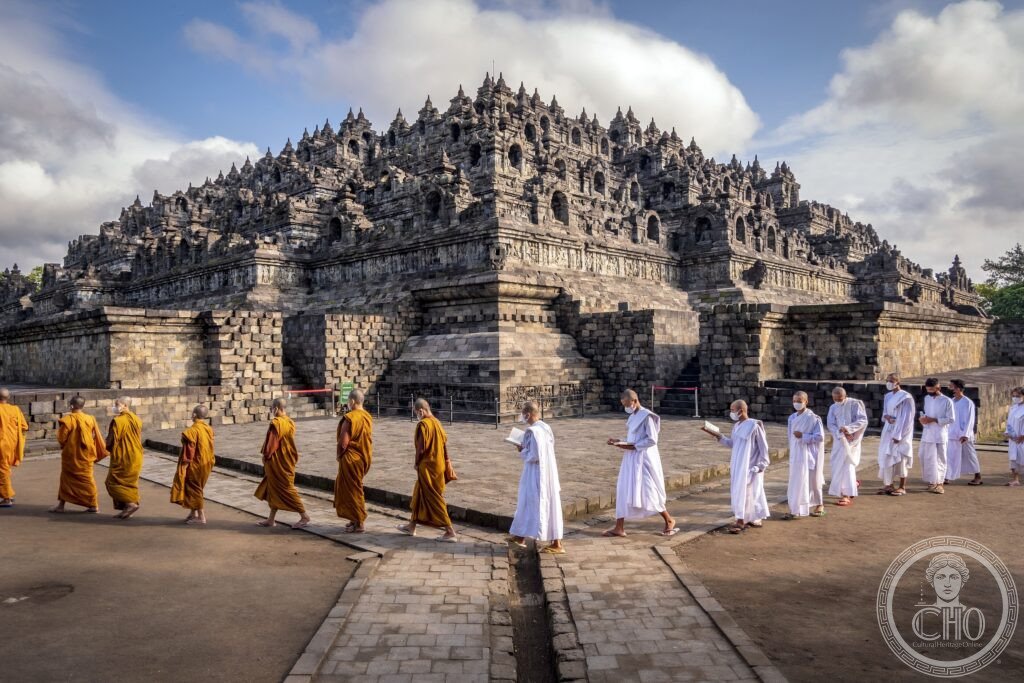
Borobudur is a stone mandala the size of a hill, its nine platforms rising through three tiers of Buddhist cosmology to a single hollow stupa at the summit. Walking its galleries in sequence traces, panel by panel, the entire Mahayana Buddhist path from desire to formlessness.
At a glance
Borobudur is built as a flat-topped artificial hill of andesite stone, arranged as nine stacked platforms: six lower square terraces of enclosed gallery corridors, three upper circular terraces of open lattice-work stupas, and a single summit stupa. The plan reads as a mandala when seen from above, and the whole structure corresponds to the three realms of Buddhist cosmology, from the world of desire at the base to the world of formlessness at the top.
The lower galleries carry roughly 4.5 kilometres of continuous relief carving across 2,672 panels, narrating episodes from the life of the Buddha, his previous incarnations, and a pilgrim’s journey towards enlightenment. The upper terraces hold 72 stupas, each sheltering a seated Buddha, while niches on the gallery walls hold further Buddha statues in different hand gestures according to their cardinal direction.
Key facts
- Built: c. 760–830 CE, under the Sailendra dynasty, Mahayana Buddhist patrons
- Material: around 55,000 m³ of andesite stone, cut and fitted without mortar
- Structure: nine platforms, base 121 metres square, summit stupa 35 metres above ground
- Relief panels: 2,672 panels across roughly 4.5 km of gallery corridor
- Buddha statues: hundreds of statues across gallery niches and the 72 stupas of the circular terraces
- Heritage status: UNESCO World Heritage Site, Borobudur Temple Compounds, inscribed 1991
History
Borobudur was raised by the Sailendra dynasty, whose name is traditionally read as ‘Lords of the Mountain’, on the Kedu Plain of Central Java. The dynasty maintained links with the Srivijaya Empire in Sumatra and with the Buddhist monastic centre of Nalanda in India, contacts reflected in the iconography of the temple’s reliefs. Construction is thought to have taken some seventy years.
The temple was abandoned around 900–1000 CE. The cause is not established with certainty, though the most commonly cited factors are an eruption of Mount Merapi, which buried the site in ash and disrupted the agricultural surplus supporting the Sailendra court, and a shift of Javanese power eastward towards the Brantas valley and eventually Bali.
Borobudur remained buried until 1814, when Thomas Stamford Raffles, then British Lieutenant-Governor of Java, sent the Dutch engineer H.C. Cornelius to investigate reports of a hidden temple; Cornelius and a team of workers cleared jungle and ash to expose the main stupa. A first systematic restoration was carried out between 1907 and 1911 by the Dutch engineer Theodore van Erp. A far larger restoration, undertaken jointly by the Indonesian government and UNESCO between 1973 and 1983, involved dismantling, cleaning and reassembling the stones with improved drainage.
What you see
Seen from above, Borobudur resolves into a complete mandala: the square lower terraces give way to three circular platforms crowded with bell-shaped, lattice-work stupas, each holding a seated Buddha, before the eye reaches the plain summit stupa. On the ground, visitors walk the enclosed galleries of the lower terraces, where the relief panels run almost uninterrupted along the walls, before emerging onto the open circular terraces with their rows of stupas and views out over the Kedu Plain.
Beneath the visible base lies a hidden foot, briefly excavated in the nineteenth century, carved with a further set of reliefs depicting the consequences of human desire; these were covered over with a stone casing not long after the temple’s completion. The summit stupa itself was found empty when opened, and its original contents, if any, remain unknown.
Beyond the temple, the horizon is ringed by volcanoes, among them Mount Merapi, an active volcano a short distance to the north-east, visible from the upper terraces on a clear day.
Practical information
- Visiting: the site is open to the public with entry through a managed archaeological park; current hours and ticketing are best checked on the official Borobudur site channels.
- On site: galleries are walked clockwise from base to summit, following the traditional pilgrimage route.
- Nearby volcano watch: Mount Merapi remains active, and visitors should follow official advisories on access to the area around the volcano.
Getting there
Borobudur stands on the Kedu Plain in Magelang Regency, Central Java. For current transport options and access arrangements, visitors are advised to consult the site’s official information channels.
Nearby
- Mount Merapi — around 8 km north-east, an active volcano visible from the temple’s upper terraces
- Prambanan — a Hindu temple complex forming a counterpart to Borobudur’s Buddhist context
Sources
- UNESCO World Heritage Centre
Find it on the map
See this place and what’s around it →📷 Become a Cultural Heritage Online photographer
Share your photos of places: they stay published under your name as the author. The more they're seen, the more you get noticed — and soon a contest will reward the most appreciated photos.
Log in or sign up free to add a photo