
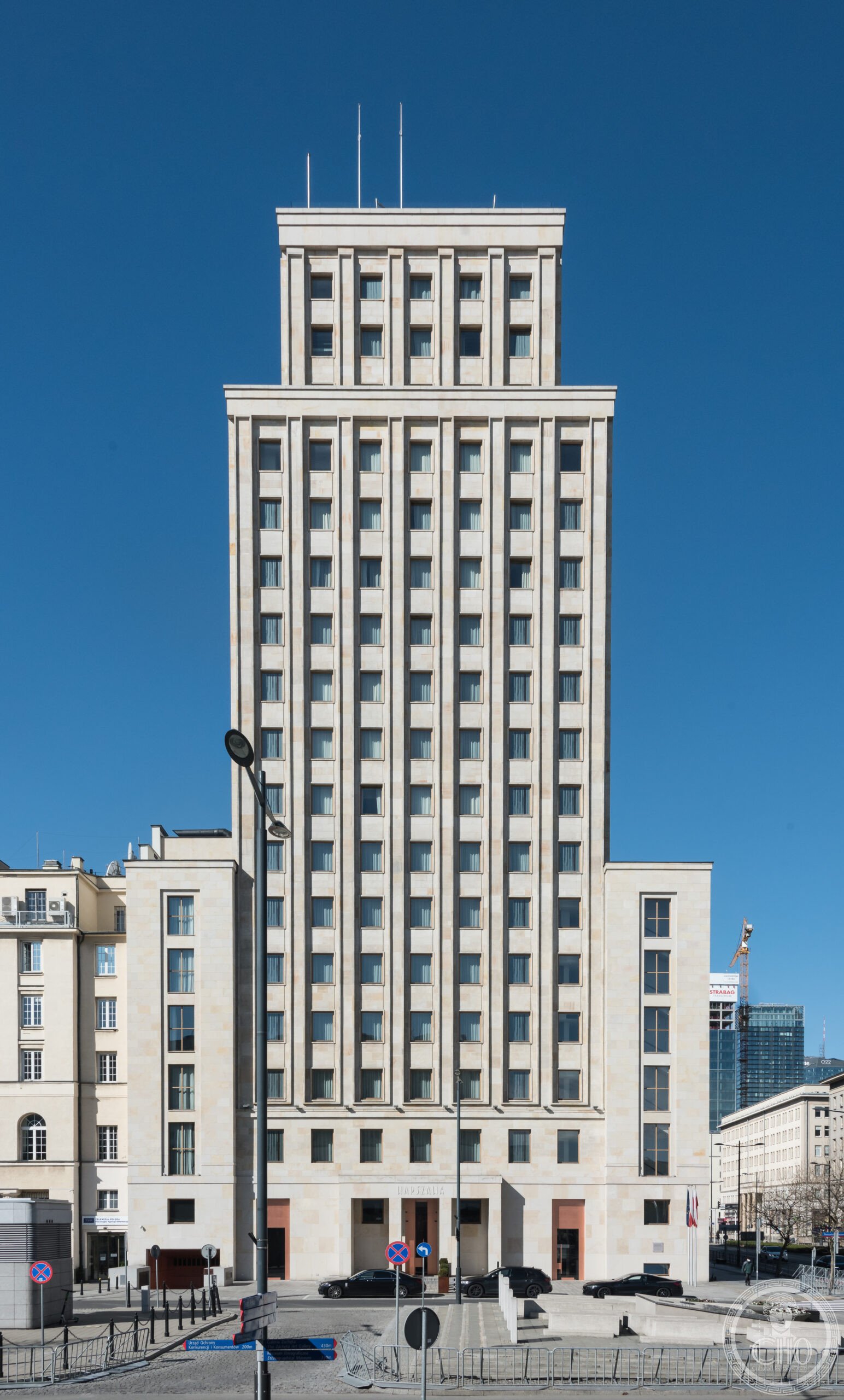
Prudential House — officially reborn as Hotel Warszawa — is a landmark Art Deco skyscraper standing at Warsaw Insurgents Square, Poland. Completed in 1933 for the British Prudential insurance company, it soared 66 metres over the city and was briefly the sixth-tallest building in Europe. Its steel-framed tower hosted the first television broadcasts on the continent in 1936. During the 1944 Warsaw Uprising, some one thousand artillery shells struck the building, including a two-tonne Karl-Gerät mortar round, reducing it to a skeletal frame that became a symbol of the city’s defiance and suffering. Painstakingly rebuilt and repurposed as a hotel, it was fully restored to its pre-war Art Deco facades in 2010 and reopened as a five-star hotel in 2018, reclaiming its place as one of Warsaw’s most resonant architectural monuments.
At a glance
- Type
- Skyscraper / Hotel
- Period
- 1931–1933 (original); rebuilt 1948–1954; restored 2010–2018
- Style
- Art Deco
- Location
- Warsaw Insurgents Square, Świętokrzyska Street, Warsaw, Poland
- Coordinates
- 52.2356° N, 21.0128° E
- Architect(s)
- Marcin Weinfeld (design); Stefan Bryła and Wenczesław Poniż (steel framework)
Overview
Prudential House was Warsaw’s tallest building at its 1933 completion, a steel-framed tower clad in Art Deco limestone rising 66 metres above Świętokrzyska Street. Commissioned by the British Prudential Assurance Company, it dominated the interwar skyline and remained the city’s highest structure until the Palace of Culture and Science was completed in 1955. Today, restored to its original silhouette and operating as a five-star hotel, it stands as one of the most historically layered buildings in Central Europe, carrying within its fabric the full arc of Warsaw’s twentieth-century story — ambition, catastrophe, reconstruction, and revival.
History
Construction began in 1931 to designs by architect Marcin Weinfeld, with structural engineers Stefan Bryła and Wenczesław Poniż devising a pioneering all-welded steel skeleton. The tower opened in 1933 and quickly became a civic landmark; in 1936 a 27-metre antenna on its roof carried Europe’s first television broadcasts. During the 1944 Warsaw Uprising, German artillery targeted the building relentlessly — approximately one thousand shells struck it, including a massive two-tonne Karl-Gerät mortar projectile. Only the steel skeleton survived. The ruined frame became an iconic image on postwar anti-war posters. Soviet-era reconstruction converted it into Hotel Warszawa, which operated from 1954. A comprehensive restoration completed in 2010 reinstated the Art Deco facades, and the hotel reopened under the name Hotel Warszawa in November 2018 after a full interior overhaul.
Architecture & Design
Weinfeld’s design belongs firmly to the Art Deco vocabulary fashionable across European capitals in the early 1930s: a tiered, setback massing clad in pale limestone, with restrained geometric ornament emphasising verticality. The building’s most technically innovative feature was its all-welded steel frame, engineered by Stefan Bryła — a then-novel construction method that proved structurally decisive when wartime bombardment stripped the exterior to bare steel yet left the skeleton standing. The 2010 restoration was guided by archival photographs and surviving drawings, reintroducing the original cornice profiles, window surrounds, and entrance detailing that Socialist-era renovations had obscured.
Cultural significance
Few buildings anywhere encapsulate a city’s history as completely as Prudential House. It was Warsaw’s statement of metropolitan modernity in 1933, a broadcasting pioneer in 1936, and a monument of resistance and destruction in 1944. The image of its bombed-out skeleton — reproduced on the famous postwar poster by Tadeusz Trepkowski — entered the global iconography of wartime devastation. Its survival and restoration are read by Varsovians as a metaphor for the city itself: destroyed but not erased, rebuilt with determination, and restored to its original dignity.
Visiting today
The building operates as Hotel Warszawa, a five-star property with 142 rooms and suites. The ground-floor public areas — lobby, bar, and restaurant — are accessible to non-guests and showcase the restored Art Deco interiors. The hotel’s rooftop offers panoramic views of central Warsaw. Guided architectural tours of the building are available on request through the hotel concierge. The surrounding Warsaw Insurgents Square is itself a significant public space with monuments and memorials worth exploring on foot.
Getting there
Hotel Warszawa sits on Świętokrzyska Street at Warsaw Insurgents Square in central Warsaw. The nearest metro station is Świętokrzyska (Lines M1 and M2 interchange), a two-minute walk away. Multiple tram and bus lines stop directly on Aleje Jerozolimskie and Marszałkowska Street nearby. Warsaw Chopin Airport is approximately 7 km south; the city centre is well served by taxi, Uber, and direct bus line 175.
Sources & resources
Find it on the map
See this place and what’s around it →Record researched and written by Luigi De Marchi for Cultural Heritage Online, 2026.
📷 Become a Cultural Heritage Online photographer
Share your photos of places: they stay published under your name as the author. The more they're seen, the more you get noticed — and soon a contest will reward the most appreciated photos.
Log in or sign up free to add a photoIs this page about you?
This page is read by travellers and heritage enthusiasts who find it on Google. Tell us how you are connected to this place and we will take it from there.