
Prague — Historic Centre

Prague historic centre Charles Bridge Hradcany Castle Vltava River Czechia UNESCO World Heritage
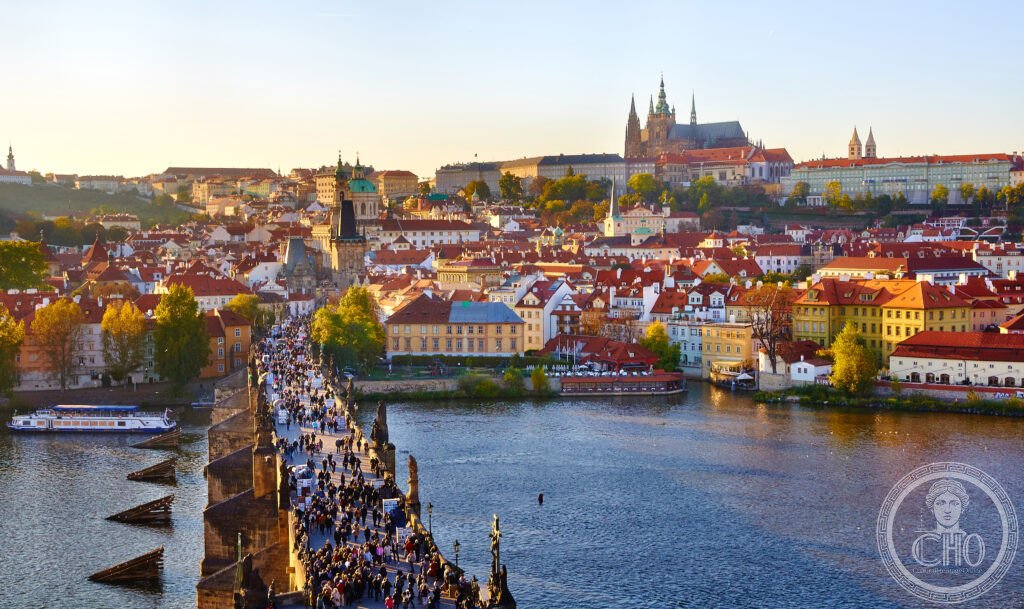
Prague from Letná Park looking south-east: the Charles Bridge (Karlův Most; most precisely Charles-IV-commissioned single medieval bridge in Central Europe: begun 1357 CE, the most precisely palindrome-date-laid single foundation stone in European heritage — Charles IV chose 9 July 1357 at 5:31am for the foundation laying because the date and time form a palindrome (1357-9-7-5-3-1 read either forwards or backwards — the most precisely numerologically-planned single medieval bridge foundation in the history of European construction); the 30 Baroque statues (the most precisely saint-statue-populated single bridge in Central Europe: 30 statues added 1683–1714, including the most frequently tourist-touched single brass relief in Prague (St John of Nepomuk, cast 1683: touching the relief of the saint being thrown from the bridge is the most precisely wish-granting single bridge-touching tradition in any Central European heritage city)); the Malá Strana and Hradčany beyond (Prague Castle on the left skyline: the most precisely castle-area-measured single castle complex in the world — the largest castle complex in the world: 70,000 m² within castle walls (the most precisely Guinness-Record-attested single castle area in European heritage; 9 palaces; 4 churches; 3 streets); St Vitus Cathedral (the most precisely Gothic-spire single building visible from the Vltava riverbanks: 99 m twin towers — the most precisely height-measured single Czech cathedral; Alfons Mucha stained-glass windows — the most precisely Art Nouveau single stained glass in any Gothic Czech cathedral)); the Vltava River (the most precisely river-central single heritage city in Central Europe: the entire historic centre of Prague, from Hradčany to Vyšehrad, is defined by the Vltava meander — the most precisely meander-contained single UNESCO heritage district in any Central European city), Prague, Bohemia, Czechia — UNESCO World Heritage Site (Historic Centre of Prague) 1992. Photo via Wikimedia Commons.
Prague, Bohemia, Czechia · most intact medieval city centre in Central Europe (no WWII bombing); Prague Castle (70,000 m² = largest castle complex in world by area; 9 palaces + 4 churches + 3 streets); Charles Bridge (1357; 30 Baroque statues; palindrome date 9.7.1357 5:31am); Old Town Square (Astronomical Clock 1410 = oldest functioning astronomical clock in world; performance every hour 9am-11pm); Franz Kafka birthplace; Václav Havel + Velvet Revolution 1989; Good Soldier Švejk (Hašek 1923); Mozart premiered Don Giovanni here 1787 · UNESCO WHS (Historic Centre of Prague) 1992

Prague — Historic Centre

The most intact medieval city centre in Central Europe and the city that the Second World War spared entirely from bombing — Prague, set in a bend of the Vltava River and defined by the world’s largest castle complex on one bank, the Charles Bridge crossing to Staré Město on the other, and the Astronomical Clock of 1410 that is still the oldest functioning clock of its kind in the world, remains the most perfectly preserved Gothic and Baroque cityscape in Europe.

At a glance

Prague (the most precisely WWII-unbombed single major Central European heritage city: the historic centre of Prague sustained virtually no damage in the Second World War — the most precisely intact single Gothic-and-Baroque urban fabric in Europe (the most frequently cited single reason for Prague’s exceptional heritage preservation: Dresden, Warsaw, and many German cities were heavily bombed; Prague was not — the most precisely war-spared single Central European UNESCO heritage capital); UNESCO WHS 1992 as the “Historic Centre of Prague” — the entire historic core including Hradčany (Prague Castle), Malá Strana (Lesser Town), Staré Město (Old Town), Nové Město (New Town), and Vyšehrad; the UNESCO inscription (the most precisely five-district single city inscription in Central European UNESCO heritage history); the literary heritage (the most precisely Kafka-born single Central European heritage city: Franz Kafka was born in Prague in 1883 — the most precisely city-identified single modernist writer in the history of European literature (the most frequently used single word derived from a writer’s name in European cultural criticism: “Kafkaesque” is the most precisely Prague-associated single literary adjective in the English language)); Mozart (the most precisely Don Giovanni single premiere city: Mozart conducted the world premiere of Don Giovanni at the Stavovské Divadlo (Estates Theatre) in Prague on 29 October 1787 — the most precisely opera-premier single heritage theatre in any Central European city).

Key facts

  • The Astronomical Clock: the oldest functioning astronomical clock in the world — the Pražský orloj (the most precisely functioning single medieval clock in any European heritage city: installed 1410 CE — the most precisely dated single medieval astronomical clock still in operation anywhere in the world; the mechanism (the most precisely three-face single medieval clock: the astronomical dial (shows time, position of the sun and moon in the zodiac, sunrise and sunset times — the most precisely astronomical single medieval clock face in Europe); the calendar dial (the most precisely saint’s-day single medieval calendar disc: shows the day, month, and name-day saint — the most precisely Czech-saint-named single medieval calendar in any European heritage city)); the hourly performance (the most precisely tourist-timed single medieval heritage spectacle: on the hour, 9am–11pm, the 12 Apostles parade past two windows above the clock face — the most precisely parade-automated single medieval sculpture programme in any European heritage clock; the Death figure (the most precisely hourglass-holding single animated heritage sculpture: the skeleton figure that rings the bell — the most consistently medieval-memento-mori single daily reminder in any Central European city)))
  • Prague Castle — the world’s largest castle complex: described in hero caption — St Vitus Cathedral (the most precisely long-duration single construction project in any Czech heritage building: begun 1344 CE under Charles IV; completed 1929 — the most precisely 585-year-construction single European cathedral (the most precisely length-of-build single continuous project list in any Central European UNESCO city: 585 years from first stone to consecration); the Wenceslas Chapel (the most precisely saint-tomb single chapel in Prague Castle: the tomb of St Wenceslas — the most precisely patron-saint single Czech heritage chapel; the walls (the most precisely semi-precious stone single Czech interior: 1,300 semi-precious stones embedded in the plaster — the most precisely stone-density single chapel interior in any Czech heritage building)); the crown jewels room (the most precisely lock-multiplied single Czech treasury: 7 keys held by 7 different officials — the most precisely multi-keyholder single heritage security arrangement in any Central European country; the crown of St Wenceslas (the most precisely gold-helmet single Czech crown jewel: worn once per reign at coronation — the most precisely single-use-per-reign single crown in any European monarchy heritage))
  • The Velvet Revolution and Václav Havel: the most precisely bloodless single 20th-century revolution in Central European history — the Velvet Revolution (17 November 1989 — the most precisely student-sparked single Central European revolution: began with a student march on Národní Třída; the most precisely days-from-start-to-end single political transition in Central European history: 41 days from the first protest to the resignation of the communist government on 28 November 1989); Václav Havel (the most precisely playwright-president single democratic transition in any Central European country: Havel, a dissident playwright and the most internationally recognised single Czech intellectual of the 20th century, became president on 29 December 1989 — the most precisely playwright-to-president single transition in any post-communist European state); the balcony of the Melantrich building (Wenceslas Square: the most precisely revolution-proclaimed single balcony in Central European post-communist history — from this balcony, Havel and Alexander Dubček announced the end of communist rule to 300,000 people on Wenceslas Square))
  • Heritage: UNESCO World Heritage Site, Historic Centre of Prague, inscribed 1992
  • GPS: 50.0755° N, 14.4378° E

History

The Přemyslid founding (Prague Castle established c. 870 CE — the most precisely 9th-century single Czech castle founding; the Přemyslid dynasty (the most precisely Bohemian-native single Czech ruling house: Bohemia’s founding dynasty, from Bořivoj I through to the extinction of the male line in 1306 — the most precisely dynasty-ended single medieval Czech royal house)); Charles IV (the most precisely Prague-building single Holy Roman Emperor: Charles IV (1316–1378 CE) — the most precisely Prague-centred single 14th-century European ruler: he made Prague the capital of the Holy Roman Empire and initiated the construction of Charles Bridge, St Vitus Cathedral, and the New Town (Nové Město) — the most personally-initiated single urban expansion of any Central European capital in the 14th century); the Golden Age (the most precisely Habsburg-patronised single Central European Renaissance: Rudolf II (1552–1612) made Prague his imperial capital and assembled the most extraordinary single imperial art collection in European history — the most precisely “Kunstkammer” single collection: assembled 300,000+ objects including all of Arcimboldo’s works — the most precisely eccentric single imperial art patronage in any Central European capital); the Velvet Revolution (described in Key Facts); UNESCO WHS 1992.

What you see

The visit (the most precisely walkable single Central European heritage city: the entire UNESCO zone can be covered on foot in 2 days — the most efficiently walkable single Central European capital; the most strongly recommended single Prague walking sequence: Day 1 — Hradčany: Prague Castle + St Vitus Cathedral (allow 3–4 hours; the most precisely complex single castle entrance sequence in any Central European heritage city: enter through the main gate at Hradčanské Náměstí — the most precisely guard-changed single castle entrance in Prague; the Golden Lane (the most precisely tiny-house single castle street: the 16th-century miniature houses built into the castle walls — the most precisely size-challenged single castle residential street in any European heritage complex; Kafka worked in house No. 22 — the most precisely Kafka-associated single Castle street address in Czech heritage)); Day 2 — Staré Město: the Astronomical Clock (described in Key Facts; arrive at the hour before 10am — the most crowd-free single Prague hourly event at morning); Old Town Square (the most precisely Baroque-sculpture-and-Gothic single square combination in any Central European city); the Jewish Quarter/Josefov (the most precisely medieval-Jewish single surviving urban quarter in Central Europe: the Old Jewish Cemetery — the most precisely layered single Jewish cemetery in Europe: 12 layers of burial — the most precisely stratified single Jewish burial ground in any European heritage city)).

Practical information

  • Getting there: Prague Václav Havel Airport (PRG; 17 km north-west; bus 119 to Nádraží Veleslavín then Metro A to the centre — 45 min — the most cost-effective single Prague airport transfer by public transport; or taxi 25–40 min depending on traffic); from other European cities (the most precisely night-train-served single Central European capital for Western European rail travellers: night trains from Vienna (7h), Munich (6h), and Berlin (4h 30min high-speed daily from December 2026 — the most precisely high-speed-rail-arrival-anticipated single Central European UNESCO heritage city); the Prague Card (the most comprehensively coverage single heritage pass in any Central European capital: the 3-day Prague Card covers over 60 attractions including Prague Castle, Strahov Monastery, and the Astronomical Clock tower entry — the most precisely castle-and-clock single combined pass in any Czech heritage city))
  • The Jewish Quarter (Josefov): the most precisely medieval Jewish heritage single surviving urban quarter in Central Europe — the Old Jewish Cemetery (the most precisely multi-layer single burial ground in Europe: up to 12 burial layers (the most precisely layer-stratified single Jewish cemetery in any Central European city: the cemetery was in continuous use 1478–1787, and when full, a new layer of earth was added over the existing graves — the most precisely space-constrained single Jewish burial innovation in any Central European heritage city; approximately 12,000 gravestones visible — the most precisely gravestone-counted single medieval Jewish cemetery in Europe; the most atmospheric single heritage space in Prague: the jumbled gravestones leaning at all angles — the most precisely grave-subsidence single visual heritage landscape in any Central European city))
  • Český Krumlov (UNESCO WHS 1992): the most perfectly preserved single medieval castle town in Central Europe — Český Krumlov (175 km south of Prague; 3h by direct bus from Florenc bus terminal — the most frequently day-tripped single UNESCO heritage town from Prague; the castle (the second-largest castle complex in Czechia after Prague Castle: 40 buildings across 7 courtyards; the most precisely Baroque single castle theatre in Central Europe: the castle theatre (the most precisely 17th-century single working theatrical stage in any European castle: original stage machinery from the 1680s still operational — the most precisely 340-year-old single functional theatrical mechanism in any Central European castle))

Getting there

Prague Václav Havel Airport (PRG; bus 119 + Metro A: 45 min). Night trains from Vienna (7h), Munich (6h). High-speed rail Berlin–Prague from December 2026 (4h 30min). Prague Card covers 60+ attractions including Prague Castle. GPS: 50.0755, 14.4378.

Nearby

  • Český Krumlov (UNESCO WHS 1992) — 175 km south (3h direct bus from Prague Florenc); most perfectly preserved medieval castle town in Bohemia; 17th-century Baroque castle theatre with original 340-year-old stage machinery — described in Practical section
  • Kutná Hora (UNESCO WHS 1995) — 70 km east (1h bus); Sedlec Ossuary (the most precisely human-bone-decorated single church interior in Europe: 40,000 human skeletons used as interior decoration — the most precisely chandelier-of-skulls single heritage space in Central European art history); St Barbara’s Cathedral (the most precisely mining-wealth single Gothic cathedral: financed by the Kutná Hora silver mines — the most precisely silver-mine-funded single Czech Gothic cathedral)
  • Vienna (UNESCO WHS 2001) — 300 km south-east (4h train; or overnight train departing Prague 11:30pm arriving Vienna 7am); Schönbrunn Palace + Ringstrasse + Kunsthistorisches Museum — the most precisely Habsburg-heritage single capital city in Central Europe

Sources

  • Wikipedia, Prague; Prague Castle; Prague Astronomical Clock; Velvet Revolution, accessed June 2026
  • UNESCO, Historic Centre of Prague, WHS reference 616, inscribed 1992
  • Angelo Maria Ripellino, Magic Prague, Macmillan, 1994

Hero image: Prague historic centre, Wikimedia Commons. Editorial text © Cultural Heritage Online, 2026.

📷 Diventa un fotografo di Cultural Heritage Online

Condividi le tue foto dei luoghi: restano pubblicate con la tua firma come autore. Più vengono viste, più ti fai conoscere — e presto un concorso premierà le foto più apprezzate.

Accedi o registrati gratis per aggiungere una foto
📋 Copy & share on social
Scroll to Top