
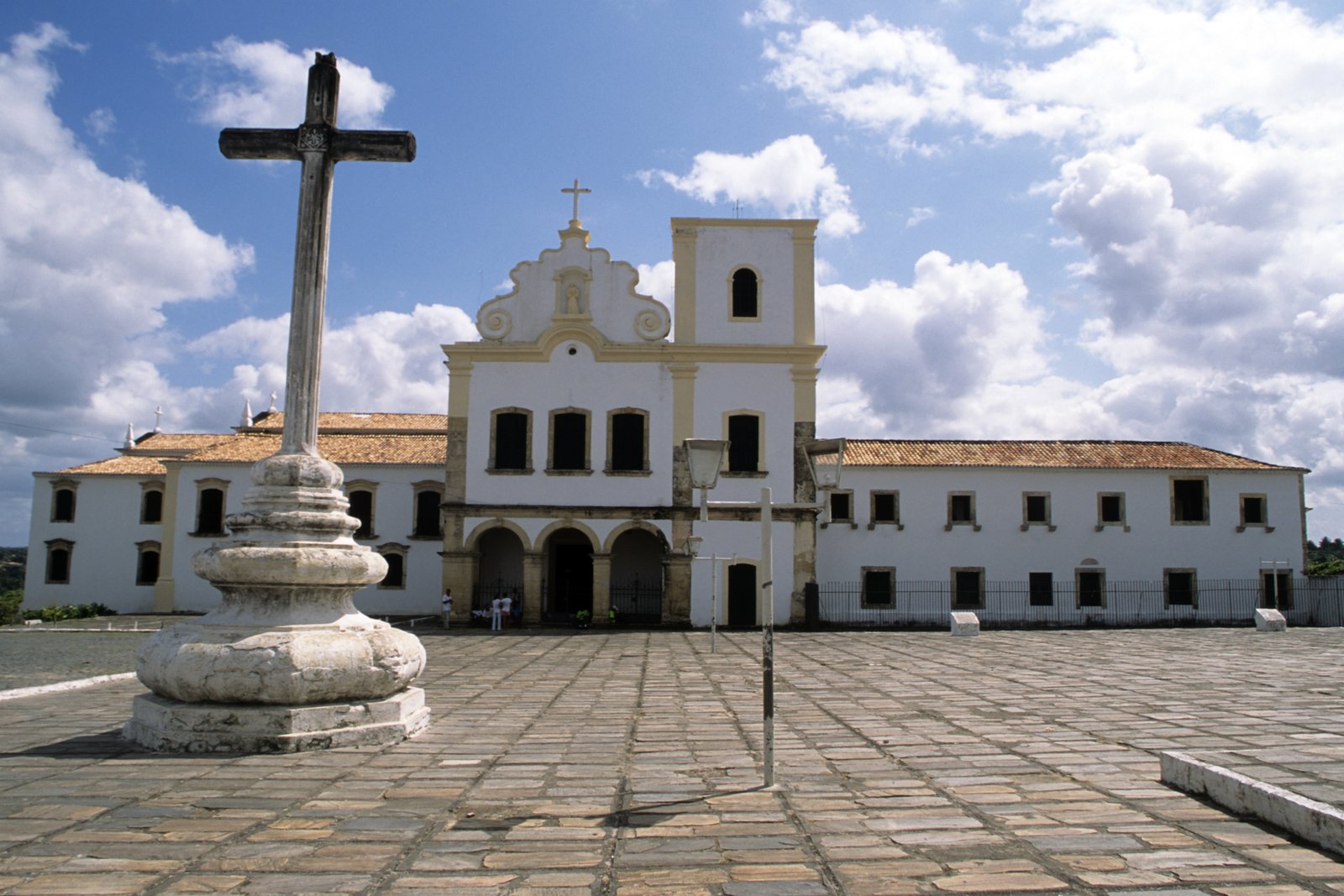
A singular colonial ensemble: the only public square in Brazil where four major religious and civic institutions from the 16th–18th centuries frame a single rectangular space — a UNESCO World Heritage Site since 2010.
At a glance
Praça São Francisco sits at the heart of São Cristóvão, one of the oldest colonial towns in Brazil and the historic capital of Sergipe state in the northeast. Founded in 1590, the town climbs a dramatic hilltop above the Poxim River, and its central square is the focal point of a largely intact 16th–18th century urban fabric. The UNESCO inscription (2010) covers the square and its four surrounding monuments — a Franciscan church and convent, a Misericórdia church, the former Provincial Palace, and the former Jesuit school — celebrated as an exceptional example of Portuguese colonial urbanism in the Americas.
Key facts
- UNESCO designation: World Heritage Site, 2010
- Location: São Cristóvão, Sergipe, northeast Brazil
- Founded: 1590 CE — one of the four oldest towns in Brazil
- Unique distinction: The only square in Brazil where four major colonial institutions surround a single central public space
- Main monument: Church and Convent of São Francisco (1693–1710), the most important Franciscan architectural complex in northeastern Brazil
- Period covered: Late 16th to early 18th century colonial Portuguese Brazil
- UNESCO criteria: (ii) outstanding exchange of human values in colonial urban planning; (iv) exceptional example of a building type illustrating significant historical stages
History
São Cristóvão was founded in 1590 by the Portuguese captain Cristóvão de Barros, making it the fourth oldest town in Brazil. It served as the capital of the Captaincy (later Province and State) of Sergipe until 1855, when the capital was transferred to Aracaju. This centuries-long administrative role meant that São Cristóvão accumulated the full complement of colonial institutions — religious orders, civic authority, charitable bodies — that are normally scattered across a city, but here were concentrated around a single hilltop square.
The Church and Convent of São Francisco was constructed between 1693 and 1710 by the Franciscan Order, which had established a significant presence in northeastern Brazil since the 17th century. The Misericórdia (Holy House of Mercy) dates from the 18th century and served as a charitable institution caring for the poor, the sick, and the dead — as did its counterparts across the Portuguese colonial world. The former Provincial Palace housed the seat of civil government; the Jesuit school provided education. Together these four buildings encapsulate the major pillars of colonial society: the Church, the mendicant orders, civic charity, and education.
After the capital moved to Aracaju, São Cristóvão gradually lost population and economic dynamism — a circumstance that paradoxically preserved its colonial heritage almost intact, as there was little pressure for the kind of 19th- and 20th-century demolition and rebuilding that transformed more prosperous Brazilian cities. By the time UNESCO evaluated the site in the 2000s, the square and its ensemble remained remarkably legible as a piece of 18th-century urban space.
What you see
The Church and Convent of São Francisco is the dominant monument of the square and one of the finest examples of colonial Baroque architecture in Brazil. Its limestone façade — carved in the rich ornamental vocabulary of Portuguese Baroque — is exceptional in the northeast, where most colonial churches are built of rougher local stone with simpler decoration. Inside, the church retains its gilded altar, carved wooden choir stalls, and extensive azulejo tile panels that narrate the life of Saint Francis in blue and white faience. The convent’s sacristy is considered one of the most beautiful Baroque sacristies in South America.
The Misericórdia Church, on another side of the square, is a more austere structure typical of the charitable foundations of the Portuguese empire. The former Provincial Palace — now the State Historical Museum of Sergipe — presents the civil architecture of colonial governance: a two-storey structure with a sober façade that contrasts with the exuberance of the Franciscan church. The former Jesuit school completes the ensemble.
The square itself is the spatial achievement: a large rectangular open space — rare in the hilly topography of northeastern Brazil — that creates a visual dialogue between all four institutions simultaneously. The unity of the ensemble is felt most powerfully from the centre of the square, where the four different patrons and four different centuries of construction read as a single, coherent colonial city.
Practical information
- Location: São Cristóvão, Sergipe, Brazil — approximately 25 km southwest of Aracaju (the state capital)
- Access: Day trip from Aracaju by bus (approximately 40 minutes) or taxi/rental car
- Church of São Francisco: Open to visitors; check local tourist office for current hours
- State Historical Museum (former Provincial Palace): Open Tuesday–Sunday; free entry
- Best time to visit: The town’s Festas de São Cristóvão (September) brings the square alive, but weekday mornings offer the square in quiet colonial calm
- Photography: Exterior and square freely photographable; interior photography policies vary by monument
Getting there
From Aracaju’s main bus terminal (Terminal Rodoviário de Aracaju), regular buses serve São Cristóvão throughout the day (journey approximately 40 minutes, inexpensive local fare). By car from Aracaju, take the BR-101 south and follow signs for São Cristóvão — approximately 25 km. From the São Cristóvão bus stop, the historic centre and Praça São Francisco are a short uphill walk. The square is at the topographic high point of the old town.
Nearby
- Aracaju — the modern state capital of Sergipe, 25 km northeast, with beaches and the Orla do Atalaia waterfront
- Laranjeiras — another colonial town in Sergipe, 18 km from São Cristóvão, with Afro-Brazilian cultural traditions and several 18th-century churches
- Cânion do Xingó — a striking canyon on the São Francisco River, approximately 220 km northwest — a natural complement to a heritage tour of Sergipe
Sources
- UNESCO World Heritage Centre — São Francisco Square in the Town of São Cristóvão (whc.unesco.org)
- Wikipedia — São Cristóvão, Sergipe; Praça São Francisco, São Cristóvão
- IPHAN (Instituto do Patrimônio Histórico e Artístico Nacional) — documentation of colonial heritage, Sergipe
Find it on the map
See this place and what’s around it →📷 Become a Cultural Heritage Online photographer
Share your photos of places: they stay published under your name as the author. The more they're seen, the more you get noticed — and soon a contest will reward the most appreciated photos.
Log in or sign up free to add a photoIs this page about you?
This page is read by travellers and heritage enthusiasts who find it on Google. Tell us how you are connected to this place and we will take it from there.