
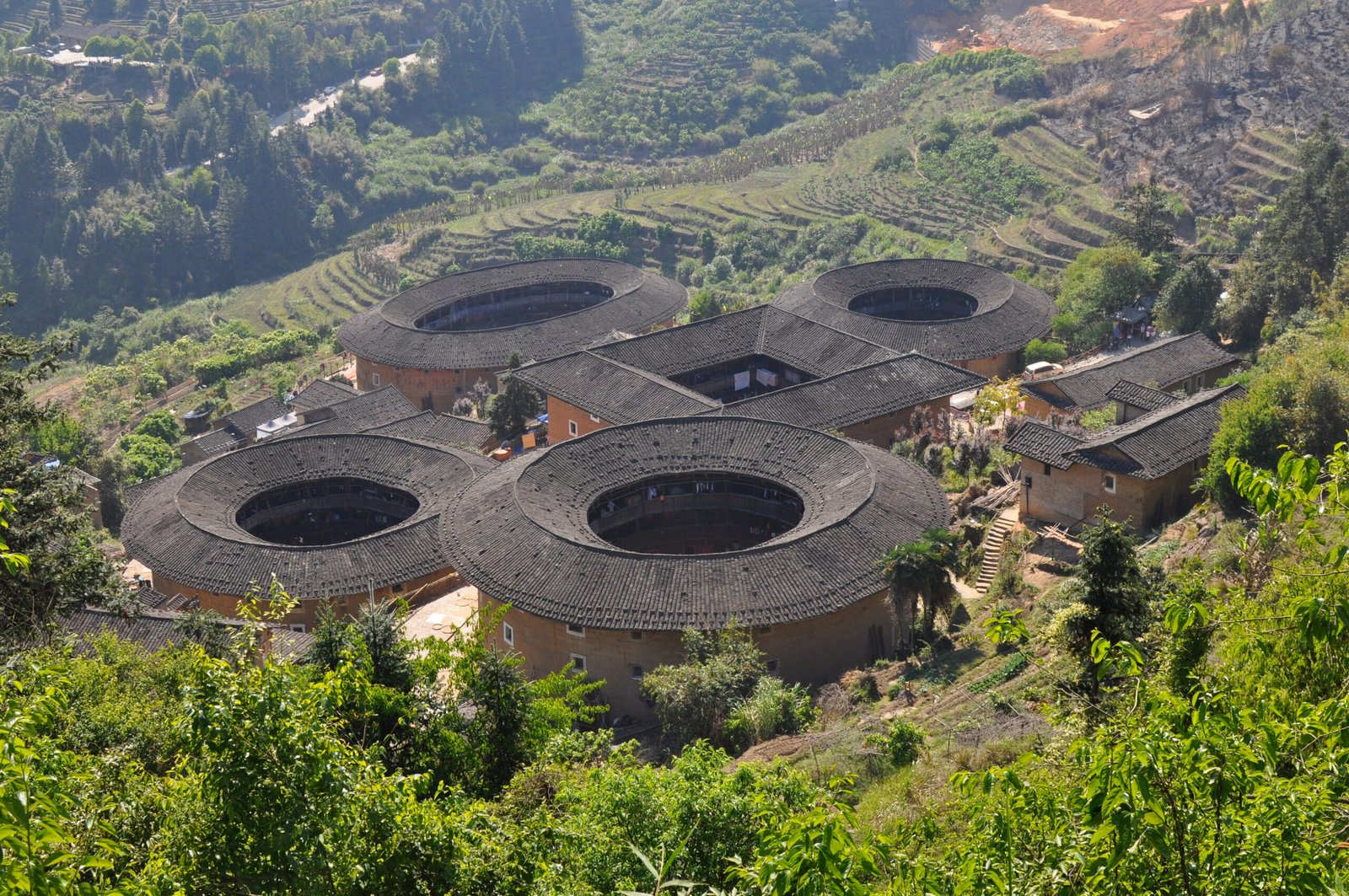
Massive circular and square earthen fortresses built by the Hakka people in the mountains of south-east China — communal residences that can house 800 people in a single structure, so perfectly preserved they were briefly mistaken for missile silos on Google Earth. UNESCO World Heritage Site since 2008.
At a glance
In the mountainous interior of Fujian Province, between the 13th and early 20th century, the Hakka and Minnan peoples constructed an extraordinary form of communal architecture: the tulou (literally earthen building). These massive circular or square fortified residences — built from rammed earth, timber, and stone — are simultaneously fortress, apartment block, village, and temple. Their walls can reach 2 metres thick at the base and 5 storeys high. Their interiors are inward-facing courtyards where hundreds of families share a well, a kitchen, and a meeting hall, each family occupying a vertical slice — one room per floor — from ground level to the top. The ground floor houses animals and stores; upper floors are for living. The 46 tulou inscribed by UNESCO in 2008 are distributed across four clusters in Nanjing, Hua’an, and Yongding counties. Many are still inhabited today.
Key facts
- UNESCO inscription: 2008 (World Heritage Site)
- Date range: 13th–early 20th century CE
- Builders: Hakka and Minnan peoples
- UNESCO-inscribed clusters: 46 tulou in 4 clusters (Chuxi, Tianluokeng, Hekeng, Gaobei)
- Largest tulou: Chengqi Building, King of Tulou — houses up to 800 people
- Provinces: Fujian (Yongding, Nanjing, Hua’an counties)
- Construction: Rammed earth, timber, bamboo, granite foundations
- Status: Many buildings remain inhabited
History
The Hakka — whose name means guest people — were Han Chinese who migrated over centuries from the central plains of China southward into the mountainous borderlands of Fujian, Guangdong, and Jiangxi. In these forested mountains, far from government protection, they faced constant threats from bandits and local rivalries. Their response was architectural: communal fortified residences that could shelter an entire clan behind walls impervious to arrows, fire, and assault. The earliest surviving tulou date to the 13th–14th centuries CE; the great building period was the 15th–18th centuries. The last tulou were constructed in the early 20th century.
Construction of a major circular tulou was a multi-generational undertaking. The rammed-earth walls — mixed with glutinous rice, brown sugar, and egg whites for binding — took years to complete and dry. The timber interior structure was built simultaneously, floor by floor. A clan tulou might take 10–20 years to complete and represent the labour of thousands of person-days. Chengqi Building (Gaobei cluster, Yongding), completed in 1709, required three generations to build.
The tulou remained largely unknown outside China until the late 20th century. In the early days of Google Earth (around 2005–2008), their perfectly circular formations in remote mountains caused confusion among US intelligence analysts, who reportedly considered whether they might be missile silos or other military installations. This episode dramatically increased global awareness of the tulou — and helped precipitate the UNESCO inscription in 2008.
What you see
The four inscribed clusters offer distinct character. Tianluokeng (Nanjing County) is the most famous: five tulou arranged on a hillside — one square building surrounded by four circular ones — visible from a scenic overlook that makes them look like a flower or a set of nested rings from above. This is the image that appears on the 2006 Chinese postal stamp and in virtually every photograph of the Fujian Tulou. Hekeng (Nanjing County) contains 13 tulou in a river valley, the most concentrated grouping. Gaobei (Yongding County) contains Chengqi Building, the largest surviving tulou: four concentric rings of rooms with a central ancestral hall, housing capacity for 600–800 people in 400 rooms across 4 floors.
Inside a tulou, the spatial experience is unlike anything in European architecture. You enter through a single heavy timber gate into a circular or square courtyard. Around you rise 3–5 storeys of interior galleries, each lined with doors leading to family apartments. The ground floor is communal: kitchen fires, water wells, and stone mortars. The upper floors are residential. Staircases are shared. The ancestral hall stands at the centre of the inner ring (in multi-ring tulou) or opposite the main gate (in single-ring buildings). Stone inscriptions, woodblock carvings, and traditional paintings decorate the public spaces.
Practical information
- Access: Entrance fees apply at the inscribed clusters (RMB 60–120 per cluster)
- Best time to visit: April–June or September–November (avoid summer monsoon)
- Accommodation: Homestays available inside operational tulou at Tianluokeng and Hekeng clusters
- Photography: Freely permitted in all public areas; residents may request privacy
- Duration: Minimum 1 full day for one cluster; 2–3 days to see all four UNESCO clusters
- Language: Hakka dialect locally; Mandarin widely understood; English guides available in Tianluokeng
Getting there
The clusters are spread across Nanjing, Hua’an, and Yongding counties, roughly 50–100 km southwest of Xiamen. From Xiamen Gaoqi International Airport: buses and car hire to Nanjing County (approximately 1.5–2 hours) or Yongding (approximately 2.5–3 hours). No direct rail service to the tulou clusters — the nearest high-speed rail is Nanjing South Station or Longyan. A rental car or private tour gives the most flexibility for covering multiple clusters in one visit.
Nearby
Xiamen (90 km northeast) is one of China’s most charming coastal cities, with the colonial-era Gulangyu Island (itself a UNESCO World Heritage Site since 2017) just 600 metres offshore. Quanzhou (170 km northeast), a UNESCO WHS since 2021, was the greatest port in the medieval world during the Song–Yuan dynasties and contains extraordinary Islamic, Hindu, and Christian heritage from its cosmopolitan trading past. For Hakka heritage, the city of Meizhou in adjacent Guangdong Province is the spiritual homeland, with temples and museums dedicated to Mazu (the sea goddess) and Hakka culture.
Sources
- UNESCO World Heritage List — Fujian Tulou (Ref. 1113): whc.unesco.org/en/list/1113
- Wikipedia: Fujian tulou
- China National Tourist Office (Fujian Tulou): cnto.org
Find it on the map
See this place and what’s around it →📷 Become a Cultural Heritage Online photographer
Share your photos of places: they stay published under your name as the author. The more they're seen, the more you get noticed — and soon a contest will reward the most appreciated photos.
Log in or sign up free to add a photo