

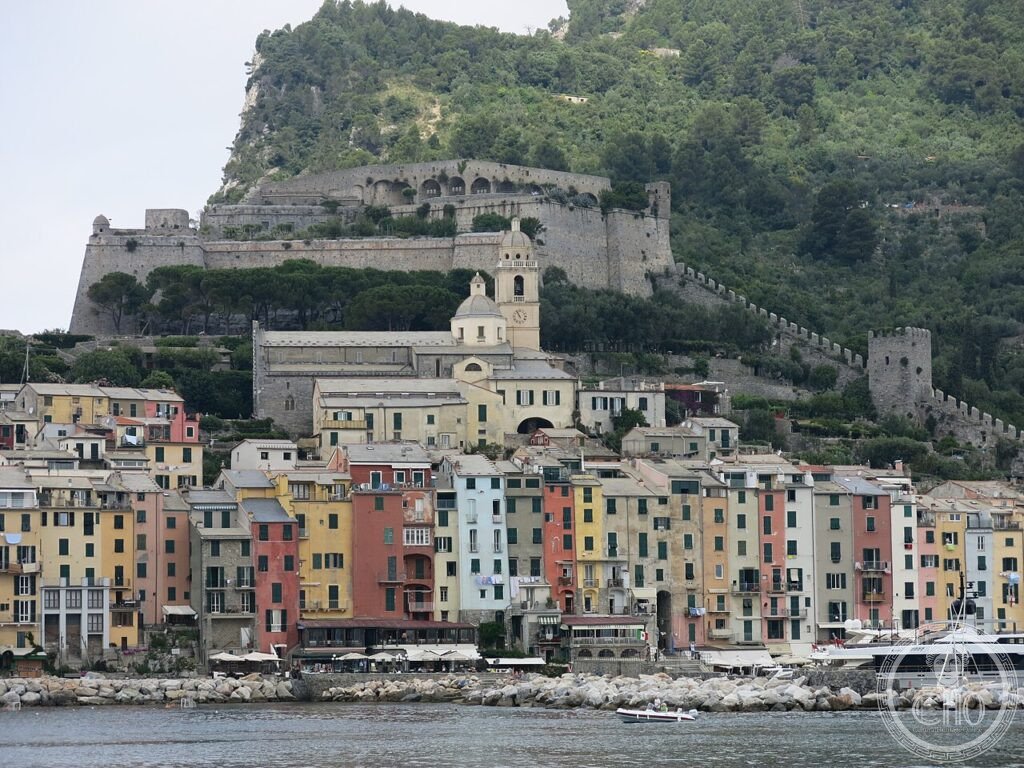
Vernazza is the only village of the Cinque Terre built around a natural harbour, its tall coloured houses stacked against the cliff above the water. A Genoese watchtower, a Romanesque church on the port, and the coastal path towards Monterosso make it the most photographed of the five.
At a glance
Vernazza is one of the five villages of the Cinque Terre, a stretch of the Ligurian coast between La Spezia and Levanto where medieval settlements cling to cliffs above the sea. The UNESCO World Heritage listing covers not just the five villages but also Portovenere and the offshore islands of Palmaria, Tino and Tinetto.
The landscape is essentially vertical: there is no flat ground between the sea and the Apennines behind, and centuries of dry-stone terracing, known locally as fasce, were built by hand to allow vines and olives to be grown on the slopes. The Cinque Terre National Park has estimated the total length of these walls at around 6,700 kilometres, though a significant proportion has collapsed since the 1950s as the villages lost population.
Key facts
- Location: Vernazza, Cinque Terre, Liguria, at approximately 44.1346° N, 9.6844° E.
- Distinguishing feature: the only natural harbour among the five Cinque Terre villages.
- Torre Doria: Genoese watchtower dating from the 12th century.
- Church: Santa Margherita d’Antiochia, built in 1318, with a Romanesque five-lobed bell tower.
- Coastal path: the Sentiero Azzurro links all five villages; the Vernazza–Monterosso stretch is considered its most scenic section.
- World Heritage status: inscribed by UNESCO in 1997 under reference 826, covering the five villages, Portovenere and three offshore islands.
History
Vernazza is first documented in 1080, one of five villages recorded between the 11th and 13th centuries along this stretch of coast. From around 1200 the villages came under the Republic of Genoa, which built the defensive towers and fortifications still visible today, including Vernazza’s Torre Doria and its Castello Doria.
Terracing of the cliffs for vines and olives progressed from the 11th to the 19th century, reaching its greatest extent in the late 1800s. The resulting Sciacchetrà wine was exported by Genoese merchants as far as London. The La Spezia–Genoa railway, built in 1874 and threaded through tunnels along the coast, connected the previously isolated villages and brought the first tourist infrastructure in the 1880s. UNESCO inscribed the Cinque Terre, Portovenere and the three nearby islands as a World Heritage Site in 1997, under reference 826.
What you see
Vernazza’s houses rise four to six storeys against the cliff above the harbour, arranged in the tight, colourful pattern typical of the village. The Torre Doria stands above the port as a reminder of Genoese coastal defence, and the Church of Santa Margherita d’Antiochia, dating from 1318, sits close to the water with its Romanesque bell tower. The natural harbour itself, unique among the five villages, is lined with small boats and a restaurant built almost at the water’s edge. From the Castello Doria there are views back along the coast, and the path towards Monterosso is regarded as the most scenic stretch of the trail linking the villages.
The other Cinque Terre villages each have their own character: Monterosso al Mare is the largest, with the longest beach and the Sanctuary of Nostra Signora di Soviore; Corniglia is the only one without direct sea access, reached on foot or by shuttle and requiring a long flight of steps down to the water; Manarola has its cooperative winery producing Sciacchetrà and the Church of San Lorenzo; Riomaggiore has the Church of San Giovanni Battista and marks one end of the Via dell’Amore. Portovenere, at the southern end of the protected area, has a medieval centre, the Church of San Pietro on its seaward promontory, and the Grotta Arpaia, associated with Lord Byron’s swimming in 1822.
Practical information
- Access to the coastal path: the Cinque Terre National Park operates a paid daily pass system for the Sentiero Azzurro; check current arrangements with the park’s official channels before travelling.
- Seasonality: the villages become very crowded in July and August; late spring and early autumn are quieter alternatives.
- Accommodation: hotel capacity in the five villages is limited, with most stays in bed and breakfasts or short-term rentals, so early booking is advisable in summer.
- Via dell’Amore: the cliffside path between Riomaggiore and Manarola was closed for over a decade after a rockfall and has since reopened following restoration.
Getting there
Vernazza and the other Cinque Terre villages are reached by a frequent local train service from La Spezia, with each stop only a short ride apart. Genoa connects to Monterosso by regional and intercity trains, and travellers from Florence typically change at La Spezia. Driving is discouraged, as parking is limited and access roads are often closed in summer.
Nearby
- La Spezia — about 20 km away, home to the Museo Tecnico Navale, a major Italian naval museum with historic ships, submarines and anchors.
- Lerici — about 25 km away, with its 12th-century castle and the Gulf of Poets, where Byron and Shelley lived in 1821–1822.
- Isola di Palmaria — a short boat crossing from Portovenere, known for the Grotta Azzurra and its holm oak woodland.
Sources
- UNESCO World Heritage List: “Portovenere, Cinque Terre, and the Islands (Palmaria, Tino and Tinetto)”, ref. 826.
- Parco Nazionale delle Cinque Terre.
- Antonioli Corigliano, Magda: “Strade del vino ed enoturismo”, Egea, Milano 1999.
Find it on the map
See this place and what’s around it →📷 Become a Cultural Heritage Online photographer
Share your photos of places: they stay published under your name as the author. The more they're seen, the more you get noticed — and soon a contest will reward the most appreciated photos.
Log in or sign up free to add a photo