

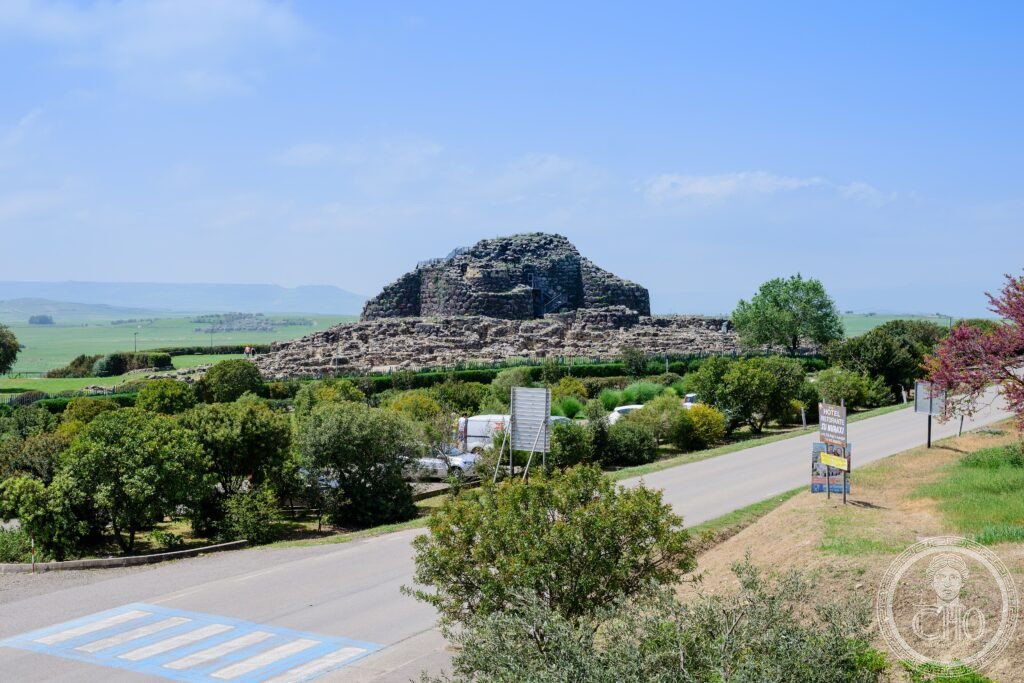
Su Nuraxi is the most complete surviving example of Sardinia’s nuragic civilisation, a Bronze Age culture with no direct parallel elsewhere in the Mediterranean. A dry-stone tower built without mortar stands at the centre of a village of circular huts, buried for centuries and only uncovered in 1949.
At a glance
Su Nuraxi di Barumini sits in the Medio Campidano region of Sardinia. At its heart is a truncated conical tower built from large basalt blocks in dry-stone technique, without mortar, surrounded by a defensive enclosure of four secondary towers and, beyond that, a village of more than two hundred circular huts. The site was inscribed on the UNESCO World Heritage List in 1997, reference 833, the only prehistoric site in Sardinia to hold that status.
Key facts
- Location: Barumini, Medio Campidano, Sardinia, Italy (39.7025° N, 9.0186° E)
- Period: c. 1500–900 BCE, Middle and Late Bronze Age
- Structure: central truncated conical tower, originally about 18.6 metres high, now around 14.7 metres, with a base diameter of roughly 14 metres, built in dry-stone basalt
- Defensive enclosure: four secondary towers added around 1000 BCE, linked by curtain walls around a courtyard with a sacred well
- Village: over 200 circular stone huts, including a large communal assembly hut with stone benches
- Recognition: UNESCO World Heritage Site since 1997, reference 833
History
Su Nuraxi was built in stages. The central tower was raised in the Middle Bronze Age, roughly 1600–1300 BCE, with construction completed around 1500–1300 BCE. The defensive enclosure of four towers connected by curtain walls followed around 1000–900 BCE, in the Late Bronze Age. The surrounding village reached its greatest extent between about 1200 and 700 BCE.
The site remained in use long after the nuragic period itself. Phoenicians settled Sardinia’s coasts from around 800 BCE, but the interior, including Barumini, stayed under nuragic control. After Rome took Sardinia from Carthage in 238 BCE, the village continued to be inhabited: Roman-period huts were built directly over the Bronze Age remains, and excavation has produced Roman coins and pottery. Occupation persisted until around 700 CE, into the Byzantine period.
Over the following centuries the site was buried beneath several metres of accumulated sediment and became an unremarkable hillock, known locally as the cuccuru. It was identified in 1949 by the Sardinian archaeologist Giovanni Lilliu, who led excavations there between 1950 and 1956. Su Nuraxi was inscribed on the UNESCO World Heritage List in 1997 under reference 833, the first and so far only prehistoric site in Sardinia to receive that recognition.
What you see
The main nuraghe is a truncated conical tower containing a tholos chamber, a corbelled dome formed by courses of stone projecting progressively inward until they close at the top. Internal stone staircases, open to visitors, lead up through an entrance chamber with four wall niches on the ground floor to an upper chamber above.
Around the tower stands the bastionatura, an enclosure of four towers linked by curtain walls around a central courtyard that contains a sacred well providing water within the defensive perimeter. Beyond this lies the village itself, more than two hundred circular basalt huts of varying sizes. The largest, the assembly hut, is about 27 metres across and retains stone seating along its walls; other huts held circular furnaces used for bronze-working, and stone querns for grinding grain.
The nearby Casa Zapata civic museum in Barumini displays finds from the site, including amphorae, bronze votive figurines showing warriors, animals and boats, loom weights and pottery.
Practical information
- Access: the site is visited by guided tour only; guides depart at set intervals and full details of timing and admission are best checked on the official channel before travelling
- Suggested time: around 1.5 hours for the guided visit, plus around 30 minutes for the Casa Zapata museum
- Footwear: the ground is uneven basalt stone, so sturdy closed shoes are required; parts of the site are not accessible to wheelchair users
Getting there
Su Nuraxi lies about 50 kilometres from Cagliari, reached by car via the SS131 and SP35. There is no direct rail service; the nearest station is at Sanluri, around 20 kilometres away, with a bus connection onward. The nearest airport is Cagliari-Elmas, roughly 55 kilometres from the site.
Nearby
- Cagliari — about 50 km, with the Castello quarter dating from the thirteenth-century Pisan period and the National Archaeological Museum, home to the world’s largest collection of nuragic bronze figurines
- Nuraghe Losa — about 45 km, near Abbasanta, considered the second most important nuragic site in Sardinia, dating from the same 1500–900 BCE period
- Villanovaforru — about 15 km, home to the Genna Maria museum, with nuragic pottery and a reconstructed hut
Sources
- UNESCO World Heritage List: “Su Nuraxi di Barumini”, ref. 833
- Giovanni Lilliu, “La civiltà dei Sardi dal neolitico all’età dei nuraghi”, ERI Torino, 1967
- Gary S. Webster, “A Prehistory of Sardinia 2300-500 BC”, Sheffield Academic Press, 1996
Find it on the map
See this place and what’s around it →📷 Become a Cultural Heritage Online photographer
Share your photos of places: they stay published under your name as the author. The more they're seen, the more you get noticed — and soon a contest will reward the most appreciated photos.
Log in or sign up free to add a photoIs this page about you?
This page is read by travellers and heritage enthusiasts who find it on Google. Tell us how you are connected to this place and we will take it from there.