

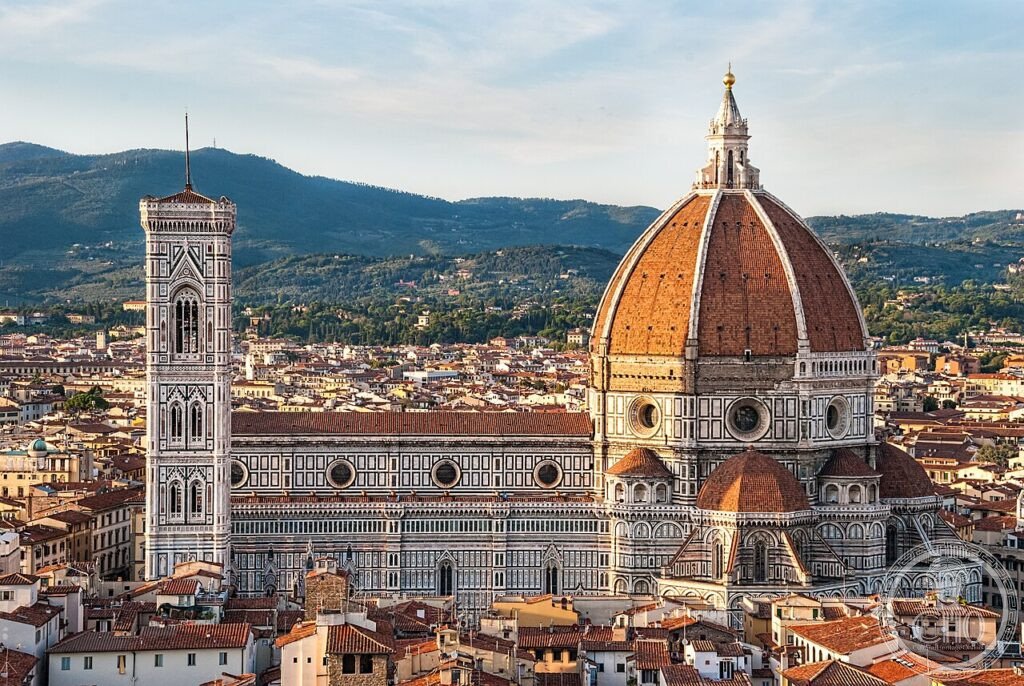
The most complete surviving medieval and Renaissance city in Europe: Brunelleschi's dome, Giotto's Campanile, Ghiberti's Gates of Paradise, Palazzo Vecchio, the Uffizi, and Ponte Vecchio within a single walkable historic core.
At a glance
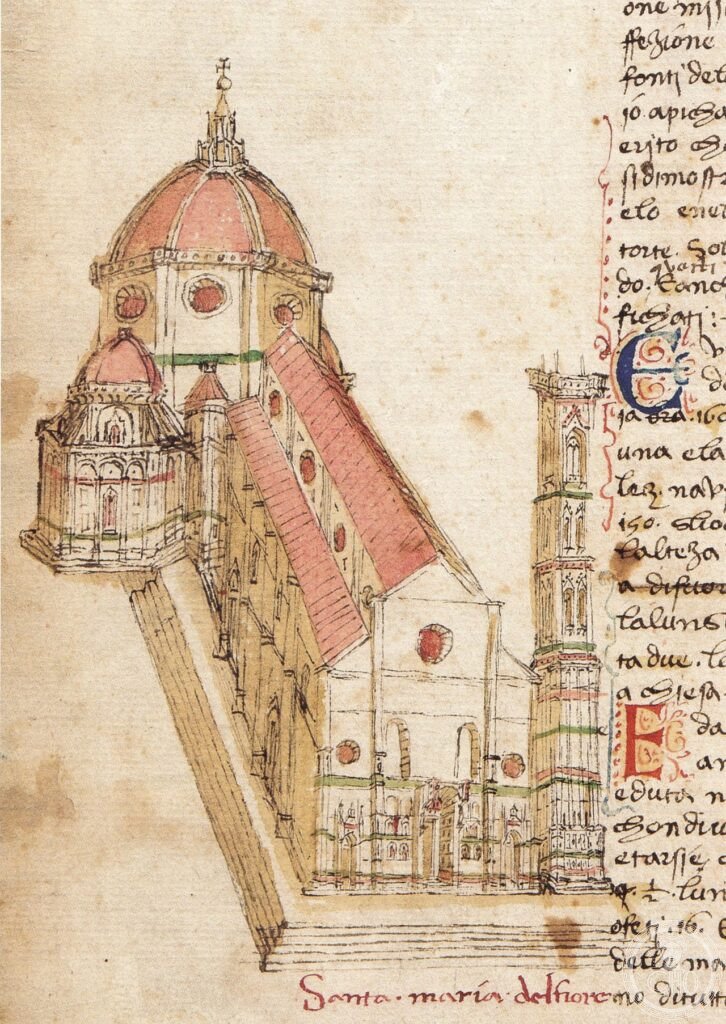
Florence's historic centre covers 505 hectares within the 14th-century ring of walls. Its UNESCO listing in 1982 under criteria i, ii, iii, iv, and vi recognised it as the birthplace of the Renaissance. It also recognised the city as the one that most completely preserves the architectural, artistic, and urban fabric of that transformation. The dome of Santa Maria del Fiore (1420–1436) by Filippo Brunelleschi was the largest dome built since the Pantheon in Rome; its construction required the invention of new scaffolding, brick-laying, and hoisting techniques. Ghiberti spent 27 years (1425–1452) on the east doors of the Battistero, which Michelangelo called “the Gates of Paradise”. Vasari built the Uffizi (1560–1580) for Cosimo I de' Medici as a government office building; by 1584 part of the top floor held the Medici art collection. It became the first purpose-built museum in Europe.
Key facts
- Duomo di Santa Maria del Fiore: begun 1296, Arnolfo di Cambio; dome by Brunelleschi 1420–1436; 153 m long
- Campanile di Giotto: 1334–1359, Giotto di Bondone and Francesco Talenti; 84.7 m tall
- Battistero di San Giovanni: 11th century Romanesque; Ghiberti's north doors 1403–1424, east doors 1425–1452
- Palazzo Vecchio: 1299–1314, Arnolfo di Cambio; seat of Florentine city government since 1322
- Galleria degli Uffizi: 1560–1580, Giorgio Vasari; Botticelli, Leonardo, Raphael, Michelangelo
- Ponte Vecchio: 1345, Neri di Fioravante; only bridge in Florence to survive German demolition in 1944
- UNESCO inscription: 1982, criteria i, ii, iii, iv, vi
- Coordinates: 43.7696° N, 11.2558° E — Google Maps
History
Florence was founded as a Roman colony in 59 BCE; its medieval rebirth began in 1115 when the commune gained independence from the Margrave of Tuscany. The wealth that funded the great buildings came from the wool trade and banking. Florentine merchants and bankers introduced the letter of credit to Europe and coined the gold florin in 1252, the most widely used currency on the continent for three centuries. The Medici family assumed control of the Florentine Republic in 1434 under Cosimo de' Medici; their patronage over the next century made Florence the capital of European intellectual and artistic life. Lorenzo the Magnificent (1469–1492) hosted the Platonic Academy and commissioned works from Botticelli, Leonardo da Vinci, and the young Michelangelo at his household.
The Duomo's dome was the central engineering problem of the age. The octagonal crossing was 42 metres wide with no precedent in the medieval tradition for closing a span that large without a wooden centring form. Brunelleschi solved it by building two self-supporting shells in herringbone brick, each ring of bricks capable of bearing the weight of the next before mortar set. The outer shell follows the pointed profile that reduces horizontal thrust. The inner shell carries the lantern that Brunelleschi designed but never saw finished. He died in 1446, and the lantern was set in 1461. The drum galleries, the marble inlay of the exterior, and the interior fresco cycle by Vasari and Zuccari (1572–1579) completed the cathedral's external appearance as it stands today.
What you see
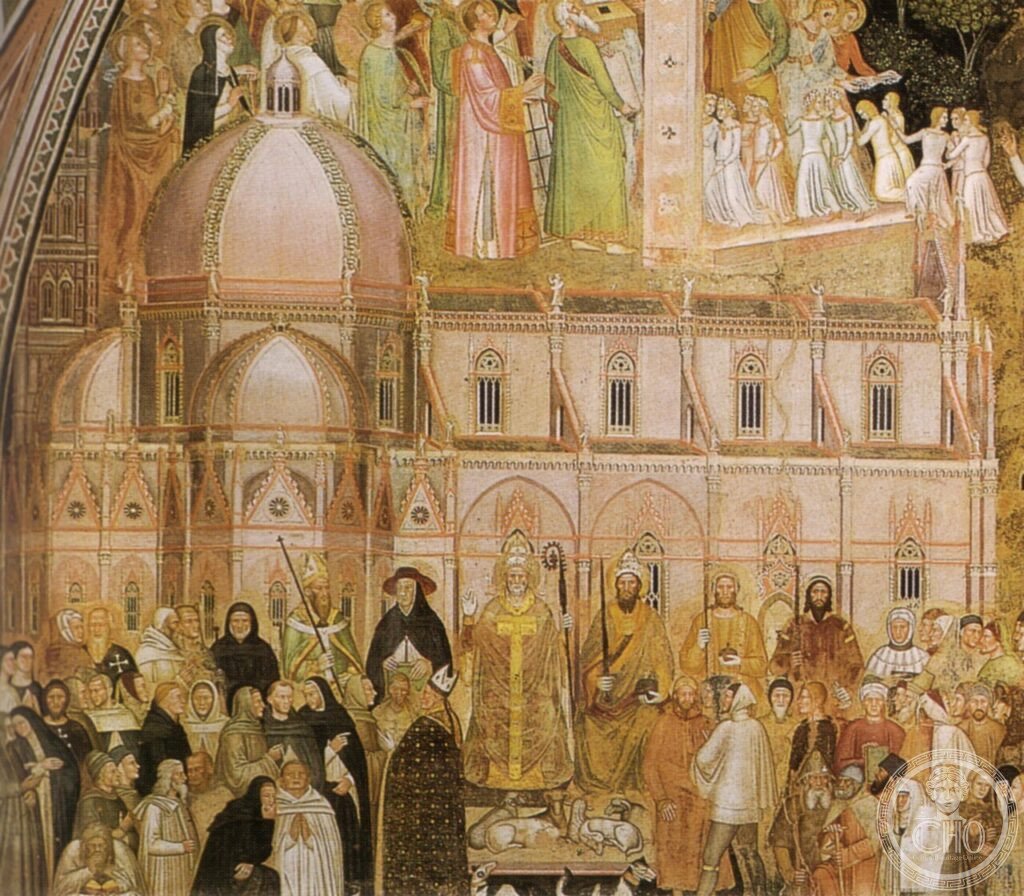
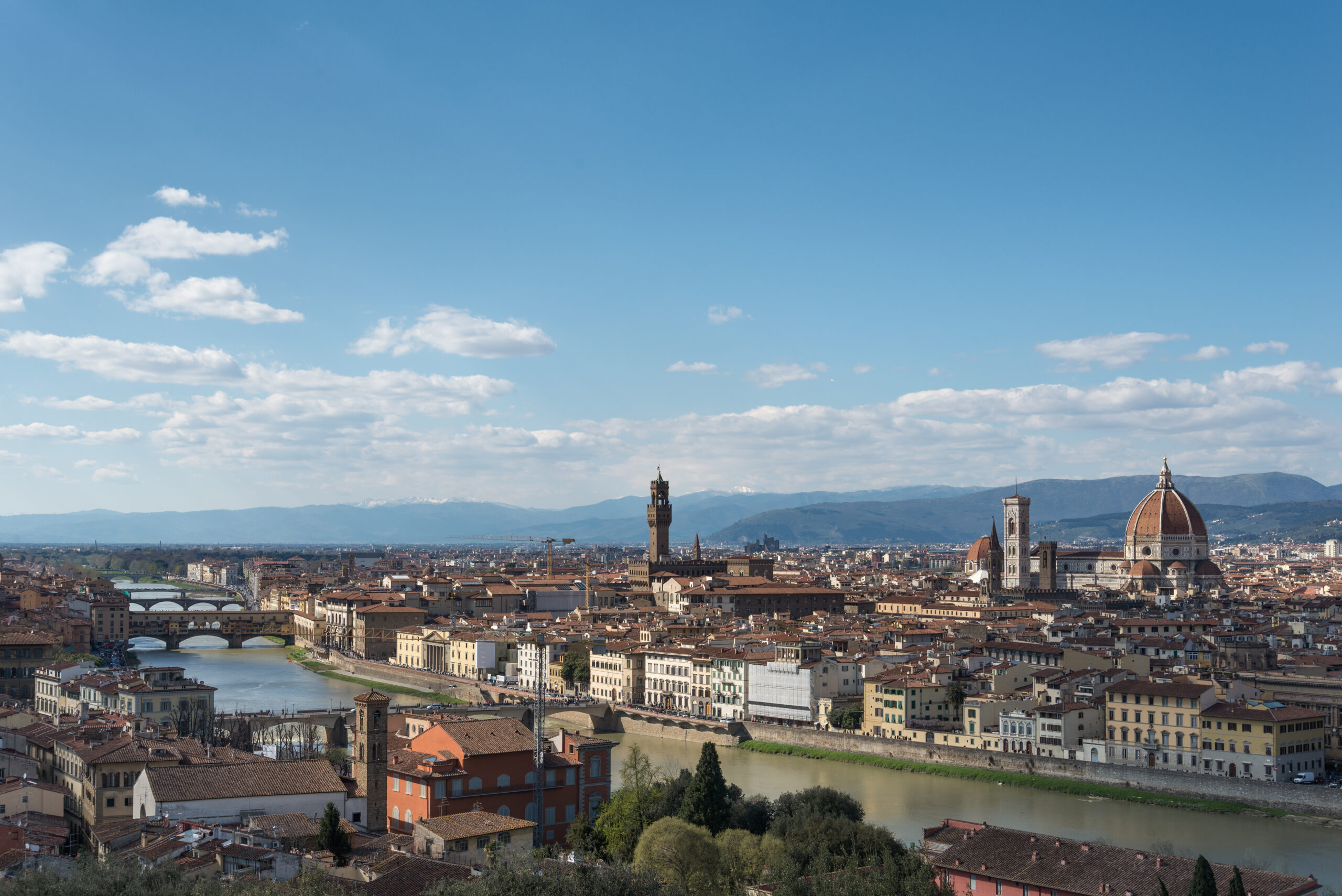
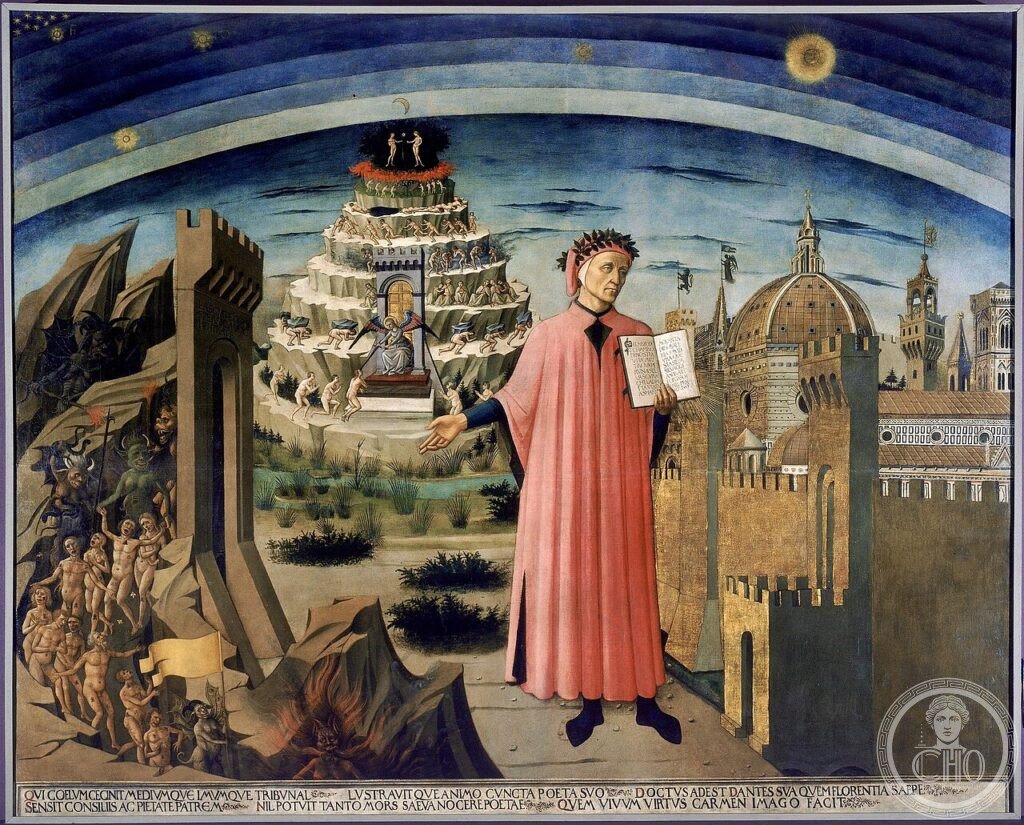
The dome is visible from every hill around Florence and from almost every street in the historic centre. Its profile — red-orange octagonal ribs against white herringbone marble cladding — gave the city a silhouette so distinctive that Florentine painters used it as a shorthand for “here” even when painting biblical scenes set in Jerusalem. At close range, the façade of the cathedral is dated 1887–1887 and was designed by Emilio de Fabris in neo-Gothic style using white, green, and pink marble. It reads almost too elaborately decorative against the austere mass of the dome above it. The contrast is the point: the surface richness of the façade pulls attention forward, while the dome's geometry asserts gravity and permanence behind it.
Ponte Vecchio is the oldest bridge in Florence and the only one rebuilt in its medieval form. Its three stone arches (1345) carry two rows of goldsmiths' shops that overhang the river on wooden brackets, with a narrow passage between. Above the shops runs the Vasari Corridor (1565), the private elevated walkway that connected Palazzo Vecchio to Palazzo Pitti. It allowed the Medici to move through the city without stepping onto the street. The corridor survived World War II because Hitler personally ordered it spared when German engineers demolished every other bridge in the city in August 1944.
Practical information
- Uffizi + Accademia: Book online (uffizi.it) at least 1–2 weeks ahead in peak season; timed entry, 2–3 hours minimum
- Duomo dome climb: 463 steps, narrow spiral staircase; book at museumflorence.com; not suitable for claustrophobia
- Palazzo Vecchio: Regular opening hours, no booking required; Secret Passages tour recommended
- ZTL: Historic centre is a Limited Traffic Zone; park outside walls (Piazzale Michelangelo area) and walk or take tram T1
- Time needed: Minimum 2 full days for the major sites; a week to do the city justice
Getting there
Santa Maria Novella railway station (S.M.N.) is at the north edge of the historic centre, 10 minutes' walk from the Duomo. High-speed trains from Rome (1h 30m) and Milan (1h 40m) serve S.M.N. Peretola Airport (FLR) is 6 km north; tram T2 from the terminal (running from 2020) reaches S.M.N. in 20 minutes. The entire historic centre is walkable; the main monuments cluster within 1 km of Piazza del Duomo.
Nearby
- Galleria dell'Accademia: 15 min walk — Michelangelo's David (1501–1504) and the unfinished Prigioni
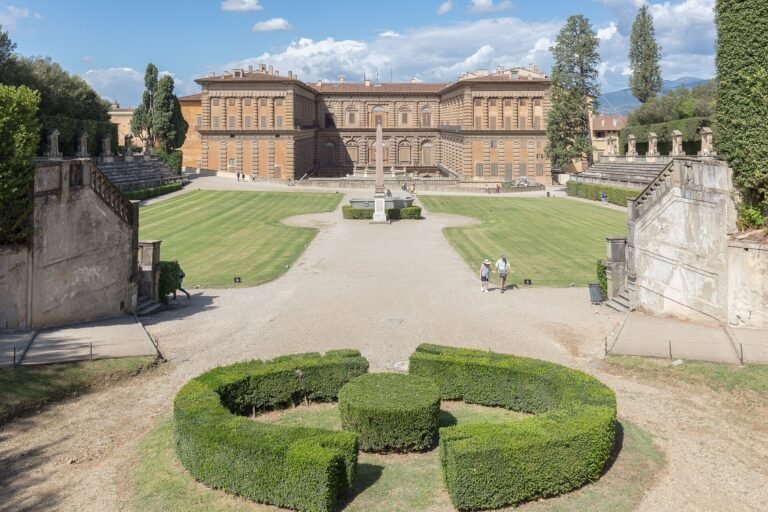
- Palazzo Pitti e Boboli: Oltrarno — Medici royal apartments, Palatine Gallery, terraced Renaissance garden
- Certosa del Galluzzo: 8 km south — 14th-century Carthusian monastery with chapter-house frescoes by Pontormo
- Fiesole: 8 km northeast — Etruscan and Roman remains on the hill overlooking Florence
Gallery
Sources
- UNESCO World Heritage List — Historic Centre of Florence, rif. 174, inscribed 1982
- Opera di Santa Maria del Fiore — museumflorence.com
- Galleria degli Uffizi — uffizi.it
- Ross King, Brunelleschi's Dome, Walker & Company, 2000
- Wikimedia Commons — CC BY-SA images of Florence historic centre
Find it on the map
See this place and what’s around it →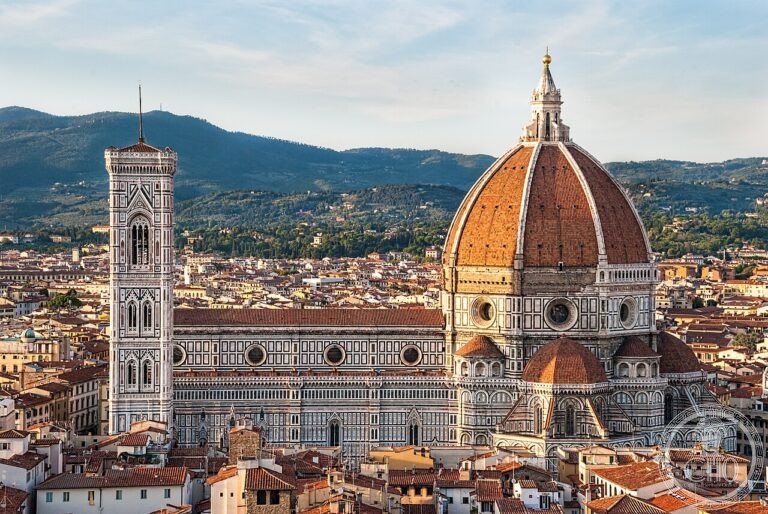
📷 Become a Cultural Heritage Online photographer
Share your photos of places: they stay published under your name as the author. The more they're seen, the more you get noticed — and soon a contest will reward the most appreciated photos.
Log in or sign up free to add a photo