

Buried under volcanic ash and pumice when Vesuvius erupted in 79 CE, Pompeii survives as the most complete surviving fragment of Roman daily life: streets, houses, frescoes and bodies preserved in the moment the city stopped.
At a glance
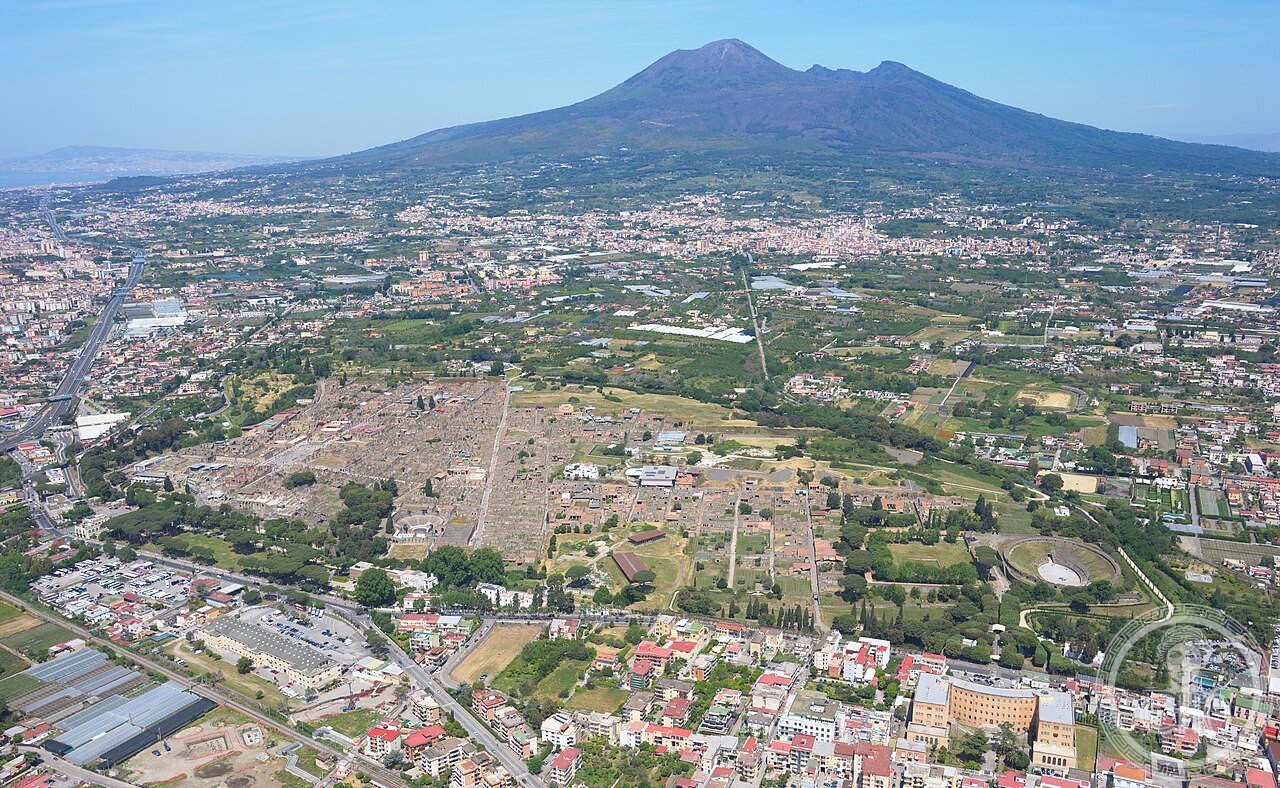
Pompeii was a Roman city on the Bay of Naples, buried by the eruption of Vesuvius on 24 October 79 CE. At the time of its destruction it covered around 66 hectares within a 3.2 km circuit of walls pierced by seven gates, and is thought to have held a population of roughly 11,000, an estimate drawn from the number of rooms excavated across its residential blocks.
Its street plan follows a modified grid, with the irregular alignment of the oldest quarter, in the area known as Regio VI-VII, sitting alongside the more regular Roman-period layout. The site inscribed by UNESCO in 1997 covers not only Pompeii itself but also Herculaneum and the villa remains at Torre Annunziata, including the Villa of Poppaea Sabina with its extensive floor mosaics and paintings.
Key facts
- Location: Pompei, province of Naples, Campania, Italy
- Founded: by the Oscans in the 6th century BCE, with the oldest surviving building, the Doric Temple in the Triangular Forum, dating to 580–560 BCE
- Destroyed: buried by the eruption of Vesuvius on 24 October 79 CE
- Rediscovered: 1748, under the patronage of Karl III of Bourbon, King of Naples
- UNESCO status: inscribed in 1997 as part of the Archaeological Areas of Pompei, Herculaneum and Torre Annunziata, reference 829
- Extent excavated: of the 66 hectares of the ancient city, roughly 44 hectares have been excavated, with the remainder deliberately left untouched since a 1973 decision to preserve it for future conservation methods
History
Pompeii began as an Oscan settlement in the 6th century BCE, and came under the influence first of the Greek colony at Naples and then of the Samnites, whose control from around 420 to 80 BCE saw the city’s greatest cultural growth, including the laying out of the Via dell’Abbondanza in its present form during the 4th century BCE. In 80 BCE Sulla besieged the city and established a Roman colony there, renaming it Colonia Cornelia Veneria Pompeianorum after his own family name and his patron goddess Venus.
An earthquake in 62 CE caused major damage, and repairs were still under way when Vesuvius erupted in 79 CE; scaffolding around the Temple of Apollo, unfinished reconstruction at the Temple of Isis and incomplete columns in the Forum’s northern colonnade all point to a city still recovering when it was buried. The site lay forgotten until its rediscovery in 1748, when systematic excavation began under Karl III of Bourbon, King of Naples. Pompeii, together with Herculaneum and Torre Annunziata, was inscribed on the UNESCO World Heritage List in 1997, reference 829.
What you see
The Parco Archeologico di Pompei recommends a circuit beginning at Porta Marina, the main entrance, leading into the Forum, a civic square measuring 38 by 142 metres flanked by the Temple of Jupiter and the Basilica, thought to be the oldest surviving basilica anywhere and originally a hall for legal and commercial business rather than a place of worship. Nearby stands the Macellum, the city’s food market, built around a circular oculus with shops set around its perimeter.
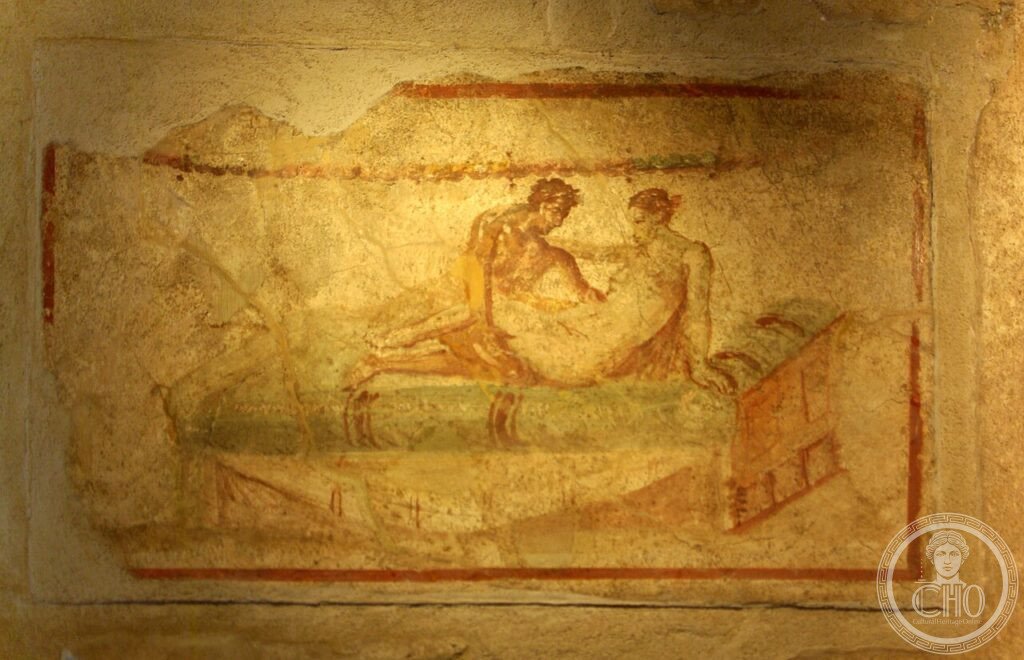
Via del Lupanare leads to the city’s only confirmed brothel, identified by its built-in stone beds and by erotic paintings above each doorway, thought to have served as both advertisement and visual instruction for clients and workers who did not share a common language. Outside the Porta Ercolano stands the Villa dei Misteri, a suburban villa whose final form covered ninety rooms across two floors and included its own wine-producing wing. Its best-known feature is the Dionysiac frieze in the so-called Room of the Mysteries, a continuous painted composition seventeen metres wide showing twenty-nine figures in a sequence generally read as scenes of initiation into the Dionysiac Mysteries, a rite that had been formally banned by the Roman Senate in 186 BCE yet appears to have continued in private well into the following centuries. The city’s amphitheatre, built around 70 BCE, is counted among the oldest surviving Roman amphitheatres.
Practical information
- Visiting time: a thorough visit can occupy a full day, though a shorter circuit of a few hours covers the main highlights
- Entrance: Porta Marina serves as the principal entrance to the site
- Tickets and hours: consult the Parco Archeologico di Pompei’s official website for current opening times and admission arrangements
Getting there
Pompei sits on the Bay of Naples in Campania and is reached by regional and suburban rail lines connecting Naples with the Sorrento peninsula; travellers should check current timetables and routes through official transport providers before setting out.
Nearby
- Herculaneum — a smaller Roman town also buried in the 79 CE eruption, included with Pompeii in the same UNESCO inscription
- Torre Annunziata — site of the Villa of Poppaea Sabina, with extensive Roman floor mosaics and wall paintings, also part of the inscribed area
- Mount Vesuvius — the volcano responsible for the city’s destruction, visible from the Forum
Sources
- UNESCO
- Parco Archeologico di Pompei
- Pliny the Younger, Epistulae VI.16
Gallery
Find it on the map
See this place and what’s around it →📷 Become a Cultural Heritage Online photographer
Share your photos of places: they stay published under your name as the author. The more they're seen, the more you get noticed — and soon a contest will reward the most appreciated photos.
Log in or sign up free to add a photo