
According to tradition, the Theotokos appeared to the monks in the form of a column of fire, leaving the print of a foot in the rock on which she had appeared. For centuries the faithful have attributed healing properties to the water that flows from that print. In 1675, during an Ottoman and Cossack siege, an apparition of the Virgin accompanied by angels and by Saint Job is said to have put the besiegers to flight — an episode that made Pochaiv one of the most important pilgrimage destinations in eastern Europe.
About Pochaiv Lavra
The first documented record of the monastery at Pochaiv dates to 1527, although local tradition holds that it was founded three centuries earlier, during the Mongol invasion, by monks fleeing either the Kyiv Monastery of the Caves or Mount Athos. According to tradition, the Theotokos appeared to the monks as a column of fire, leaving her footprint in the rock on which she had stood; this imprint became venerated for the reputedly curative properties of the water issuing from it. In 1597, the noblewoman Anna Hojska donated land to the monastery along with a miracle-working icon of the Theotokos, said to have cured her brother’s blindness. Ivan Zalizo, an Orthodox monk who took the name Job, joined the monastery in 1604 and became one of its most consequential figures, establishing a printing press in 1630 that supplied theological literature across Galicia and Volhynia; he died on 25 October 1651 and was soon canonised as Job of Pochaiv. During the Zbarazh War in 1675, Ottoman-Cossack forces besieging the monastery reportedly fled upon witnessing an apparition of the Theotokos accompanied by angels and St. Job, an episode tradition credits with cementing Pochaiv’s reputation as a site of miraculous protection. The monastery’s ecclesiastical affiliation shifted repeatedly over the following centuries: it passed to Greek Catholic Basilian monks in 1720, was transferred to the Russian Orthodox Church by Tsar Nicholas I in 1831, and was granted the formal status of lavra in 1833. By the close of the 19th century, Pochaiv had become a major pilgrimage destination for Orthodox believers across the Russian Empire and the Balkans. The monastery remained open even under Soviet rule following the 1939 annexation of the region, an unusual exception among religious institutions of the period. In December 2023, Ukraine’s Supreme Court ruled to award spiritual control of the monastery to the Orthodox Church of Ukraine, following years of jurisdictional disputes.
Key facts
- 1527: first documented record of the monastery; tradition claims earlier 13th-century origins
- 1597: Anna Hojska donates land and a miracle-working icon of the Theotokos
- 1604-1651: Job of Pochaiv’s monastic life; establishes a printing press in 1630
- 1675: a Marian apparition reportedly repels an Ottoman-Cossack siege
- 1720-1831-1833: passes to Greek Catholic control, then Russian Orthodox control, then granted lavra status
- 1771-1783: Dormition Cathedral built, designed by Gottfried Hoffmann
- 1861-1869: the 65-metre bell tower is built, among the tallest in Ukraine
- 1906-1912: Trinity Cathedral built, by architect Aleksey Schusev with mosaics by Nicholas Roerich
- 2023: Ukraine’s Supreme Court rules on the monastery’s ecclesiastical jurisdiction
History
Job of Pochaiv’s establishment of a printing press in 1630, distributing theological literature across Galicia and Volhynia during a period of intense religious contestation following the 1596 Union of Brest, made the monastery a significant centre of Orthodox textual production at a moment when confessional identity across the region was under active dispute. The monastery’s repeated shifts between Orthodox and Greek Catholic administration across the 18th and 19th centuries — Basilian control from 1720, Russian Orthodox control from 1831, formal lavra status from 1833 — trace the wider contest for religious authority in this contested borderland between competing Christian traditions and political powers.
Pochaiv’s unusual survival as an open, functioning monastery through the Soviet period, even as most religious institutions across the USSR faced closure or suppression, reflects the sheer scale of its established pilgrimage significance by the early 20th century, a reputation substantial enough to complicate straightforward Soviet religious suppression. The monastery’s continued relevance as a site of active ecclesiastical contestation, reflected in the December 2023 Ukrainian Supreme Court ruling on its jurisdiction, situates Pochaiv as a living institution still directly shaped by the same currents of religious and political authority that have defined its history since the 16th century.
What you see
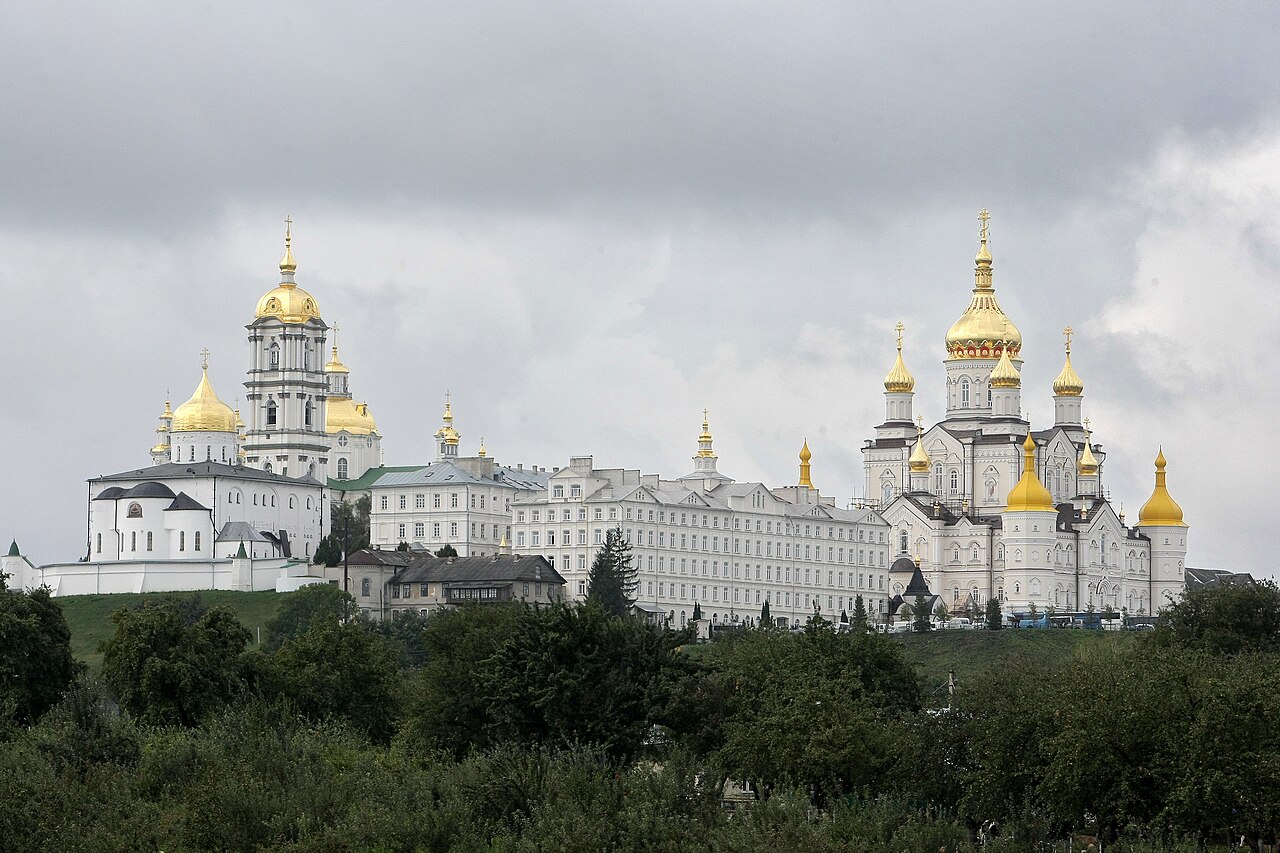
The Dormition Cathedral, built 1771-1783 to designs by Gottfried Hoffmann, shows a transitional Baroque-Neoclassical style. The 65-metre bell tower, built 1861-1869, ranks among the tallest in Ukraine. The Trinity Cathedral, built 1906-1912 by the architect Aleksey Schusev, draws on medieval Northern Russian architectural forms and is decorated with Symbolist mosaics by the painter Nicholas Roerich. The rock bearing the traditional footprint of the Theotokos remains a focal point of pilgrim veneration within the complex.
Practical information
- Opening hours: generally open daily; check current hours and travel conditions before visiting; free admission
- Address: Pochaiv, Kremenets Raion, Ternopil Oblast, 47025, Ukraine
Getting there
Pochaiv is reachable by car from Ternopil (approximately 1 hour) in western Ukraine’s Ternopil Oblast. GPS: 50.0018° N, 25.5111° E.
Nearby
- Kremenets — a nearby historic town with its own medieval castle ruins
- Ternopil — approximately 1 hour away; the regional capital
- Volhynia region — the wider historic region surrounding Pochaiv
Sources
- Wikipedia — “Pochaiv Lavra” (en.wikipedia.org)
- OrthodoxWiki — “Pochaev Lavra of the Dormition of the Theotokos” (orthodoxwiki.org)
- Encyclopedia of Ukraine — “Pochaiv Monastery” (encyclopediaofukraine.com)
Find it on the map
See this place and what’s around it →📷 Become a Cultural Heritage Online photographer
Share your photos of places: they stay published under your name as the author. The more they're seen, the more you get noticed — and soon a contest will reward the most appreciated photos.
Log in or sign up free to add a photo