

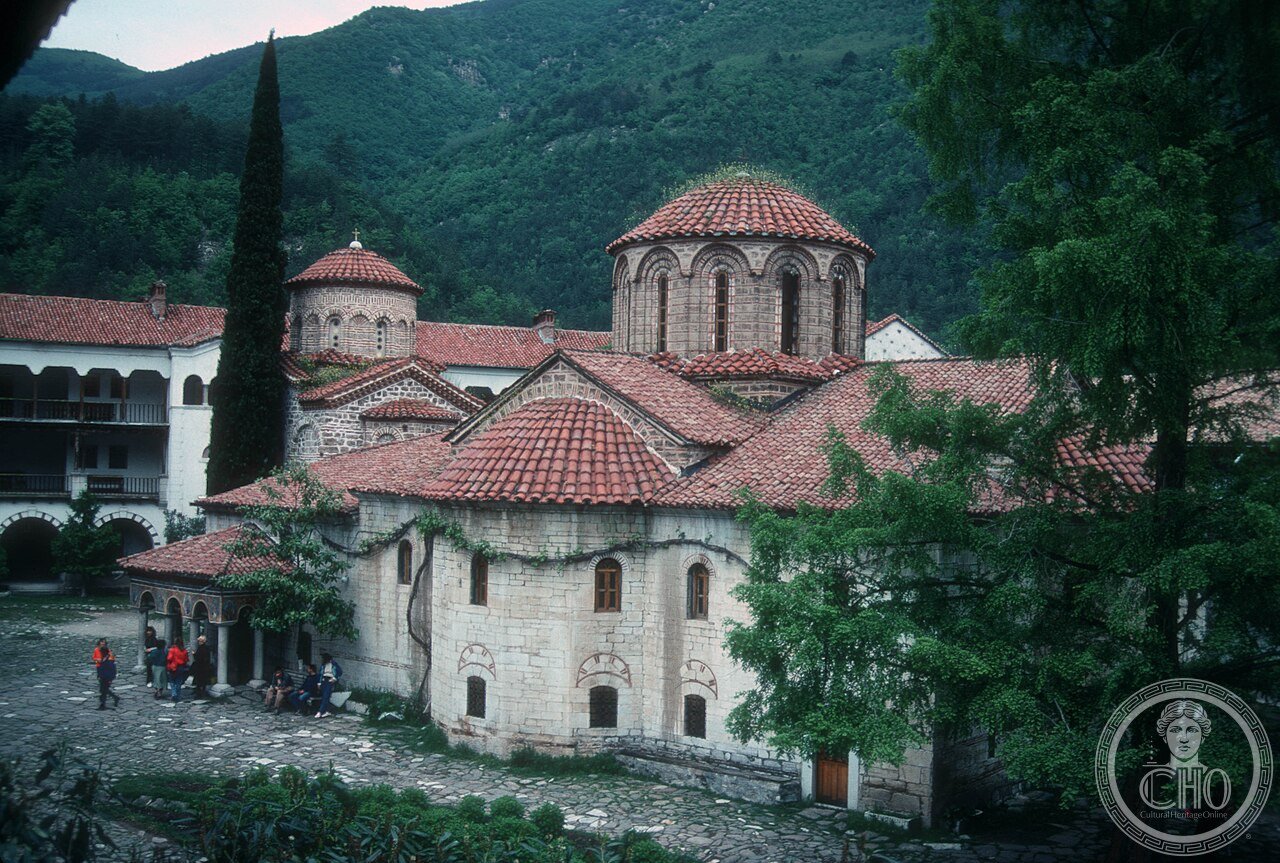
Gregory Pakourianos, a Georgian statesman and military commander in the service of the Byzantine emperor Alexios I Komnenos, founded in 1083 a Georgian Orthodox monastery at the heart of what would become Bulgaria, laying down in his own typikon (monastic rule) that his monks should know the Georgian language. He also opened a school there for the young, with a curriculum of religion, mathematics, history and music — a Georgian cultural outpost hundreds of kilometres from the homeland.
About Bachkovo Monastery
Bachkovo Monastery was founded in 1083 by Gregory Pakourianos, a prominent Georgian statesman who served as a military commander in Byzantine service and was appointed “megas domestikos of All the West” — supreme commander of Byzantine forces in Europe — by Emperor Alexios I Komnenos. Pakourianos established the monastery explicitly as a Georgian Orthodox monastic centre, and his own typikon required that resident monks know the Georgian language; alongside the Iviron Monastery on Mount Athos, Bachkovo became one of the principal centres abroad where Georgian monks produced original theological works and translations of foreign religious texts, sending them back to Georgia. Pakourianos also established a seminary at the monastery, its curriculum covering religion alongside mathematics, history, and music. During the Second Bulgarian Empire, Tsar Ivan Alexander became a patron of the monastery, his portrait still preserved in the ossuary’s narthex, and Patriarch Euthymius, founder of the influential Tarnovo Literary School, is said to have worked at the monastery’s school in the early 15th century. Bachkovo survived the earliest waves of Ottoman conquest but was subsequently looted and destroyed, only to be restored toward the end of the 15th century. The refectory was reconstructed in 1601, and the Church of Mary, still standing today, was completed in 1604. In the 19th century, the painter Zahari Zograf decorated the vaulted narthex of the Church of the Archangels in 1841, and the celebrated “Panorama” mural depicting the monastery’s full architectural ensemble was completed by the painter Alexi Atanasov on 22 July 1846, with further frescoes added in 1850. Today Bachkovo is Bulgaria’s second-oldest and second-largest monastery.
Key facts
- Foundation: 1083, by Gregory Pakourianos, Georgian Byzantine general and “megas domestikos of All the West”
- Georgian character: typikon required monks to know Georgian; a Georgian theological centre alongside Iviron Monastery on Athos
- Ossuary: the only surviving structure from the original complex, with Syrian-Palestinian architecture, 14 burial niches, and a rare painted fresco programme
- Ottoman era: survived early invasions, later looted and destroyed, restored by the late 15th century
- 1601-1604: refectory reconstructed; Church of Mary completed
- 1841-1850: Zahari Zograf and Alexi Atanasov add major frescoes, including the “Panorama” mural (1846)
- Today: Bulgaria’s second-oldest and second-largest monastery
History
Gregory Pakourianos’s decision to found and staff a Georgian-language monastic centre deep within Byzantine Thrace, in territory that would later become Bulgaria, illustrates how far the Byzantine Empire’s multi-ethnic military aristocracy could project cultural and religious institutions well beyond their own homeland — Bachkovo functioned for centuries as a genuine transnational hub of Georgian theological scholarship, its monks producing and exporting original texts and translations back toward Georgia itself. The monastery’s ossuary, as the sole surviving structure from Pakourianos’s original 11th-century foundation and one of the rare Byzantine ossuaries anywhere to preserve its painted fresco programme intact, gives Bachkovo unusual documentary value for understanding medieval Orthodox funerary architecture and practice.
The monastery’s continued patronage under Tsar Ivan Alexander during the Second Bulgarian Empire, and its association with Patriarch Euthymius’s Tarnovo Literary School in the early 15th century, situates Bachkovo within the wider medieval Bulgarian cultural and religious establishment even though its own founding character remained distinctly Georgian — a layered identity across Georgian, Byzantine, and Bulgarian traditions that the monastery’s own historians and visitors have long emphasised as central to its character.
What you see
The monastery’s ossuary, situated some 300 metres from the main complex, is the only structure surviving from Pakourianos’s original 11th-century foundation, its two-level Syrian-Palestinian-style design pairing a funerary chapel above a crypt with fourteen burial niches, decorated with a rare surviving painted fresco cycle. The three-aisled cathedral houses a wonder-working icon of the Virgin Mary dated to 1310. The Church of the Archangels preserves a vaulted narthex painted by Zahari Zograf in 1841, while the monastery’s famous 1846 “Panorama” mural, by Alexi Atanasov, depicts the full architectural ensemble of the complex.
Practical information
- Opening hours: generally open daily; check current hours before visiting; free admission
- Address: Бачковски манастир, 86, Бачково, 4251 Asenovgrad, Bulgaria
Getting there
Bachkovo Monastery is reachable by car from Plovdiv (approximately 40 minutes) in the Rhodope Mountains, near Asenovgrad. GPS: 41.9419° N, 24.8495° E.
Nearby
- Asenovgrad — the nearby town, with its own medieval fortress
- Chepelare Gorge — the river gorge surrounding the monastery
- Plovdiv — approximately 40 minutes away; one of Europe’s oldest continuously inhabited cities
Sources
- Wikipedia — “Bachkovo Monastery” (en.wikipedia.org)
- Archaeology in Bulgaria — “Gregory Pakourianos (Gregorius Pacurianus)” (archaeologyinbulgaria.com)
- Mapping Eastern Europe (Princeton) — “The Ossuary of the Bachkovo Monastery” (mappingeasterneurope.princeton.edu)
Find it on the map
See this place and what’s around it →📷 Become a Cultural Heritage Online photographer
Share your photos of places: they stay published under your name as the author. The more they're seen, the more you get noticed — and soon a contest will reward the most appreciated photos.
Log in or sign up free to add a photo