
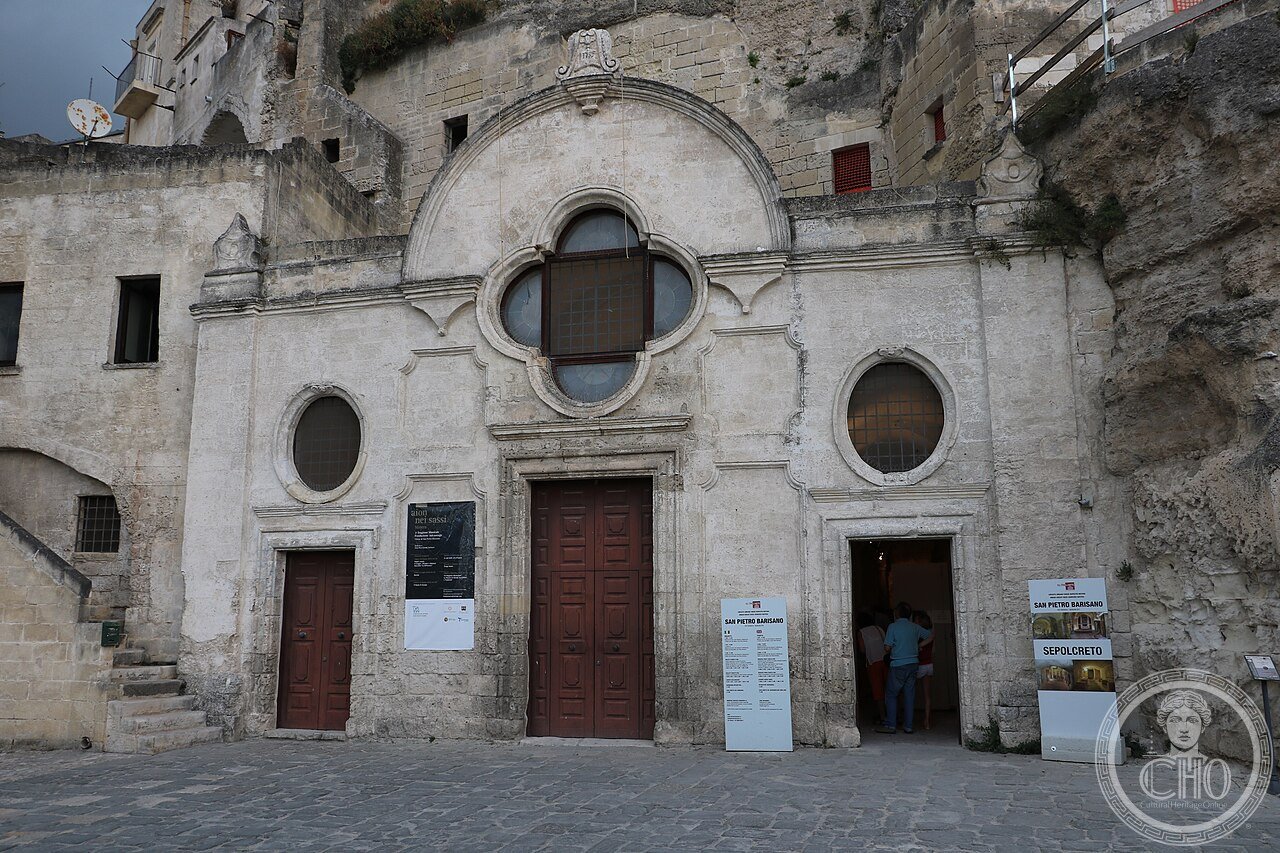
On the underground level of the largest rock-hewn church in Matera lies the putridarium: a room cut into the tufa where, until the eighteenth century, the bodies of dead priests were placed seated, still dressed in their sacred vestments, in niches fitted with drainage holes. The remains were removed only once decomposition was complete — a funerary practice reserved for the clergy alone, which today makes the underground rooms of the church one of the most startling visits in the Sassi.
About San Pietro Barisano
San Pietro Barisano, originally known as San Pietro de Veteribus, is the largest rock-hewn church in Matera. Archaeological investigation has traced the earliest excavated level of the church to the 12th-13th century, at a level lower than the current floor. A first major enlargement between the 15th and 16th centuries deepened the excavation and added lateral chapels, while a further 17th-18th-century restructuring gave the church its present three-nave layout and a new facade, dated 1755. Beneath the church, the underground level was given over to a specific and unusual funerary practice reserved for priests or those training for the priesthood: bodies, dressed in sacred vestments, were seated within niches carved directly into the tuff rock, each fitted with drainage holes — the so-called scolatoi — allowing bodily fluids to drain away as decomposition proceeded; the skeletal remains were only removed once decomposition was complete, in a chamber known as the putridarium. The monastic community relocated in 1903 to the nearby chapel of Sant’Agostino, and during the depopulation of the Sassi di Matera through the 1960s and 1970s, the abandoned church suffered extensive theft and vandalism, including the loss of two altar paintings stolen in 1977. Following the broader restoration of the Sassi district, the church has been reopened to visitors, its remaining 16th-century frescoes, altars, and the underground putridarium now among the most visited rock-church sites in Matera.
Key facts
- 12th-13th century: earliest excavated level of the church, below the current floor
- 15th-16th century: first major enlargement, deepening the excavation and adding lateral chapels
- 17th-18th century: restructuring gives the church its present three-nave form; facade dated 1755
- The putridarium: underground chamber with rock-cut niches (scolatoi) for draining priests’ bodies before final burial
- 1903: the monastic community relocates to the chapel of Sant’Agostino
- 1960s-1970s: abandonment during the depopulation of the Sassi; theft and vandalism, including two stolen altar paintings in 1977
- Today: the largest rock church in Matera, restored and open to visitors, accessible to visitors with disabilities
History
The putridarium’s specific funerary practice — seating clothed corpses in rock-cut niches fitted with drainage holes, restricted exclusively to priests and those training for the priesthood — situates San Pietro Barisano among a distinctive regional tradition of Southern Italian ecclesiastical death ritual, one that treated the slow, controlled decomposition of clergy as a matter requiring purpose-built architectural infrastructure rather than simple burial. The scale of the underground excavation required for this practice, combined with the church’s status as the largest rock-hewn structure in Matera, reflects the substantial material investment the local clergy and community made in formalising this particular funerary custom over centuries.
The church’s abandonment following the 1903 relocation of its monastic community, followed by decades of theft and vandalism during the broader depopulation of the Sassi di Matera in the 1960s and 1970s, mirrors the wider mid-20th-century crisis that saw the entire Sassi district emptied of residents under public health concerns before its eventual UNESCO-recognised restoration — San Pietro Barisano’s own recovery from near-ruin to a leading visitor site reflects that same broader arc of decline and revival.
What you see
The church’s 1755 facade fronts a three-nave interior shaped by centuries of successive rock excavation, preserving surviving 16th-century frescoes and several altars. Beneath the church, visitors descend into the underground putridarium, where the rock-cut niches with their drainage holes remain visible, alongside other hypogeal spaces once used for the community’s funerary practices. The site is equipped with multimedia displays and wheelchair access for visitors.
Practical information
- Opening hours: generally open daily with seasonal variation; check current hours before visiting; admission fee applies
- Address: Rione San Biagio, Sassi di Matera, 75100 Matera, Italy
Getting there
San Pietro Barisano is reachable on foot within the Sassi di Matera, in the Sasso Barisano district, Basilicata. GPS: 40.6687° N, 16.6092° E.
Nearby
- Sassi di Matera — the surrounding UNESCO World Heritage cave-dwelling district
- Rock complex of Madonna delle Virtù and San Nicola dei Greci — another major rock church cluster nearby
- Matera Cathedral — the city’s main cathedral, within walking distance
Sources
- I Sassi di Matera — “San Pietro Barisano” (isassidimatera.com)
- Basilicatanet — “San Pietro Barisano Chiesa Rupestre nei Sassi di Matera” (basilicatanet.com)
- Oltrelarte Matera — “San Pietro Barisano” (oltrelartematera.it)
Find it on the map
See this place and what’s around it →📷 Become a Cultural Heritage Online photographer
Share your photos of places: they stay published under your name as the author. The more they're seen, the more you get noticed — and soon a contest will reward the most appreciated photos.
Log in or sign up free to add a photo