
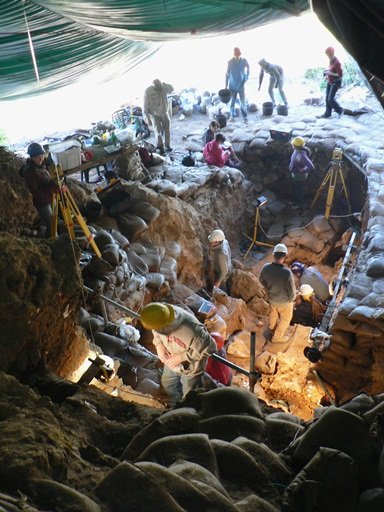
A cluster of sea caves on the Indian Ocean shoreline near Mossel Bay containing the earliest known evidence of behavioural modernity in any hominin — systematic coastal foraging, heat-treatment of stone, and symbolic ochre use all dating to approximately 164,000 BCE, more than 100,000 years before the European Upper Palaeolithic “revolution.”
At a glance
Pinnacle Point is a rocky promontory approximately 9 kilometres east of Mossel Bay on the southern Cape coast of South Africa, where a series of caves — known to archaeologists as Sites 13B, 9, and 30 — have been excavated since 1999 by Curtis Marean of Arizona State University and his international team. The site sits at the junction of the Fynbos biome and the Indian Ocean, in a landscape that would have been particularly rich in marine and terrestrial food resources during periods of shifting sea level. The excavations have produced what many regard as the most compelling evidence yet found for the early emergence of full behavioural modernity in Homo sapiens, including systematic coastal shellfish collection, deliberate heat-treatment of stone tools, and the use of ochre as a symbolic pigment — all predating the equivalent behaviours in European archaeology by more than 100,000 years. The site is a declared Heritage Site of South Africa.
Key facts
- Period: c. 164,000 BCE to c. 40,000 BCE (Middle Stone Age)
- Location: Pinnacle Point promontory, approximately 9 km east of Mossel Bay, Western Cape Province
- Core significance: Earliest known evidence of systematic coastal shellfish harvesting, stone heat-treatment, and symbolic ochre use — all dated to c. 164,000 BCE
- Key researcher: Curtis Marean, Arizona State University (excavations from 1999)
- Key publication: Marean et al. (2007), Nature — “Early human use of marine resources and pigment in South Africa during the Middle Pleistocene”
- Additional sites: Pinnacle Point 9 (PP9) and PP30 extend the sequence from c. 164,000 to c. 50,000 BCE
- Status: South African Heritage Site; research ongoing
- Visitor access: The active research sites are not open to tourists; viewable from a distance from the Pinnacle Point Golf Estate coastal path
Three innovations 100,000 years ahead of Europe
The excavation of Pinnacle Point Site 13B — a sea cave in the cliff face above the wave platform — has produced three types of behavioural evidence that had previously been attributed exclusively to the Upper Palaeolithic “revolution” in Europe (c. 40,000–50,000 BCE), which had long been cited as the moment at which anatomically modern humans became cognitively modern. The key paper, published in Nature in 2007 by Marean and colleagues, reported three findings. First, large quantities of marine shellfish bones (limpets, periwinkles, brown mussels) arranged in patterns consistent with deliberate and organised collection rather than opportunistic scavenging — the earliest documented systematic exploitation of coastal marine resources. Second, the heat-treatment of silcrete, a flint-like coastal stone that fractures unpredictably in its natural state but can be improved dramatically by controlled heating to approximately 350°C before knapping; the technique requires knowledge of material properties, advance planning, and controlled fire management. Third, pieces of ochre (iron-rich red pigment) in quantities and processing patterns consistent with symbolic use — body decoration or marking — rather than food preparation or functional tasks. The combination of all three behaviours in a single occupation layer dated independently to approximately 164,000 BCE using luminescence dating, uranium-series dating, and biostratigraphy demolished the idea that behavioural modernity was a sudden revolution that emerged in Europe or the Near East around 50,000 BCE, and supported instead the view that it emerged gradually in Africa, deeply rooted in coastal environments that provided consistent, reliable nutrition during periods of climate stress.
The caves and the coastal landscape
The Pinnacle Point caves are formed in the cliff face of the rocky promontory, opening above the present wave-cut platform. During the last glacial maximum (approximately 20,000 BCE) global sea levels were approximately 120 metres lower than today, placing the cave entrances far inland from the shore; during the warm periods when the site was most intensively used (c. 164,000 BCE) the coastline was probably closer and a broad coastal plain rich in estuarine and marine resources may have extended in front of the caves. Site 13B is the principal excavation: it has yielded a continuous stratigraphic sequence from approximately 164,000 to approximately 90,000 BCE. Site PP9, a larger cave higher up the cliff, contains a complementary sequence from approximately 120,000 to approximately 50,000 BCE. Site PP30 extends coverage through to approximately 40,000 BCE. Together, the three sites form one of the most complete continuous records of Middle Stone Age human behaviour available anywhere in the world.
Practical information
- Location: Pinnacle Point, approximately 9 km east of Mossel Bay on the N2/R102 coastal road, Western Cape
- GPS: 34.1700°S, 22.0833°E
- Note: The cave sites are within the Pinnacle Point Beach & Golf Resort; access to the excavation areas is restricted to researchers
- Finds displayed at: The George Museum and the Iziko South African Museum, Cape Town
- Research institution: Arizona State University, Institute of Human Origins; in partnership with the South African Heritage Resources Agency (SAHRA)
Getting there
Pinnacle Point is approximately 9 km east of Mossel Bay via the R102 coastal road, in the Western Cape. Mossel Bay is accessible by road from Cape Town (approximately 4 hours on the N2) or from Port Elizabeth (approximately 3 hours). The nearest airport is George Airport (approximately 50 km to the east), with regular flights from Cape Town and Johannesburg. The caves themselves are within a private resort and not open for independent tourist access, but the clifftop area near the resort entrance offers views over the promontory and the adjacent coastline.
Nearby
- Mossel Bay (9 km west) — the nearest town, with accommodation and services; the Bartolomeu Dias Museum Complex documents the Portuguese navigators who rounded the Cape in the 1480s–90s
- Blombos Cave (approx. 90 km west, near Still Bay) — another key Middle Stone Age site on the same southern Cape coastline, with the world’s oldest engraved ochre and personal ornaments
- George (approx. 50 km east) — regional centre with airport and services; gateway to the Garden Route
- Wilderness and Knysna (approx. 70–100 km east) — the Garden Route’s most celebrated coastal towns, within the Garden Route National Park
Sources
- Marean, C. W., Bar-Matthews, M., Bernatchez, J., Fisher, E., Goldberg, P., Herries, A. I. R., … and Watts, I. (2007). Early human use of marine resources and pigment in South Africa during the Middle Pleistocene. Nature, 449, 905–908. DOI: 10.1038/nature06204
- Brown, K. S., Marean, C. W., Herries, A. I. R., Jacobs, Z., Tribolo, C., Braun, D., … and Watts, I. (2009). Fire as an engineering tool of early modern humans. Science, 325(5942), 859–862.
- Wikipedia contributors. “Pinnacle Point.” Wikipedia, The Free Encyclopedia. Accessed June 2026.
- Arizona State University Institute of Human Origins — principal research institution.
Find it on the map
See this place and what’s around it →📷 Become a Cultural Heritage Online photographer
Share your photos of places: they stay published under your name as the author. The more they're seen, the more you get noticed — and soon a contest will reward the most appreciated photos.
Log in or sign up free to add a photo