
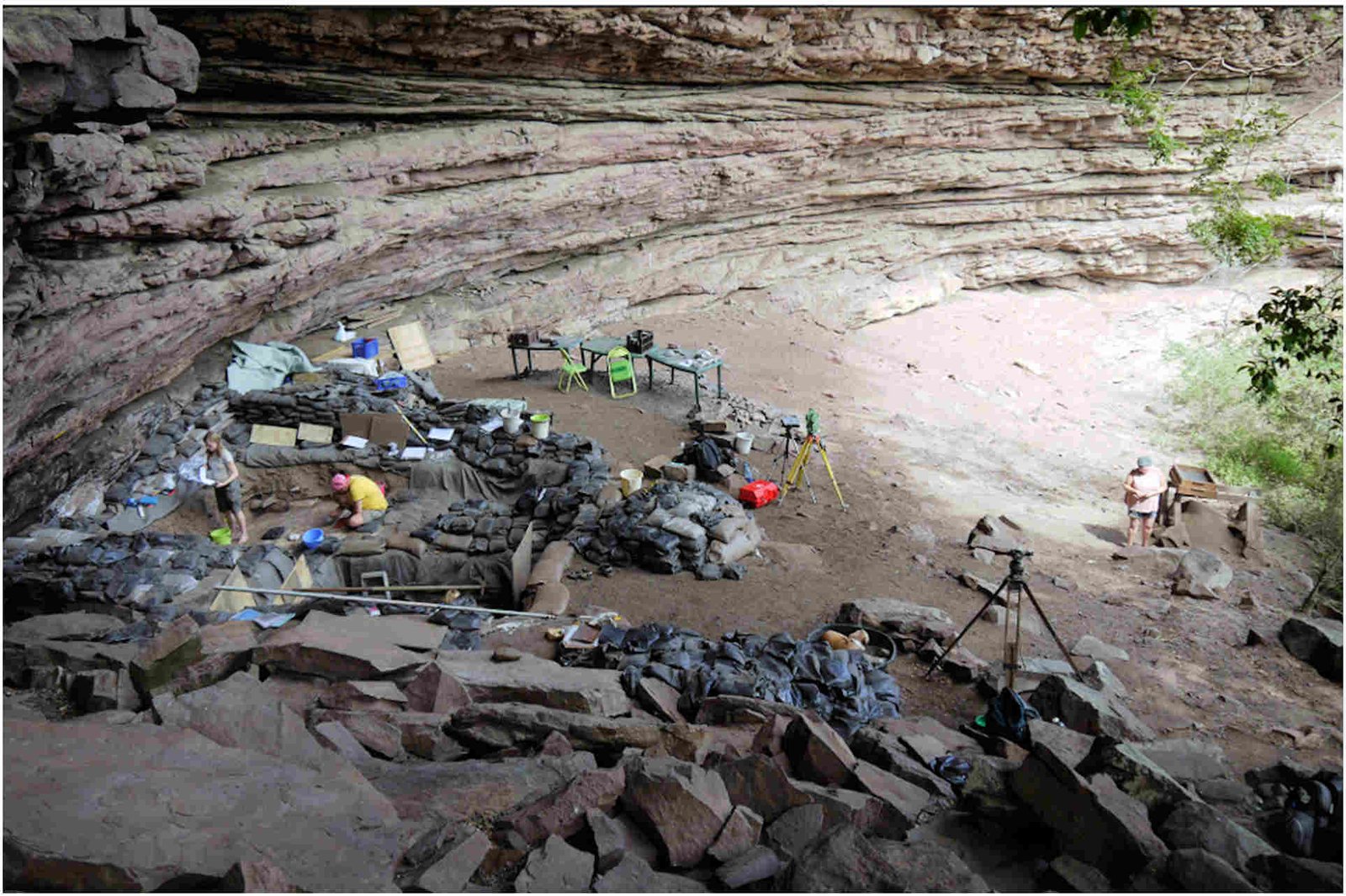
A large sandstone rock shelter north of Durban containing the world’s oldest known bedding (compacted aromatic plant mattresses deliberately burned for pest control, c. 77,000 BCE), the earliest documented compound adhesives, and a rich Middle Stone Age sequence that shows Homo sapiens solving domestic and technological problems 70,000 years before the European Upper Palaeolithic.
At a glance
Sibudu is a large rock shelter formed in a sandstone cliff overlooking the Tongati River approximately 40 kilometres north of Durban in KwaZulu-Natal province, South Africa. Excavations led by Lyn Wadley of the University of the Witwatersrand since 1998 have revealed a stratified sequence of Middle Stone Age occupation spanning from approximately 77,000 to 38,000 years ago — a period that encompasses the last interglacial, the height of the last glacial maximum, and the beginning of post-glacial warming. The site has yielded multiple “world firsts” in the archaeological record of human behaviour, most famously the oldest known bedding, and is now one of the most intensively studied Middle Stone Age sites in southern Africa. Sibudu is not open to the public; research is ongoing.
Key facts
- Period: c. 77,000 BCE – c. 38,000 BCE (Middle Stone Age)
- Location: Sandstone cliff above the Tongati River, near Tongaat, KwaZulu-Natal Province, approximately 40 km north of Durban
- Core significance: World’s oldest known bedding (c. 77,000 BCE); oldest multi-component adhesives (c. 75,000 BCE); earliest evidence of snare hunting; heat-treated stone tools
- Key researcher: Lyn Wadley, University of the Witwatersrand (excavations from 1998)
- Key publications: Wadley et al. (2011), Science — compound adhesive technology; Wadley et al. (2020), Science — oldest plant bedding and pest control
- Status: Active research site, not open to the public
The world’s oldest bed — and five other firsts
The most-cited discovery from Sibudu is the oldest known bedding: thin but consistent layers of compacted leaves from Cryptocarya woodii (an aromatic tree with documented insect-repellent properties), underlaid by Celtis africana (laurel) leaves forming a raised border, dated to approximately 77,000 years ago. The Sibudu people periodically burned these mattresses — ash layers at approximately 77,000–73,000 BP alternate with fresh plant layers — in what Lyn Wadley and colleagues interpret as deliberate sanitation against ticks, mites, and mosquitoes, since burned ash is alkaline and hostile to arthropod pests. This represents a form of public health awareness predating any other evidence of insect-avoidance behaviour by approximately 70,000 years. The second major discovery is compound adhesives: multi-component glues combining ochre, plant gum, and a fat or wax binder, applied to fix stone flakes to wooden handles (hafting), dated to approximately 70,000–75,000 years ago. Making these adhesives required sequential processing steps, knowledge of material chemistry, and deliberate planning. A third discovery is evidence for snares or traps: bones of blue duiker found with injury patterns consistent with snare capture rather than direct hunting, dated to approximately 70,000 years ago — the oldest known evidence of trapping technology. Fourth, heat-treated silcrete stone tools appear at approximately 72,000 years ago, predating the Pinnacle Point evidence and suggesting this technological innovation spread independently or was invented multiple times across the southern Cape. Fifth, the deposit contains evidence of a distinctive backed tool technology (Howiesons Poort industry) with geometric blade forms that appear and then disappear from the sequence, suggesting cognitive flexibility in technological tradition.
The shelter and its deposits
Sibudu is a shallow-but-wide sandstone overhang rather than a deep enclosed cave, offering shelter from rain and sun while remaining well ventilated. The Tongati River below would have provided fresh water, and the surrounding thornbush and coastal forest — today largely transformed by sugar-cane agriculture — would have been rich in game, edible plants, and the tree species used for bedding materials. The deposit is approximately 3–4 metres deep and contains multiple distinct occupation layers separated by thin sterile zones, suggesting alternating periods of use and abandonment correlated with regional climate shifts. The shelter’s orientation provides good natural light and protection from prevailing winds, making it an attractive camping location across the full 40,000 years of recorded use.
Practical information
- Location: Sibudu area near Tongaat, KwaZulu-Natal, approximately 40 km north of Durban off the N2 highway
- GPS: 29.5333°S, 31.0833°E
- Visitor access: The site is not open to the public; it is an active excavation managed by the University of the Witwatersrand
- Finds displayed at: Iziko South African Museum, Cape Town; Natal Museum, Pietermaritzburg
- Research institution: University of the Witwatersrand, Johannesburg; in partnership with multiple international institutions
Getting there
Sibudu is located near Tongaat in KwaZulu-Natal, approximately 40 km north of Durban on the N2 coastal highway. King Shaka International Airport (Durban) is approximately 25 km south and has regular connections to Johannesburg, Cape Town, and other South African cities. The site itself is not accessible to tourists, but Durban — KwaZulu-Natal’s major city — offers numerous cultural heritage attractions including the KwaZulu-Natal Museum and various sites connected to Zulu history and the colonial-era battlefields further inland.
Nearby
- Durban (40 km south) — KwaZulu-Natal’s main city; diverse cultural heritage including the KwaZulu-Natal Museum and Golden Mile seafront
- Tongaat (adjacent) — small town in a sugar-cane growing area; the adjacent Tongati River valley landscape is the immediate setting of the shelter
- iSimangaliso Wetland Park (approx. 130 km north) — UNESCO World Heritage Site; significant wetland, coastal and marine ecosystem on the KwaZulu-Natal coast
- Drakensberg Mountains (approx. 200 km west) — major mountain range with rock art sites (also UNESCO World Heritage); San hunter-gatherer paintings in shelters throughout the range
Sources
- Wadley, L., Hodgskiss, T., and Grant, M. (2009). Implications for complex cognition from the hafting of tools with compound adhesives in the Middle Stone Age, South Africa. PNAS, 106(24), 9590–9594.
- Wadley, L., Backwell, L., d’Errico, F., and Sievers, C. (2020). Cooked starchy rhizomes in Africa 170 thousand years ago. Science, 367(6473), 87–91. (plant food preparation)
- Wadley, L. et al. (2020). Fire and grass-bedding construction 200 thousand years ago at Border Cave, South Africa. Science, 369(6505), 863–866. (contextual bedding evidence)
- Wikipedia contributors. “Sibudu.” Wikipedia, The Free Encyclopedia. Accessed June 2026.
- University of the Witwatersrand — primary research institution for Sibudu Cave.
Find it on the map
See this place and what’s around it →📷 Become a Cultural Heritage Online photographer
Share your photos of places: they stay published under your name as the author. The more they're seen, the more you get noticed — and soon a contest will reward the most appreciated photos.
Log in or sign up free to add a photo