

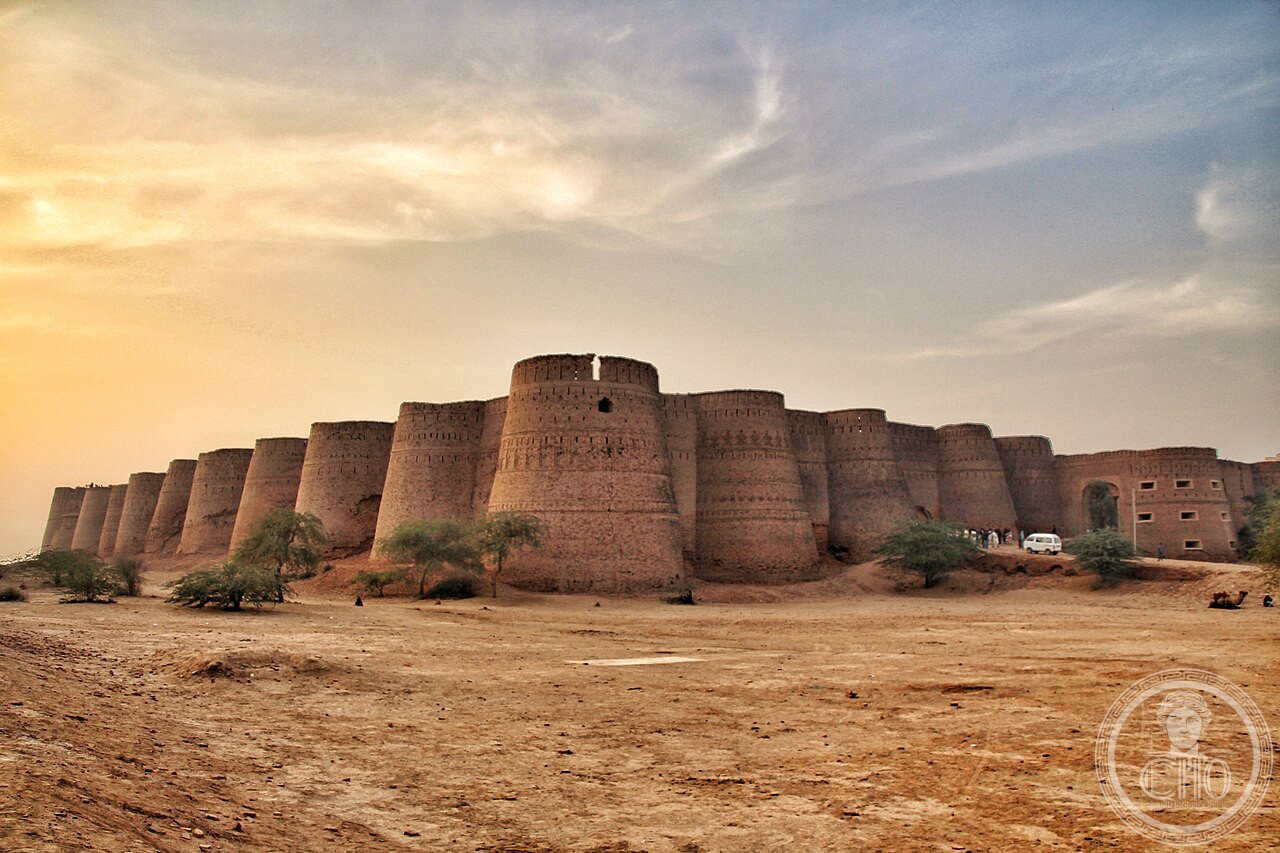
Forty smooth cylindrical bastions rising from the dead-flat Cholistan Desert, visible for 30 kilometres in every direction — the great desert fortress of the Nawabs of Bahawalpur, standing as one of the most dramatically sited fortifications in South Asia.
At a glance
In the heart of the Cholistan Desert approximately 100 kilometres south of Bahawalpur in southern Punjab, Derawar Fort rises with jarring abruptness from the flat sand: a massive square fortress approximately 1.5 kilometres in perimeter, with 40 cylindrical bastions of smooth-plastered white-and-ochre brick standing up to 30 metres above the desert floor. Without windows, entrances, or features for most of their height, the bastions rise in continuous curves that create a dreamlike geometry. Built in its current form in the 18th century CE by the Abbasi Nawabs of Bahawalpur on the site of an earlier 9th-century fort, it served as the winter residence and treasury of one of the wealthiest Mughal successor states. Immediately adjacent stands the Abbasi Mosque, whose white marble domes and minarets rise from the desert alongside the bastions to create one of the most extraordinary architectural juxtapositions in Pakistan.
Key facts
- Built: Current form 18th century CE; original fort 9th century CE (Dera dynasty)
- Builders: Abbasi Nawabs of Bahawalpur (Nawabate founded c. 1748)
- Scale: ~1.5 km perimeter; 40 cylindrical bastions; tallest ~30 m above desert floor
- Setting: Cholistan Desert, ~100 km south of Bahawalpur, southern Punjab
- Adjacent: Abbasi Mosque (18th century, white marble domes and minarets)
- Management: Privately managed by the Nawab of Bahawalpur family
- Visibility: Visible from ~30 km in every direction across the flat desert
History
The site of Derawar was first fortified in the 9th century CE by the Dera dynasty, Hindu rulers who gave their name to the settlement. The original fort controlled a section of the ancient Hakra River caravan route — the dried bed of the Ghaggar-Hakra system, which some archaeologists identify with the legendary Saraswati River of the Rigveda, and whose course through the Cholistan Desert is marked by approximately 400 sites of the Indus Valley Civilisation (3000–1700 BCE), making this desert one of the most archaeologically dense landscapes in South Asia.
The fort passed through various hands before being taken in 1733 CE by Nawab Sadiq Muhammad Khan I, who founded the Abbasi dynasty and the Nawabate of Bahawalpur — a princely state that would become, by the early 19th century, one of the wealthiest and most sophisticated of the Mughal successor states of the subcontinent. The Nawabs completely rebuilt Derawar in its current form during the 18th century, transforming it into a massive square fortress with 40 cylindrical bastions of fired brick coated in lime plaster, and adding the adjacent Abbasi Mosque in a refined Mughal style.
Bahawalpur State remained nominally independent under British paramountcy from 1833 until it joined Pakistan in 1955. The Nawabs used Derawar as their winter residence and as the repository of the state treasury, which at its peak included one of the largest collections of jewels and historical artefacts in the subcontinent. The fort is still owned by the Nawab family and is not a public museum, though it is accessible to visitors by arrangement and is regularly photographed from outside its walls.
What you see
The visual drama of Derawar is absolute: the fort appears to float on the desert, its 40 bastions forming an unbroken ring of smooth curved brick surfaces that reflect the light differently at every hour. Unlike most South Asian forts, which are built on hills or at river confluences, Derawar has no natural defensive advantage — its protection comes entirely from the massiveness and geometry of its walls, which offer no handholds, no ledges, and no easy approach from any direction.
The bastions are the defining architectural element: each is approximately 10–12 metres in diameter, solid brick for most of their height, with battlements and cannon emplacements at the top. The smooth lime-plaster coating, which in its maintained state is brilliant white, bleaches to ochre and cream where it has weathered. The overall silhouette, seen from a distance across the flat sand, is unlike any other fort in South Asia.
The Abbasi Mosque, immediately to the south of the fort entrance, is a refined 18th-century structure in white marble and plaster with three domes and four minarets, closely modelled on the Badshahi Mosque in Lahore. The interior is decorated with painted floral panels and calligraphic inscriptions. The juxtaposition of the massive military geometry of the fort with the delicate religious architecture of the mosque, both rising directly from the flat desert, is one of the most compelling architectural landscapes in Pakistan.
Practical information
- Access: Privately owned by the Nawab family; exterior and mosque accessible; interior by permission
- Best time: November to February (desert winters); summers reach 50°C and above
- Time needed: 2–3 hours including the mosque; longer if exploring the surrounding desert
- Getting to site: The road from Bahawalpur (~100 km) is paved for most of the route but can be sandy near the fort; 4WD recommended in wet season
- Photography: Outstanding; the fort is best photographed at sunrise or sunset when the bastions cast long shadows across the sand
- Base: Bahawalpur city (~100 km north) has hotels and services; no facilities at the fort
Getting there
Derawar Fort is approximately 100 kilometres south of Bahawalpur city in the Cholistan Desert. From Bahawalpur, take the road south toward Yazman and then into the desert. The route is signposted but road conditions vary by season; a 4WD vehicle is recommended. The nearest city with regular air and rail connections is Bahawalpur (served by Bahawalpur Airport, Shahbaz International Airport, and the Lahore–Bahawalpur railway). From Lahore the drive is approximately 400 km (4–5 hours).
Nearby
- Abbasi Mosque — immediately adjacent; 18th-century Mughal-style mosque in white marble, built by the Nawabs of Bahawalpur
- Cholistan Desert — surrounding landscape; ~400 Indus Valley Civilisation sites along the ancient Hakra river bed
- Bahawalpur city — ~100 km north; former capital of the Nawabate, with the Noor Mahal palace (1872) and Sadiq Garh Palace
- Ucch Sharif — ~120 km northeast; medieval Islamic city with extraordinary 13th–15th century mausoleums, UNESCO Tentative List
- Fort Marot — ~60 km south; smaller but well-preserved Abbasi fort in the desert
Sources
- Wikipedia: Derawar Fort
- Pakistan Tourism Development Corporation records, Bahawalpur District
- Cholistan Desert Archaeological Survey documentation
Find it on the map
See this place and what’s around it →📷 Become a Cultural Heritage Online photographer
Share your photos of places: they stay published under your name as the author. The more they're seen, the more you get noticed — and soon a contest will reward the most appreciated photos.
Log in or sign up free to add a photo