
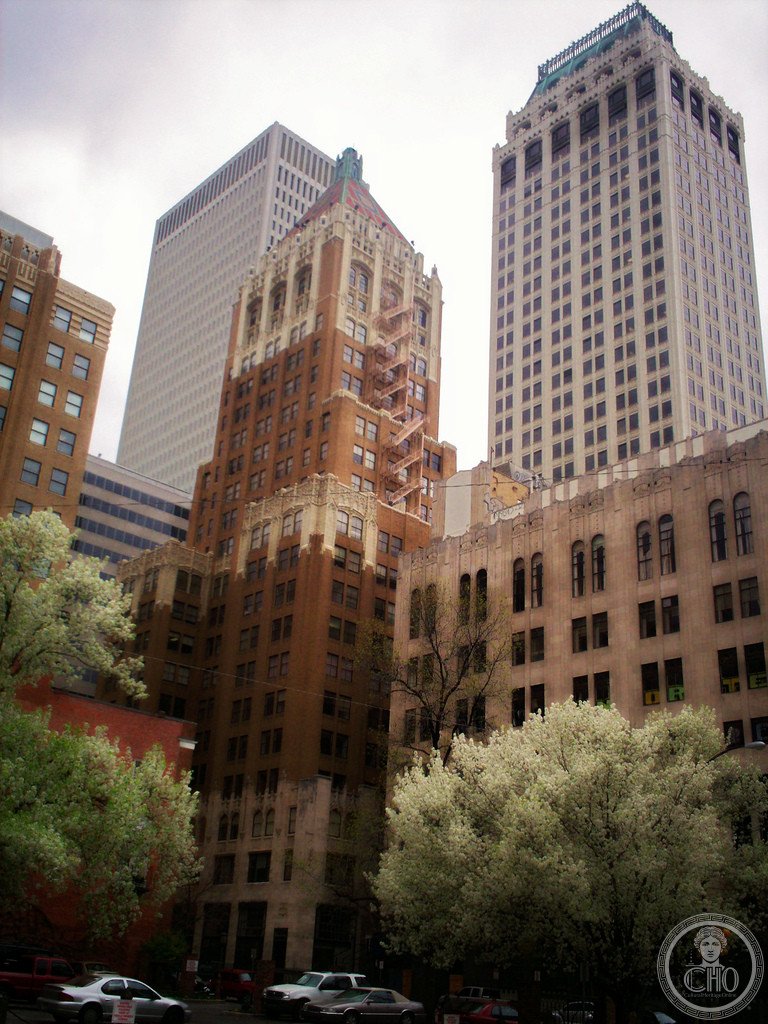
At 323 feet, Waite Phillips’s 1928 tower synthesises Gothic pinnacles and Jazz Age terracotta into the defining vertical accent of Tulsa’s oil-boom skyline — a building that still signals downtown’s ambition from twenty miles out.
At a glance
The Philtower rises 323 feet (98 m) over downtown Tulsa in 23 storeys of buff brick and polychrome terracotta. Built in 1927–1928 for Phillips Petroleum heir Waite Phillips, it was designed by Edward Buehler Delk of Kansas City in the Gothic Art Déco mode that characterised American skyscraper design of the late 1920s: setbacks at the upper floors, richly carved terracotta at the crown, and a two-storey ground-floor arcade of polished marble and bronze. The building is individually listed on the National Register of Historic Places (1979) and forms the centrepiece of the Oil Capital Historic District (2010).
Key facts
- Architect: Keen & Simpson with Edward Buehler Delk
- Commissioner: Waite Phillips
- Completed: 1928
- Height: 323 ft (98 m)
- Floors: 23
- Style: Gothic Art Déco
- Cladding: Terracotta, brick, polished limestone
- NRHP: 1979 (individual; NR 79002032) · Oil Capital Historic District 2010
- Address: 427 S. Boston Ave., Tulsa, OK 74103
History
Waite Phillips (1883–1964) was one of the three Phillips brothers whose oil operations defined Tulsa’s first half-century. Unlike his brother Frank (founder of Phillips 66), Waite concentrated on real estate and philanthropy, eventually donating the Philbrook estate to the city as a museum and Philmont Ranch to the Boy Scouts of America. The Philtower — and the adjacent Philcade Building — were his downtown commercial anchors, designed to reinforce his name across the Tulsa skyline while generating rental income from the city’s booming petroleum economy.
The collaboration of Keen & Simpson and Edward Buehler Delk produced a tower that drew directly on the Woolworth Building’s Gothic-skyscraper vocabulary but adapted it to Tulsa’s warmer palette and lower height. Construction ran through 1927–1928; the building opened fully occupied. The lobby was fitted with Botticino marble from Italy, bronze elevator doors, and a vaulted ceiling of Guastavino tile. Waite Phillips occupied offices in the building through the 1930s.
The building changed hands several times after Phillips donated the building to the Boy Scouts of America in 1941, but the exterior was never fundamentally altered. A restoration campaign in the 1990s stabilised the terracotta and cleaned the marble lobby. Today it is part of the Oil Capital Historic District, whose 2010 NRHP listing recognised over 20 buildings within a four-block radius.
What you see
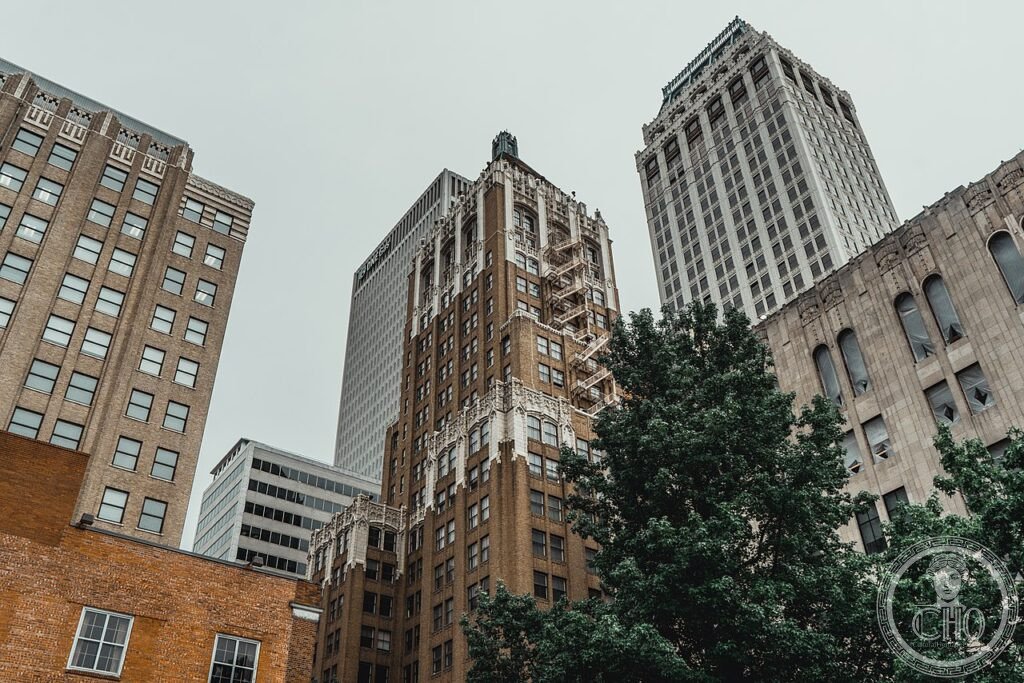
The Philtower’s street presence is defined by its corner siting at Fifth Street and Boston Avenue. The base opens with large arched windows under a colonnade of polished limestone piers; above, the shaft rises in rectilinear buff brick until the setbacks begin at the eighteenth floor. Each step of the crown receives progressively denser terracotta ornament — Gothic pinnacles, foliate tracery, and a central attic level whose projecting gargoyle-like brackets give the roofline its silhouette against the Oklahoma sky.
The lobby rewards close attention. The original polychrome marble floor survives intact; the bronze elevator surrounds carry stylised oil-derrick motifs — a local adaptation of the Art Déco machine aesthetic. Ceiling coffers of gilded plasterwork and the long marble banking counter (now repurposed) make this one of the best-preserved 1920s commercial lobbies in the south-central United States.
Practical information
- Address: 427 S. Boston Avenue, Tulsa, OK 74103
- GPS: 36.151944, -95.988611
- Lobby: Open weekday business hours; accessible to the public
- Time needed: 30 minutes for exterior and lobby
- Art Déco walk: The Philcade Building is directly adjacent; Mid-Continent Tower is one block north
Getting there
The Philtower stands at the corner of Fifth Street and Boston Avenue in downtown Tulsa. Walking distance from the BOK Center (5 minutes) and the Convention Center (3 minutes). Paid parking is available in the adjacent Philtower parking garage and on Fifth Street. Tulsa International Airport is approximately 8 miles northeast, a 20-minute drive.
Nearby
- Philcade Building (1931) — Waite Phillips arcade, directly adjacent
- Mid-Continent Tower — one block north, Tulsa’s tallest
- Boston Avenue Methodist Church (1929) — National Historic Landmark, 10 min walk south
Photo gallery
Sources
- Wikidata entity Q3381275 — GPS, architect, year
- Wikipedia EN — Philtower
- National Register of Historic Places — Philtower individual listing (1979, NR 79002032); Oil Capital Historic District (2010)
- Oklahoma Historical Society — Waite Phillips biographical record
- Tulsa Preservation Commission — Philtower documentation
Find it on the map
See this place and what’s around it →📷 Become a Cultural Heritage Online photographer
Share your photos of places: they stay published under your name as the author. The more they're seen, the more you get noticed — and soon a contest will reward the most appreciated photos.
Log in or sign up free to add a photoIs this page about you?
This page is read by travellers and heritage enthusiasts who find it on Google. Tell us how you are connected to this place and we will take it from there.