

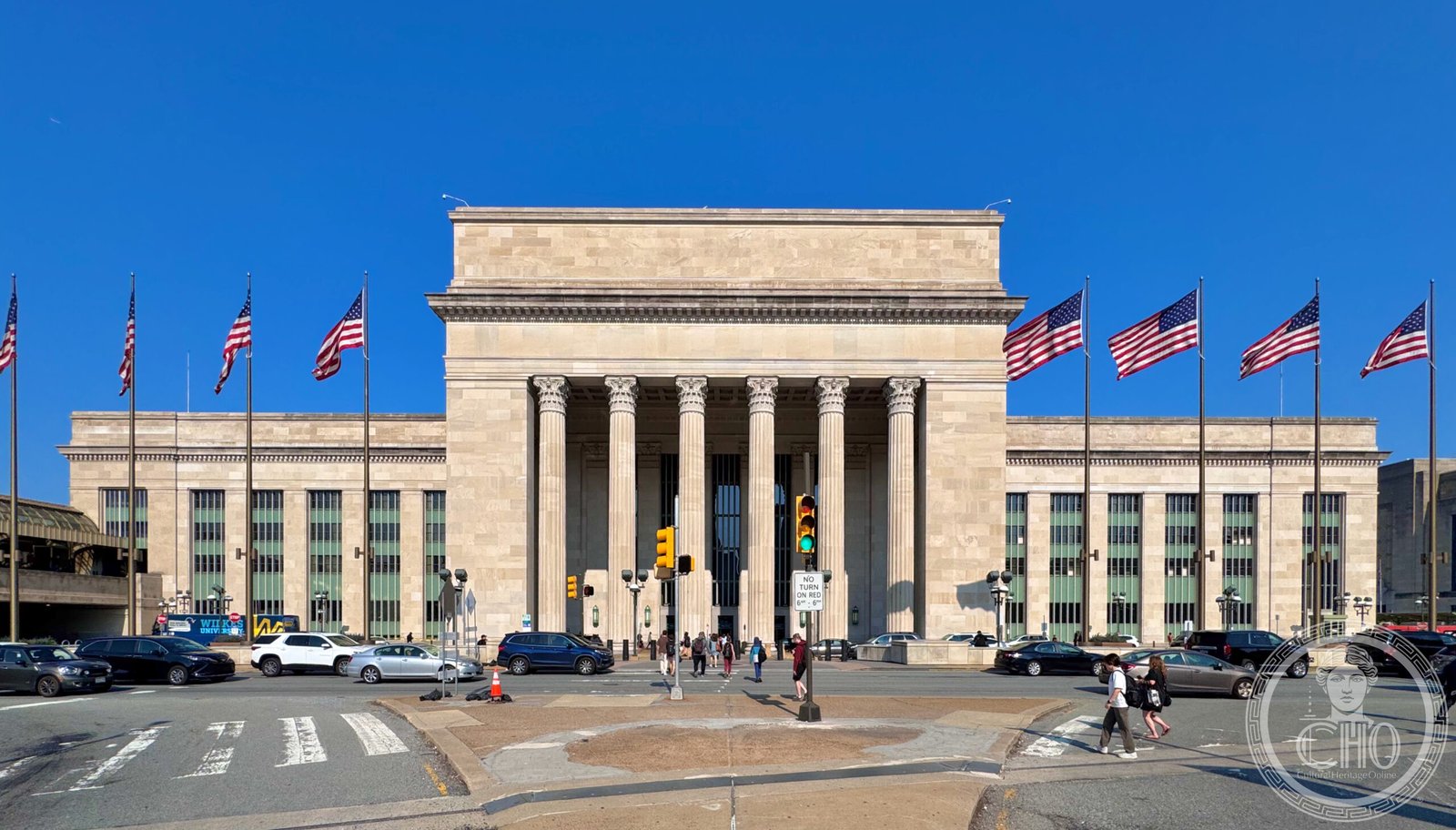

Completed in 1933 to designs by Graham, Anderson, Probst & White and still one of the busiest rail stations in the United States, 30th Street Station in Philadelphia is a Classical Moderne landmark whose 95-foot coffered main hall, Corinthian limestone colonnade, and Walker Hancock’s monumental bronze “Angel of the Resurrection” memorial create a civic space of genuine grandeur in the city’s University City district.
At a glance
30th Street Station at 2955 Market Street is the principal Amtrak terminal in Philadelphia and one of the most active intercity rail stations in the United States, serving Amtrak’s Northeast Corridor between Boston and Washington, the SEPTA commuter rail network, and New Jersey Transit connections. Designed by Graham, Anderson, Probst & White — the Chicago firm that had also designed the Terminal Tower in Cleveland and Washington’s Union Station headhouse improvements — and opened in stages from 1933, the building presents a monumental Classical Moderne facade of Corinthian columns and Indiana limestone to Market Street. The main hall inside — the waiting room and concourse — is one of the grandest public spaces in Philadelphia: approximately 300 feet long and 95 feet high, its coffered ceiling supported on Corinthian columns, with Walker Hancock’s 39-foot bronze memorial to Pennsylvania Railroad workers killed in the Second World War — “The Angel of the Resurrection” — presiding over the south end of the hall. The building is listed on the National Register of Historic Places.
Key facts
- Completed: 1933 (opened in stages).
- Architects: Graham, Anderson, Probst & White (Chicago).
- Style: Classical Moderne.
- Address: 2955 Market St (at 30th St), Philadelphia, PA 19104.
- Main hall: Approximately 300 ft long / 95 ft (29 m) high; coffered ceiling.
- War memorial: “The Angel of the Resurrection”, Walker Hancock (1895–1998); 39-ft bronze; 1952; south end of main hall.
- Designation: National Register of Historic Places (1978).
- Notable: Amtrak Northeast Corridor hub; SEPTA regional rail; one of busiest stations in USA.
History
The Pennsylvania Railroad was, at the time of the 30th Street Station’s construction, the largest corporation in the United States — its network of tracks and its ambitions for its Philadelphia terminal reflected the resources and the confidence of an organisation accustomed to thinking in the very largest terms. The existing Broad Street Station in central Philadelphia had become inadequate by the 1920s, and the Pennsylvania Railroad’s decision to replace it with a new terminal west of the Schuylkill River required a massive infrastructure investment: the electrification of the Philadelphia mainlines, the elevation of the tracks over the rail yard, and the construction of the station itself.
Graham, Anderson, Probst & White — heirs to the Burnham firm tradition — produced a design in the Classical Moderne mode that the firm had already deployed at the Cleveland Union Terminal and at other large civic commissions: Corinthian limestone colonnade on the exterior, coffered ceilings and classical proportions in the interior, the ornamental vocabulary of the Beaux-Arts tradition simplified and made monumental rather than elaborate. The building opened in stages in 1933 as the electrification programme was completed, and quickly became the primary intercity terminal for Philadelphia, a role it has retained through all subsequent changes in American transportation.
Walker Hancock’s memorial sculpture “The Angel of the Resurrection,” installed in 1952 to commemorate Pennsylvania Railroad employees who died in the Second World War, is the station’s most powerful interior element: a 39-foot figure of an archangel lifting a fallen soldier, the angel’s wings spread to their full span, the figure’s scale calibrated to the 95-foot height of the main hall’s coffered ceiling. The sculpture is among the most significant examples of mid-century public memorial art in the United States, and it anchors the south end of the main hall with a solemnity that gives the space a quality beyond that of most commercial transportation buildings.