
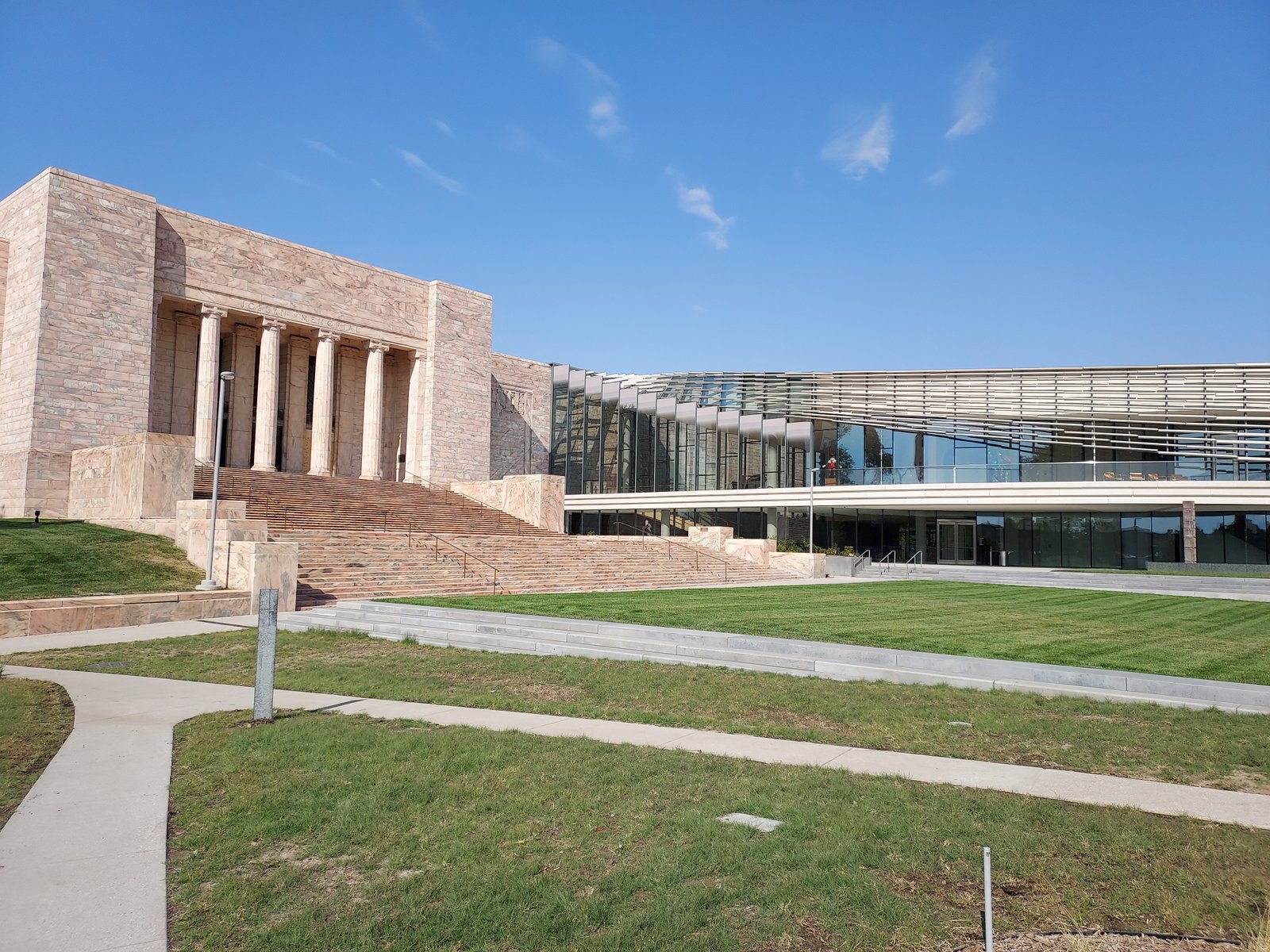

Built as a memorial to a newspaper magnate, the Joslyn rises in Georgian pink marble from the flat Omaha streetscape — one of the most improbable Art Deco monuments on the American plains.
At a glance
The Joslyn Art Museum occupies a city block in midtown Omaha, its pink Georgia marble cladding catching the late-afternoon sun in a way that stops traffic on Dodge Street. Opened in October 1931, it was funded entirely by Sarah Joslyn as a memorial to her husband George, and it gave a city of just under 200,000 people an art museum and a concert hall — an act of civic generosity on a Depression-era budget that has never quite been replicated.
Key facts
- Opened: October 1931
- Style: Art Deco with classical proportions
- Exterior: Georgia pink marble cladding over reinforced concrete frame
- Patron: Sarah Joslyn, in memory of George A. Joslyn (1848–1916), founder of the Western Newspaper Union
- Signature collection: Karl Bodmer watercolours documenting the 1833 Missouri River expedition
- Address: 2200 Dodge Street, Omaha, NE 68102
History
George A. Joslyn built his fortune distributing ready-print content to rural newspapers across the American Midwest and West. By the time he died in 1916 the Western Newspaper Union had made him one of Omaha’s wealthiest citizens, and his wife Sarah chose to commemorate him with something the city lacked: a proper museum. Construction began in 1928 and the building opened in October 1931, with the country already deep into the Great Depression.
The Depression did not stop the Joslyn’s acquisitions program. During the 1940s the museum developed a particular strength in American West painting, and the acquisition of Karl Bodmer’s watercolour series from the 1833 expedition up the Missouri River with Prince Maximilian of Wied became the institution’s defining holding. Bodmer’s precise, ethnographically faithful images of Plains Indian life are considered among the most important visual documents of the pre-reservation West.
A substantial addition by Norman Foster opened in 1994, connecting to the original building underground and adding gallery space without obscuring the marble facade. The original 1931 structure remains the institution’s architectural and symbolic core.
What you see
The exterior is a compact, horizontal composition — three primary stories of pink marble with shallow carved ornament at the cornice and geometric relief panels flanking the window bays. Art Deco discipline prevails: the ornament is tight and abstract, the material does the emotional work. The main entrance on South 22nd Street is framed by pilasters rising the full height of the facade, giving the entrance a monumental scale that the building’s modest footprint would not otherwise suggest. The pink marble holds warmth in morning light and goes nearly grey under an overcast sky.
Inside, the original galleries range around a central atrium lit by a glass ceiling — a layout that allows natural light to penetrate the building’s core. The concert hall in the north wing, now called the Hitchcock Recital Hall, retains its original Art Deco volume: deep coffered ceiling, shallow balcony, and the kind of proportional restraint that acoustics demand.
Practical information
- Hours: Tuesday–Saturday 10am–5pm, Sunday noon–5pm; closed Monday
- Admission: General admission charged; members and children free
- Allow: 2–3 hours for the permanent collection; longer for temporary exhibitions
- Note: The Bodmer collection is in the dedicated Native American galleries on the upper level — allow time for it
Getting there
The Joslyn sits at 2200 Dodge Street in midtown Omaha, about 2 miles northwest of downtown. Omaha Eppley Airfield (OMA) is 10 miles to the north. The museum has its own surface parking lot; Metro bus routes serve Dodge Street along the museum’s frontage. On foot from downtown the walk along Dodge Street takes approximately 35 minutes.
Nearby
- Old Market district — Omaha’s 19th-century warehouse quarter, about 1.5 miles southeast
- Durham Museum — occupies the 1931 Art Deco Union Station on 10th Street; Omaha’s second great Depression-era monument
- Lauritzen Gardens — botanical garden 3 miles south along the Missouri bluffs
Sources
- Joslyn Art Museum — official collection and building history (joslyn.org)
- National Register of Historic Places documentation
- Maximilian of Wied expedition records, Joslyn Art Museum archive
- Bodmer watercolour catalogue, Joslyn Art Museum Publications
Find it on the map
See this place and what’s around it →📷 Become a Cultural Heritage Online photographer
Share your photos of places: they stay published under your name as the author. The more they're seen, the more you get noticed — and soon a contest will reward the most appreciated photos.
Log in or sign up free to add a photoIs this page about you?
This page is read by travellers and heritage enthusiasts who find it on Google. Tell us how you are connected to this place and we will take it from there.