
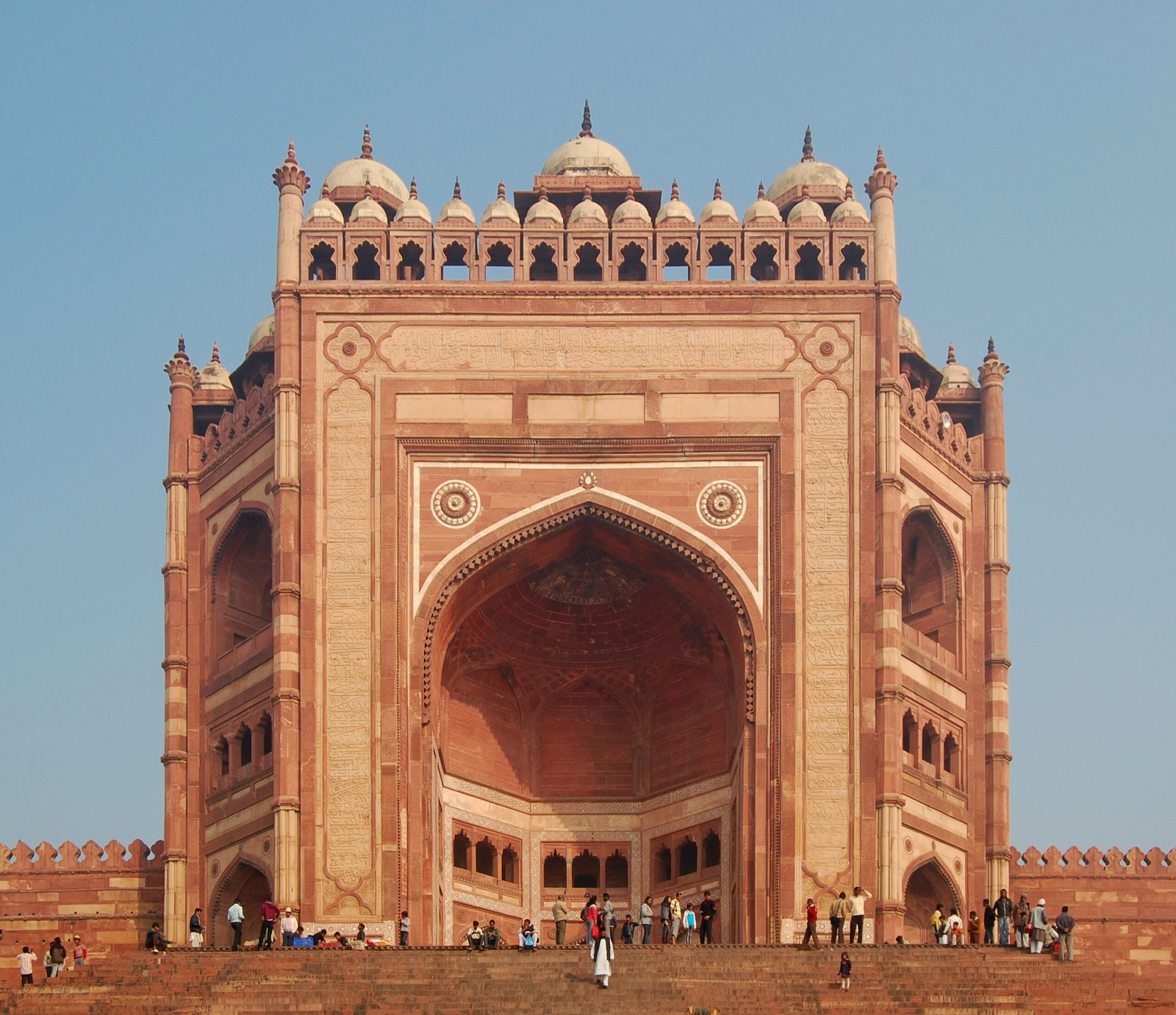
Thirty-seven kilometres from Agra, the Emperor Akbar built the most ambitious Mughal city of his reign and abandoned it fourteen years later, leaving the most perfectly preserved Mughal ghost town in the world.
At a glance
In 1569, the Emperor Akbar visited the Sufi saint Sheikh Salim Chishti at his hermitage on the Sikri ridge to pray for an heir. Three sons were subsequently born, and Akbar decided to relocate the Mughal capital from Agra to Sikri. Construction of Fatehpur Sikri (City of Victory) began in 1571, employing thousands of craftsmen over approximately fifteen years. The completed city covered roughly 11 sq km and housed the imperial court, mosques, palaces, and residential quarters for an estimated population of 200,000. In 1585, Akbar moved the court to Lahore and never returned. UNESCO inscribed the site in 1986.
Key facts
- Built: 1571–1585 AD under Emperor Akbar (Mughal Empire)
- Area: approximately 11 sq km at its height
- Material: red Sikri sandstone, quarried on site
- UNESCO: World Heritage Site since 1986
- Why abandoned: debated — water supply inadequacy or strategic military considerations
- Active shrine: Tomb of Sheikh Salim Chishti remains a living pilgrimage site
- Distance: 37 km west of Agra, 200 km south of Delhi
History
In 1569, Akbar (ruled 1556–1605) visited Sheikh Salim Chishti on the Sikri ridge to pray for a male heir. The saint prophesied three sons; all were born, and Akbar named his first son Salim in the saint’s honour — this Salim later became Emperor Jahangir. Attributing his sons to the saint’s blessing, Akbar decided to make Sikri his new capital.
Construction began in 1571. Thousands of craftsmen from Hindu, Muslim, and Central Asian traditions were employed; the architecture they produced was a deliberate synthesis of all three. By the mid-1580s the city was complete: palaces, audience halls, mosques, residences, stables, and bazaars covering approximately 11 sq km, housing an estimated 200,000 people.
In 1585, Akbar moved his army northwest to deal with a rebellion and stationed himself at Lahore — and never returned to Fatehpur Sikri. The city’s population dispersed. The traditional explanation for the abandonment — inadequate water supply — is now disputed by historians who point to strategic and military considerations. Fatehpur Sikri has remained largely unoccupied for more than four centuries.
What you see
The Buland Darwaza (Gate of Magnificence, 1573) — at 54 metres one of the tallest gateways in the world — leads into the Jami Masjid (Great Mosque), built to commemorate Akbar’s victory over Gujarat. The Jami Masjid is among the largest mosques in India.
The Tomb of Sheikh Salim Chishti, in the mosque courtyard, is encased in the most intricate jali (stone lattice) screens in the entire Mughal repertoire — white marble carved with such delicacy it appears to have the texture of lace. The tomb is still an active shrine; women who wish to conceive tie threads on the lattice, continuing the tradition that began Akbar’s connection with this place.
The Diwan-i-Khas (Hall of Private Audience) has a stone pillar supporting a central throne platform connected to the room’s four corners by narrow walkways — allowing Akbar to sit at the centre while advisors occupied positions at different levels. The Panch Mahal is a five-storey open pavilion supported by 176 columns, no two alike in design.
Practical information
- Open: Sunrise to sunset, 7 days a week
- Entry fee: Archaeological Survey of India rates; Jami Masjid and Chishti Tomb are free
- Best time: October to March; extreme heat May to August (40–45°C)
- Guides: Licensed guides available at the main entrance; recommended given the labyrinthine layout
- Dress code: Modest dress required; shoes removed at the Chishti Tomb shrine
- Photography: Permitted throughout the complex
Getting there
- From Agra: 37 km west on NH19; taxi or bus from Agra Fort Bus Stand, approximately 1 hour
- By train: Fatehpur Sikri station has connections to Agra and Jaipur (local trains only)
- Combined visit: Most visitors combine with the Taj Mahal and Agra Fort, or include en route to Jaipur
Nearby
- Agra Fort — Akbar’s earlier seat of government, 37 km east; UNESCO WHS
- Taj Mahal — built by Akbar’s grandson Shah Jahan; 40 km east in Agra
- Keoladeo National Park — 30 km west; UNESCO WHS, one of Asia’s finest wetland bird reserves
Sources
- Archaeological Survey of India — Fatehpur Sikri, official site description
- UNESCO World Heritage List — Fatehpur Sikri (inscribed 1986), whc.unesco.org
- Rezavi, S.A.N. — Fatehpur Sikri Revisited, Oxford University Press, 2013
- Koch, Ebba — Mughal Architecture, Prestel, 1991
- Nath, R. — History of Mughal Architecture, Abhinav Publications, 1982
Find it on the map
See this place and what’s around it →📷 Become a Cultural Heritage Online photographer
Share your photos of places: they stay published under your name as the author. The more they're seen, the more you get noticed — and soon a contest will reward the most appreciated photos.
Log in or sign up free to add a photo