
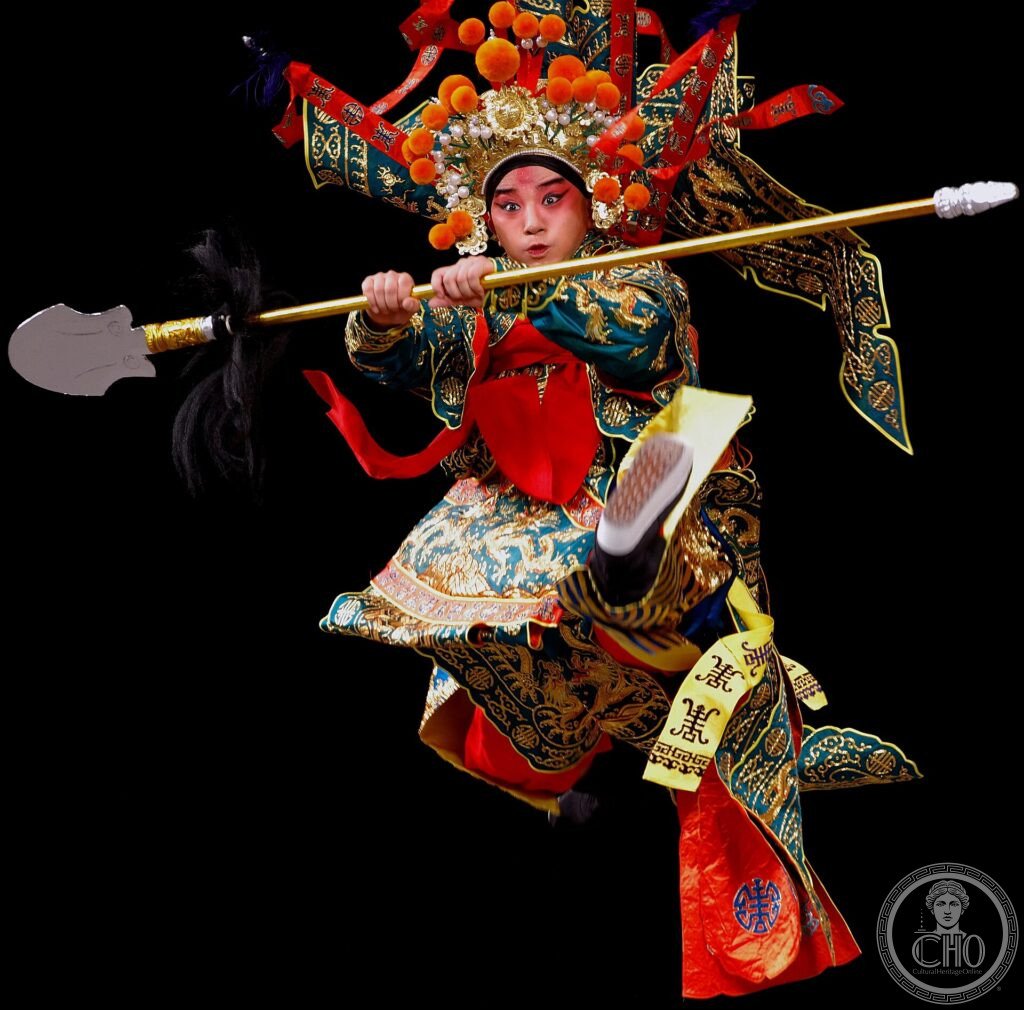
A synthesis of music, acrobatics, martial arts and symbolic gesture, Peking opera has dominated Chinese stages since the mid-19th century, blending high technique with storytelling drawn from history, folklore and contemporary life.
At a glance
Peking opera unites four disciplines—instrumental music, vocal performance, mime and acrobatics—performed by elaborately costumed actors on a characteristically sparse stage. The form prizes symbolic and suggestive movement over realistic portrayal, with every gesture layered in meaning and synchronized to music. Four main role types structure the ensemble: gentlemen (shēng), women (dàn), rough men (jìng) and clowns (chǒu).
Origins & history
Peking opera arose in Beijing during the mid-Qing dynasty (1644–1912) and achieved full recognition by the mid-19th century. It became extremely popular in the imperial court and came to be regarded as one of China’s cultural treasures. During the Cultural Revolution (1966–1976), the form was denounced as “feudalistic” and “bourgeois” and largely replaced by revolutionary operas. After the period’s end, these transformations were largely undone.
The practice
Performers master four core skills—speech, song, dance and combat—executed with precision and aesthetic refinement. Movements are symbolic rather than literal; a performer’s merit is judged primarily on the beauty of gesture. The music employs two main styles: xīpí and èrhuáng, comprising arias, fixed melodies and percussion patterns that provide the temporal framework for all action on stage.
Costumes are elaborate and colorful, making actors the sole visual focal point. Performers adhere to strict stylistic conventions that allow audiences to navigate narrative and character. The repertoire encompasses over 1,400 works, ranging from classical stories drawn from Chinese history and folklore to increasingly contemporary subjects.
Cultural significance
Peking opera represents a complete artistic synthesis unique to Chinese civilization, integrating music, literature, visual design and physical virtuosity into a single form. Its conventions and symbolism encode centuries of performance tradition and cultural knowledge. In recent decades, the practice has evolved to address changing audiences through reforms in performance quality, new performance elements, shortened works and original plays.
Key facts
- UNESCO Intangible Cultural Heritage reference: 00418
- Anchor community: Beijing, China
- Countries sharing the element: China (also preserved in Taiwan)
- Four main role types: shēng (gentlemen), dàn (women), jìng (rough men), chǒu (clowns)
- Repertoire: over 1,400 works
- Major performance troupes based in Beijing, Tianjin and Shanghai
Where to experience it
Beijing remains the heartland of Peking opera, where major performance troupes maintain active schedules. The form is also performed regularly in Tianjin and Shanghai, and has spread to the United States, Japan and other regions. In Taiwan, it is known as Guójù (National opera) and continues as a living practice.
Sources & resources
- Peking opera – Wikipedia
- Peking opera – UNESCO Intangible Cultural Heritage
- Cultural Heritage Online
Find it on the map
See this place and what’s around it →📷 Become a Cultural Heritage Online photographer
Share your photos of places: they stay published under your name as the author. The more they're seen, the more you get noticed — and soon a contest will reward the most appreciated photos.
Log in or sign up free to add a photo