
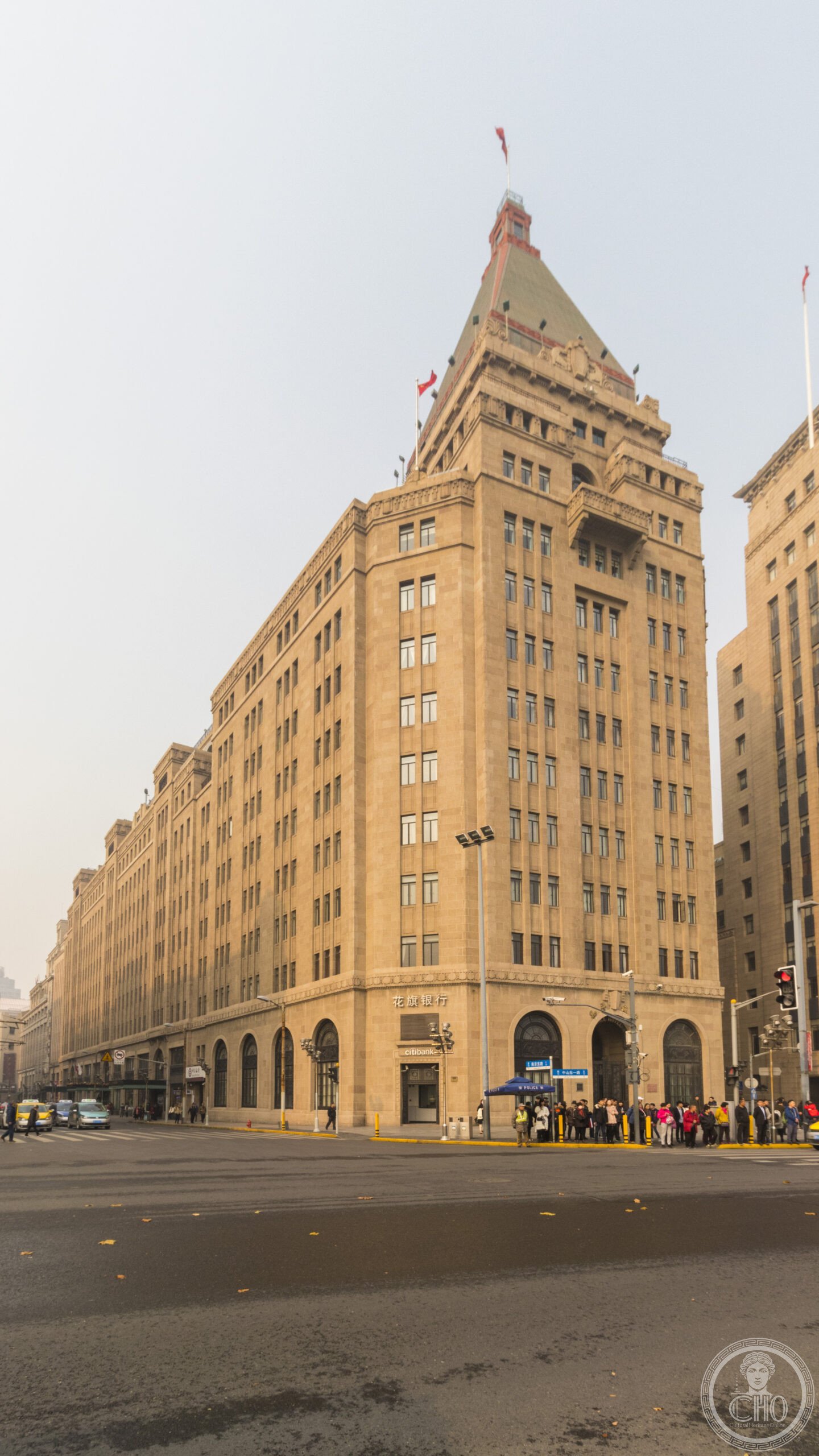
Rising above The Bund with a distinctive green copper pyramid roof, the Peace Hotel is Shanghai’s most celebrated Art Deco landmark. Originally constructed in 1929 as Sassoon House by British-Iraqi magnate Sir Victor Sassoon, the building housed the glamorous Cathay Hotel — once called “the finest hotel east of Suez.” Designed by the Hong Kong firm Palmer and Turner, its ten-story tower pioneered Art Deco in China, blending streamlined modernism with Sassoon’s flair for opulence. The hotel hosted luminaries including Charlie Chaplin, Noël Coward, and Bertrand Russell in its heyday. Today, operated by Fairmont Hotels and Resorts, it remains a living monument to Shanghai’s Jazz Age — a gilded survivor of foreign concessions, war, revolution, and revival on one of the world’s most iconic waterfronts.
At a glance
- Type
- Luxury hotel / heritage landmark
- Period
- Completed 1929
- Style
- Art Deco
- Location
- 20 Nanjing Road East, The Bund, Shanghai, China
- Coordinates
- 31.241° N, 121.485° E
- Architect(s)
- Palmer & Turner (George Leopold Wilson); commissioned by Sir Victor Sassoon
Overview
Standing at the northern end of The Bund at the junction of Nanjing Road, Sassoon House (now the Peace Hotel) commands Shanghai’s skyline with its iconic stepped pyramid crowned in green copper. The building comprises the North Building — the original Cathay Hotel of 1929 — and a separate South Building formerly known as the Palace Hotel (1908). Together they form the Peace Hotel complex, a centerpiece of Chinese architectural heritage. The Fairmont group undertook a meticulous four-year restoration completed in 2010, restoring original Art Deco interiors, mosaic floors, and the legendary Jazz Bar where an eight-piece band of senior musicians has played nightly since 1980.
History
Sir Victor Sassoon, heir to a Sephardic Jewish banking dynasty, shifted his family’s wealth from Bombay to Shanghai in the 1920s, betting on the city’s boom. He commissioned Palmer and Turner — the same firm behind the neighbouring HSBC Building — to design a prestige mixed-use tower combining offices, apartments, and the Cathay Hotel on its upper floors. The hotel opened in 1929 as the most luxurious address in Asia. Following the Communist victory in 1949, the hotel was nationalised and renamed the Peace Hotel in 1956. It served as a state guesthouse through the Mao era before reopening commercially. After years of deterioration, Fairmont took over management and undertook a landmark restoration, reopening in 2010 to international acclaim.
Architecture & Design
The North Building rises ten stories in a restrained Art Deco idiom, faced in pale granite with vertical piers that emphasise height. Its most recognisable feature is the pyramidal copper roof — green with verdigris patina — visible from across the Huangpu River. Interiors were designed around national themes: nine suites on the eighth floor each evoke a different country in their decorative schemes. The Dragon Phoenix Restaurant features elaborate Chinese lacquerwork, while the Long Bar recalls Shanghai’s colonial leisure culture. Geometric brass fittings, terrazzo floors, and stained-glass ceilings survive from the original fit-out, restored with exceptional fidelity in the 2010 refurbishment.
Cultural significance
The Peace Hotel encapsulates the cosmopolitan Shanghai of the Republican era — a city of jazz, capital flight, and unlikely cultural fusion between East and West. Its nightly Jazz Bar, running since 1980 with musicians now in their 70s and 80s, has become a living cultural institution, connecting present-day visitors to the hotel’s golden age. The building anchors the northern Bund and is integral to Shanghai’s identity as a global city. It appears in countless films, novels, and political memoirs as a symbol of both colonial excess and China’s complex 20th-century history.
Visiting today
The hotel is fully operational as a five-star property under Fairmont management. Non-guests may visit the Jazz Bar (evenings), the Dragon Phoenix Restaurant, and the Cathay Room for afternoon tea — all authentic ways to experience the Deco interiors. The rooftop terrace offers panoramic views of The Bund and Pudong. A small in-house museum documents the hotel’s history on the ground floor. Smart dress recommended; reservations advised for dining. Open daily.
Getting there
Address: 20 Nanjing Road East, Huangpu District, Shanghai. Nearest Metro: East Nanjing Road Station (Lines 2 and 10), a 5-minute walk along Nanjing Road toward The Bund. Taxis and ride-hailing apps (DiDi) are widely available. The Bund is also a short walk from Yu Garden and the Old City. Ferries cross the Huangpu River to Pudong from nearby terminals.
Sources & resources
Find it on the map
See this place and what’s around it →Record researched and written by Luigi De Marchi for Cultural Heritage Online, 2026.
📷 Become a Cultural Heritage Online photographer
Share your photos of places: they stay published under your name as the author. The more they're seen, the more you get noticed — and soon a contest will reward the most appreciated photos.
Log in or sign up free to add a photoIs this page about you?
This page is read by travellers and heritage enthusiasts who find it on Google. Tell us how you are connected to this place and we will take it from there.