
What Is Paro Taktsang?
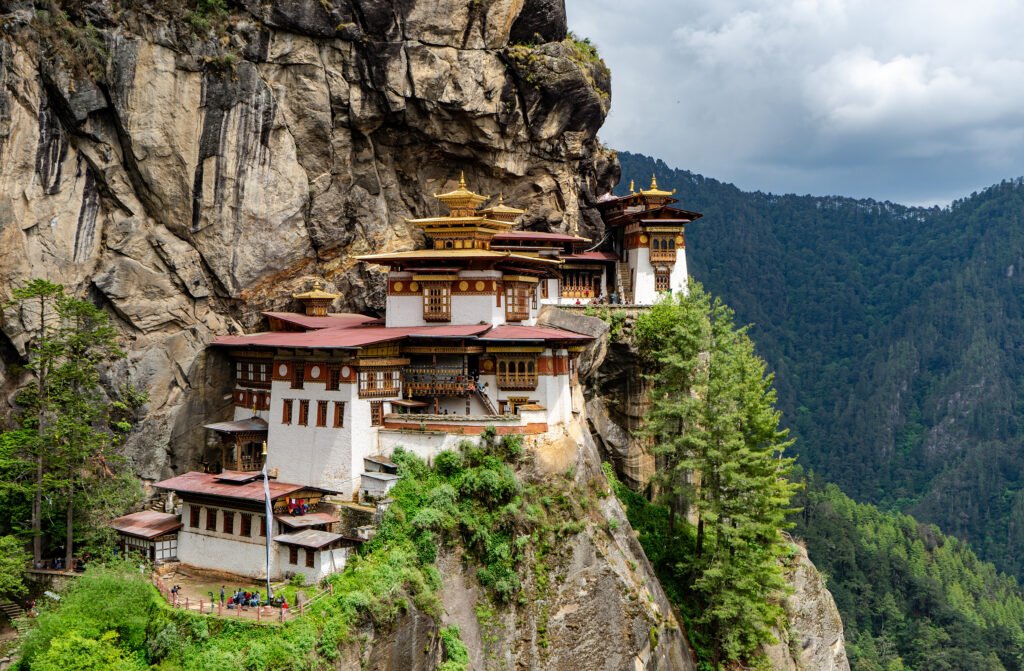
Paro Taktsang — known internationally as the Tiger’s Nest Monastery — is a Vajrayana Buddhist monastery complex built into a vertical granite cliff face in the Paro Valley of Bhutan, at an altitude of 3,120 metres, approximately 900 metres above the valley floor. The name means “Tiger’s Lair” in Dzongkha, the national language of Bhutan. The monastery is considered the most sacred site in the country and one of the holiest pilgrimage destinations in the Himalayan Buddhist world.
The word “built into” is literal rather than metaphorical. The main temple building occupies a position where the cliff overhangs, so that part of the structure is suspended over a sheer drop of nearly a kilometre. The complex consists of four main temple buildings connected by staircases and walkways cut into the cliff itself, with several meditation caves incorporated into the natural rock — including the cave where, according to tradition, the 8th-century master Guru Padmasambhava meditated for three months and brought Tantric Buddhism to Bhutan.
The Legend of Guru Rinpoche and the Tigress
The founding legend of Paro Taktsang holds that the Indian Buddhist master Guru Padmasambhava — known in Bhutan as Guru Rinpoche, “Precious Teacher” — flew to this cliff from Tibet on the back of a tigress. The tigress was reputedly his consort Yeshe Tsogyal, transformed for the journey. Upon arriving, Guru Rinpoche meditated in the natural cave for three months, subdued the local demons, and blessed the site — thereby establishing the conditions for Tantric Buddhism to take root in Bhutan.
This 8th-century event gave the site its name and its sacred status. The cave itself, Taktsang Pelphug, is now incorporated into the monastery complex and is accessible through a door in the floor of one of the temple buildings. It remains the most venerated of the site’s sacred spaces and the focus of Bhutanese and Tibetan pilgrimages.
The Architecture: How the Monastery Was Built
The current buildings date primarily from 1692, when Zhabdrung Ngawang Namgyal’s successor Gyalse Tenzin Rabgye oversaw the construction of the first formal monastery on the site. A catastrophic fire in 1998 destroyed much of the interior; the buildings were reconstructed over the following decade and reopened to visitors in 2004.
The construction logic of Taktsang is a subject of genuine architectural fascination. The builders had to work on vertical rock faces with no wheeled transport and no flat ground — all materials were carried up on human backs or by pack animals along the existing trail. Timber for floors and ceilings was cut from the nearby forest; stone was quarried from the cliff itself. The result is a set of buildings that integrate natural rock features into their structure — walls that merge seamlessly into cliff faces, floors that follow the natural slope of ledges, and internal cave spaces that serve as chapels.
The Hike: Four Hours Up a Vertical Valley
Reaching Paro Taktsang requires a 4–5 hour round-trip hike with a vertical ascent of approximately 900 metres from the valley floor. The trail begins in a forest of Himalayan blue pine and climbs steadily through increasingly sparse vegetation, passing prayer flags, small shrines, and occasional yak herds. At roughly the halfway point (2,700 metres altitude), a tea house offers rest and the first unobstructed view of the monastery across the valley — the classic photographic angle that most images of Taktsang use.
The final approach involves descending steeply into the ravine that separates the tea house viewpoint from the monastery cliff, crossing a waterfall on a footbridge, then ascending again to the monastery entrance at cliff level. Visitors must leave cameras, bags, and phones at the security post at the entrance and remove shoes before entering the temple buildings.
Inside the Monastery: Temples and Caves
The monastery complex contains four main temple buildings and several smaller shrines and meditation rooms. The Taktsang Pelphug (“Tiger’s Lair Cave”) is the most sacred — accessible through a door in the floor of the upper complex, it preserves the natural cave where Guru Rinpoche is believed to have meditated. The cave retains a quality of geological rawness: rough rock walls, low ceilings, and the sound of water from a spring that emerges within the cave itself.
The larger temples are painted with elaborate Tantric iconographic programs — wrathful and peaceful deities, lineage masters, cosmological mandalas — in a style distinct from the more restrained Tibetan palette, using the brighter, lacquer-saturated tones characteristic of Bhutanese religious painting. The 1998 fire destroyed most of the original paintings; the current cycle dates from the post-2004 restoration and represents the work of contemporary Bhutanese artists working in the traditional idiom.
Bhutan’s Tourism Policy and What It Means for Visitors
Bhutan limits total tourist numbers via a Sustainable Development Fee — set at $200–250 per person per day as of 2022 — which covers accommodation, guides, and transportation and is payable only through licensed Bhutanese tour operators. This policy makes Bhutan one of the most expensive tourist destinations per day in the world and keeps visitor numbers genuinely low compared to comparable Himalayan sites. The result at Taktsang is an experience that, while still shared with other hikers, is not overwhelmed by mass tourism in the way that comparably iconic sites in Nepal or Tibet often are.
The hike itself acts as a further natural filter: the altitude and physical demands mean that Taktsang sees a self-selected population of reasonably fit visitors. Horses are available for hire for the first section of the trail; the final approach to the monastery must be completed on foot.
Timing, Weather, and Practical Notes
The best seasons for the Taktsang hike are spring (March–May) and autumn (September–November), when skies are clear and temperatures on the trail are moderate. The summer monsoon (June–August) brings frequent cloud and rain; the cliff face is often obscured and the trail becomes slippery. Winter (December–February) offers sharp visibility but cold temperatures at altitude — the monastery itself may be partially inaccessible due to ice on the approach staircases.
The hike takes most visitors 2–2.5 hours to ascend at a moderate pace; descent is faster. The tea house at the halfway viewpoint is a reliable stopping point. Altitude acclimatisation of at least one day in the Paro Valley is recommended before attempting the hike — Paro town sits at 2,280 metres, which is already high enough to cause mild symptoms in visitors arriving from sea level.
Cultural Significance: The Holiest Site in Bhutan
Beyond its architectural drama, Paro Taktsang functions as the spiritual center of Bhutanese national identity. It appears on Bhutanese currency and in official state imagery. Every Bhutanese person is expected, as a matter of religious duty, to complete the pilgrimage to Taktsang at least once in their lifetime. The active monastic community resident at the site maintains a continuous cycle of ritual observance; visitors to the temples are expected to behave with the decorum appropriate to a functioning place of worship, not merely a heritage tourist attraction.
Find it on the map
See this place and what’s around it →📷 Become a Cultural Heritage Online photographer
Share your photos of places: they stay published under your name as the author. The more they're seen, the more you get noticed — and soon a contest will reward the most appreciated photos.
Log in or sign up free to add a photoIs this page about you?
This page is read by travellers and heritage enthusiasts who find it on Google. Tell us how you are connected to this place and we will take it from there.