
What Is Loltun Cave?
Loltun Cave is the largest cave system in the Yucatan Peninsula, with approximately 2 km of accessible passages and chambers in the Puuc Hills region of southern Yucatan state, Mexico. The cave has been used continuously by human beings for approximately 11,000 years — from at least 9,000 BC through to the late 19th century — making it one of the longest periods of documented continuous human occupation of a single site in the Americas.
The name comes from the Yucatec Maya: “loltun” means “stone flower,” a reference to the calcite formations that cover much of the cave’s surfaces — though in some dialects the word also carries the meaning of “bell,” referring to the resonant column near the entrance that produces a deep musical tone when struck. The cave served the Maya as a source of fresh water, a ceremonial space, a burial ground, a workshop, and — during the Caste War of Yucatan in the 19th century — a military refuge.
11,000 Years of Human Presence
The stratigraphic record of Loltun Cave is among the richest in Mesoamerica. The deepest excavated layers contain bones of Pleistocene megafauna — mastodons, prehistoric horses, giant ground sloths, and camels, all now extinct — mixed with stone tools. This association of human tools with megafauna bones dates to approximately 9,000 BC and provides direct evidence of early human hunting and scavenging activity during the period when these animals were disappearing from the Yucatan.
On one cave wall, a hand stencil — created by holding a hand against the rock and blowing pigment around it — has been dated to approximately 9,000 BC, making it the earliest known art in Mexico. This technique appears across the Paleolithic world from Europe to Australia; the Loltun example places it firmly in Mesoamerica’s pre-agricultural past.
Maya Occupation: Preclassic Through Classic Period
The Maya relationship with Loltun spans the entire recorded history of Mesoamerican civilisation. Preclassic Maya ceramics (1000 BC–250 AD) appear in the lower cave chambers — some of the earliest pottery in the Yucatan. Classic period (250–900 AD) bas-relief carvings appear on the cave walls near the entrance: a monumental warrior figure approximately 2 metres tall, sometimes called the “Loltun Warrior,” carved in a style consistent with the late Classic period of the 8th century AD.
Deeper in the cave, archaeologists found evidence of what appears to be a Maya flint-knapping workshop — a production site for obsidian and flint tools, with large quantities of debitage (waste flakes) and unfinished tool blanks. The cave’s darkness and stable temperature may have made it preferable for precision work. The tools produced here would have circulated through the regional trade networks of the Puuc cities.
The Maya Collapse Layer: Ceramics Abandoned in Haste
One of the most evocative sections of the cave contains what appears to be a mass deposit of Maya ceramics abandoned in apparent haste during the 9th-century Maya collapse — the still-incompletely-understood catastrophic depopulation that emptied the southern Maya lowlands over the course of roughly a century. Several chambers have floors densely covered with broken and intact pottery, with no evidence of systematic deposition — the pattern suggests not ritual placement but hasty abandonment, as if the people who brought these vessels here did not return for them.
The 9th-century Maya collapse remains one of archaeology’s central unsolved problems; scholars variously cite drought, political fragmentation, trade disruption, overpopulation, and warfare as contributing factors. The Loltun ceramics are one data point in a much larger regional picture, but they are physically present and visible on the cave floor in a way that makes the collapse immediate and tangible rather than abstractly historical.
The Nahkab Chamber and the Cathedral Effect
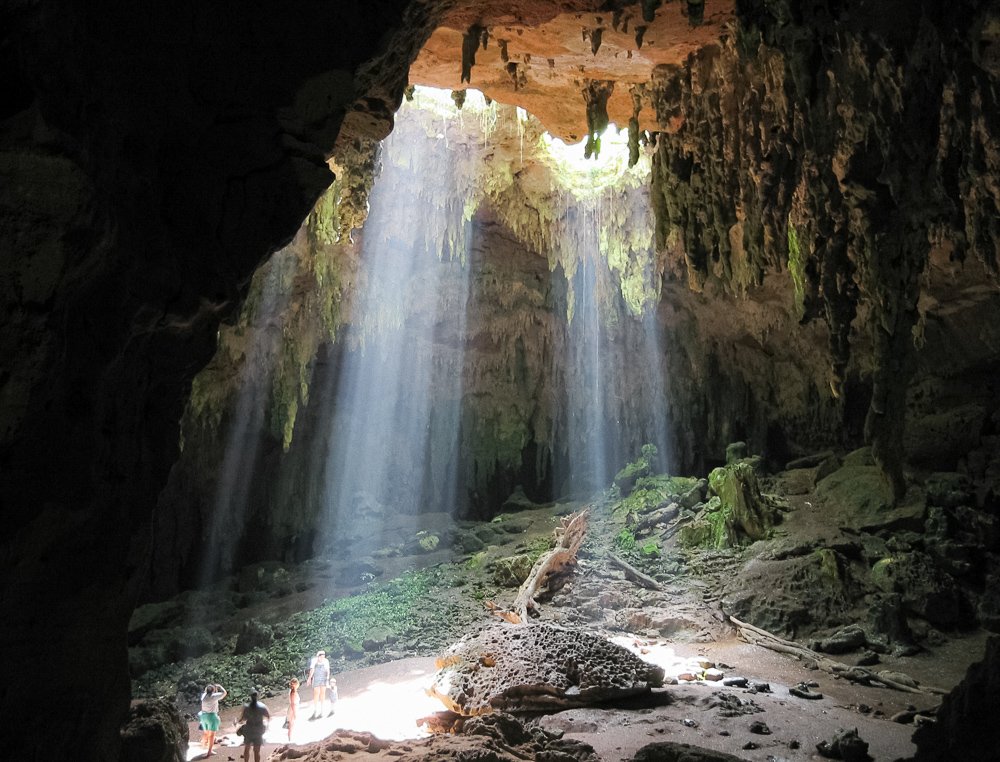
The most spectacular section of the cave is the Nahkab Chamber, a cathedral-sized space where a collapsed section of the ceiling has created a natural skylight. Daylight falls through this opening onto a forest of stalactites and stalagmites, illuminating a space whose scale is difficult to absorb from within — the chamber is large enough that the far walls disappear into shadow even in good light. The combination of natural geology and direct sunlight produces the impression of a deliberate architectural intervention that is entirely natural in origin.
The Maya recognised the significance of this space. The Nahkab Chamber shows evidence of sustained ceremonial use across multiple periods, including Classic-period ritual deposits and inscribed stones. The cenote-like pools in the deeper sections of the cave — fresh water accessible from underground — made the site critically important for permanent settlement in a region where surface water is scarce.
The Loltun Stone: A Resonant Column
Near the cave entrance stands a natural stalactite column that the Maya discovered produces a deep, resonant musical tone when struck. The sound carries through the cave system and would have been audible throughout the upper chambers. Scholars of Maya archaeoacoustics have documented the use of naturally resonant features in several cave systems across Mesoamerica for ritual purposes; the Loltun Stone is one of the most accessible and physically striking examples. Guides on the standard tour demonstrate the sound; it is unexpectedly deep and sustained, more like a bell than a rock.
The Caste War of Yucatan: 19th-Century Refuge
The most recent chapter in Loltun’s long human history is also among its most dramatic. During the Caste War of Yucatan (1847–1901) — a major Maya insurgency against the Mexican state and the Yucatecan landowning class — rebel Maya forces used Loltun as a hideout and are believed to have stored weapons, food, and supplies in the inner chambers. The cave’s multiple entrances, its labyrinthine passages, and its reliable water supply made it an effective military base in a region without natural fortifications. Evidence of 19th-century occupation includes pottery, tools, and organic materials found in the deeper sections.
Visiting Loltun: Access and Tour Information
Loltun Cave is located approximately 6 km from the archaeological site of Labna and 110 km south of Merida on the Puuc Route — a circuit of late Classic Maya cities that includes Uxmal, Kabah, Sayil, and Labna. The cave is accessible by car or by organised tour from Merida or Uxmal. Entry is by guided tour only; tours depart at fixed times and take approximately 90 minutes to cover the accessible sections. Lighting has been installed along the tour route; the deeper sections remain in natural darkness. The cave maintains a stable temperature of approximately 22°C year-round regardless of external conditions.
Archaeological Status and Research
Loltun Cave is a protected archaeological zone administered by Mexico’s National Institute of Anthropology and History (INAH). Systematic excavation has been intermittent rather than comprehensive — the cave’s size and the sensitivity of the stratified deposits make large-scale excavation both logistically difficult and archaeologically risky. Most scholarly work has focused on surface collection, ceramic analysis, and documentation of the carved and painted walls. The cave remains an active research site; significant material in the deeper and less-accessible sections has not yet been formally excavated or dated.
Find it on the map
See this place and what’s around it →📷 Become a Cultural Heritage Online photographer
Share your photos of places: they stay published under your name as the author. The more they're seen, the more you get noticed — and soon a contest will reward the most appreciated photos.
Log in or sign up free to add a photo