

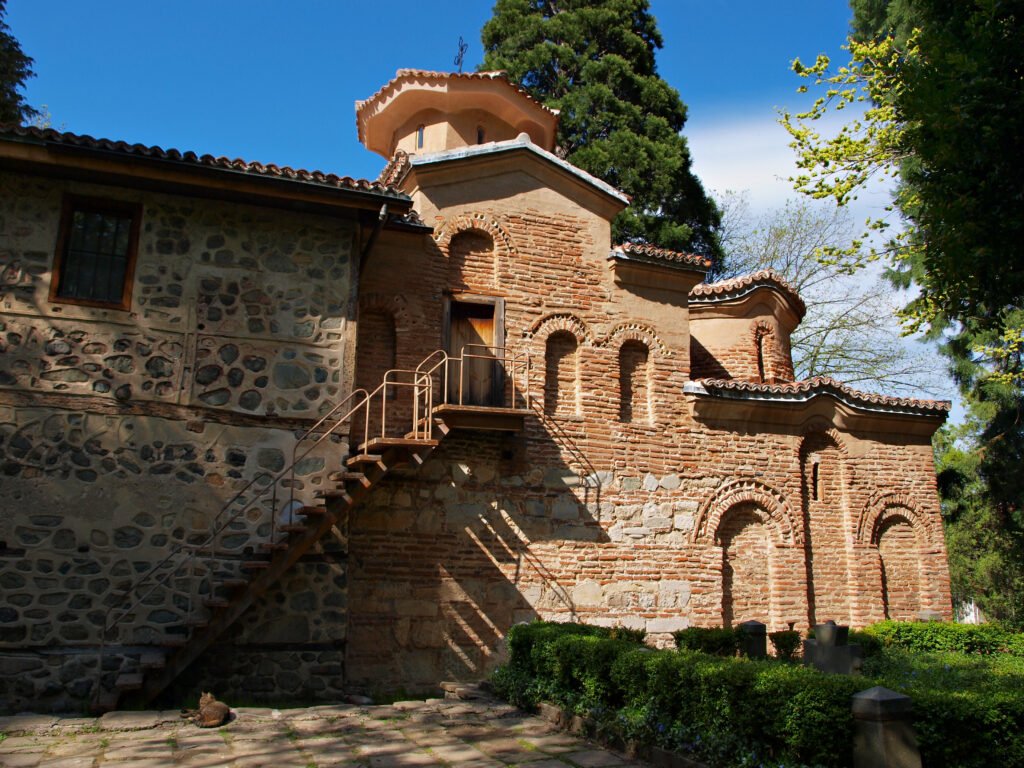
What Is Boyana Church?
Boyana Church is a small medieval Bulgarian Orthodox church in the Boyana suburb of Sofia, built in three construction phases between the 10th and 19th centuries. It is best known for its fresco cycle painted in 1259 AD — approximately 240 figures covering the interior walls and vault of the second construction phase, executed with a naturalism and psychological complexity that is completely anomalous for 13th-century European art. UNESCO inscribed the church in 1979; it is now one of the best-preserved examples of medieval Eastern European painting in existence.
The church is small — the 1259 wing measures roughly 5.5 by 8.5 metres — and strictly limited in visitor numbers (groups of ten, for ten minutes) to protect the fragile 760-year-old frescoes from humidity and carbon dioxide. This constraint makes the visit unusually concentrated: you stand in a compressed space surrounded by faces that look back at you with expressions that feel modern, individuated, and psychologically present in a way that almost no art of this period does.
The 1259 Frescoes: 200 Years Before the Renaissance
The defining feature of Boyana is the 1259 fresco cycle, painted during an expansion funded by the Bulgarian nobleman Sebastokrator Kaloyan and his wife Dessislava. The frescoes show approximately 240 figures — saints, biblical narratives, portraits of the donors — painted with characteristics that would not become standard in Western European art until Giotto di Bondone (1267–1337) and the Sienese painters a generation later, and that did not reach full expression until the High Renaissance two centuries after that.
Specifically: the Boyana figures show individualized facial expressions, with characters visibly experiencing recognisable emotions — fear, sorrow, contemplation, joy. Bodies have natural proportions under fabric, with drapery indicating the shape beneath rather than serving purely as decorative pattern. Figures appear in three-quarter and profile poses that break with the Byzantine convention of strict frontality. Certain scenes show tentative atmospheric depth — a spatial relationship between foreground and background figures that was considered revolutionary when Giotto used it in the Arena Chapel forty years later.
The Portraits of Kaloyan and Dessislava
Among the most historically significant elements of the 1259 cycle are the donor portraits of Sebastokrator Kaloyan and his wife Dessislava, painted on the south wall of the second-phase nave. These are the earliest known individualized portrait likenesses in Eastern European art — not idealized representations of patrons, but faces with specific, identifiable features that art historians believe record actual physiognomies.
Dessislava in particular is painted with a level of particularized detail — bone structure, skin tone, the specific fall of her veil — that has no parallel in Byzantine portraiture of the period. The convention in Orthodox religious art was to subordinate individual identity to spiritual type; the Boyana master departed from this convention with a directness that feels deliberately assertive, as if recording the specific person were itself a devotional act.
The Last Supper and Its Anomalous Spatial Logic
The Boyana Last Supper is frequently cited by art historians as the most technically advanced element of the 1259 cycle. The apostles are shown in varied poses: some turning to face each other, some looking down at the table, some directing their gaze outward toward the viewer. The figures occupy a suggested space rather than a flat plane. The composition implies a real gathering around a real table rather than a ceremonial arrangement of symbolic figures.
This is precisely what Giotto’s Last Supper in the Arena Chapel (1305) is celebrated for — and Giotto painted it forty-six years after the Boyana fresco. Whether the Boyana master had any contact with Italian innovations (then barely nascent), or whether this represents independent parallel evolution, remains debated. The current consensus among Bulgarian and international art historians is independent parallel development, driven by a local master whose identity is entirely unknown.
The Three Construction Phases
The church as it stands today is the result of three distinct building campaigns. The first phase (late 10th or early 11th century) produced a small single-nave church with an apse. The second phase (1259) added a two-storey narthex — the wing that contains the famous fresco cycle — funded by Kaloyan and Dessislava. The third phase (1882) added a larger nave to the west, extending the church for a congregation that had outgrown the medieval structure.
Each phase is architecturally distinct and creates an accretion effect typical of medieval Bulgarian church architecture, where buildings were extended and modified as patronage, population, and liturgical needs changed. The 1259 wing is the smallest and most intimate of the three spaces; the spatial compression intensifies the effect of the frescoes.
Visiting Boyana Church: Practical Information
Boyana Church is located in the Boyana suburb of Sofia, approximately 8 km south of the city center at the foot of Mount Vitosha. It is accessible by bus from central Sofia (lines 64 and 107) or by taxi (approximately 15 minutes from the city center). The church is open Tuesday through Sunday; Monday is closed for maintenance. Visits are strictly timed at ten persons per ten minutes due to conservation requirements — booking ahead is strongly recommended in the summer season. Photography inside the frescoed wing is not permitted.
UNESCO Heritage Status and Conservation
Boyana Church was inscribed on the UNESCO World Heritage List in 1979 under criteria (ii) and (iii) — for the exceptional artistic influence of the frescoes on Eastern European art and as an outstanding example of medieval Bulgarian culture. Conservation has focused on humidity control, microclimate monitoring, and careful surface cleaning to remove accretions deposited during periods when the church was used without visitor controls. The current ten-person limit was established following studies showing that human respiration causes measurable pigment degradation within minutes in the unventilated interior.
The Broader Context: Bulgarian Medieval Art
The Boyana frescoes are the most internationally celebrated example of the Second Bulgarian Empire’s cultural output, but they are not isolated. The Tarnovo school of fresco painting produced several comparable works during the 13th and 14th centuries, including the Ivanovo Rock Monastery frescoes (another UNESCO site). What distinguishes Boyana is the survival of nearly the complete original 1259 cycle in a remarkably well-preserved state, combined with the anomalous technical sophistication of a master whose name history did not record.
Find it on the map
See this place and what’s around it →📷 Become a Cultural Heritage Online photographer
Share your photos of places: they stay published under your name as the author. The more they're seen, the more you get noticed — and soon a contest will reward the most appreciated photos.
Log in or sign up free to add a photoIs this page about you?
This page is read by travellers and heritage enthusiasts who find it on Google. Tell us how you are connected to this place and we will take it from there.